What is User Research?
- User research comprises the principles and methods of empirical research used to obtain, analyze, and represent this knowledge.
- A key aspect of user research is the synthesis of observational data in a form that can inform design.
- One of the main motivations for user research is the realization that, in general, you are not the user.
- Basing critical design decisions on our opinions is risky, as developers and designers often represent very different points of view from the users for whom they design.
- Doing so can even be unethical, as it could result in systems, products or services that cause users harm or distress.
- We should also obtain insights about other (non-using) stakeholders, as designs do not solely affect those who use it.
- While heuristics and models can be useful to gain a generalized understanding of user needs, user research is a vital tool to help designers better understand the users they are designing for.
- Any interactive system also involves particular users performing particular activities in particular contexts.
- We need to know these particulars when we do not have a general understanding that covers them.
Aim of User Research
- The main aim of user research is to obtain concrete, empirical knowledge about users.
- Its importance is captured in slogans such as “know the user”, “early focus on users”, and “start with the needs of the user”.
- This requires that we, as researchers and designers, be in direct contact with users rather than rely on second-hand descriptions or assumptions about them.
- We cannot indirectly know the particulars of users.
- A key commitment in user-centered design is to understand first and design later.
- Understanding users can establish design goals and problems, inform requirements and shape the design as a whole.
- User research aims to produce design-neutral descriptions.
- We wish to understand users without tying ourselves to specific design decisions.
- Based on this aim, user research is rooted in social science, psychology, and other behavioral sciences.
Difficulties of User Research
- Obtaining knowledge about users is complicated.
- Some factors that contribute to this are:
The Say–Do Gap
- This problem comes from the frequent observation that what users say they do might differ from what they actually do.
- For instance, when people are asked how much they use the Internet, their self-reports tend to have a low correlation with the logged data.
- In this case, directly asking the users is not a reliable method.
Tacit Knowledge
- In their activities, users rely on knowledge that is difficult to articulate.
- Many factors driving our behavior are unconscious and are difficult or impossible to describe verbally.
- Tacit knowledge refers to knowledge that we are largely unaware of but can be easily put into use in the right situation.
- High repetition motor skills, such as riding a bike or typing in a familiar password, are good examples of tacit knowledge.
Social Reasons
- Social reasons also make it difficult to get insights into users.
- Suchman discussed how the ways work is done are often kept secret.
- Making work visible is fraught with difficulties.
- For instance, making work practices visible can challenge the power between those doing the work and other members of an organization.
Reasons for User Research
- Although user research can be very difficult, there are also good reasons to do it.
Ethical Reasons
- User research is a commitment to listening to your users and taking them seriously.
- Rooting decisions in empirical data can help avoid biases in decision-making.
- User research can help significantly reduce the chance a design is harmful or unusable.
Better Designs
- Properly conducted, empirical research outweighs empathy and opinion.
- The insights from such research can help us make decisions about the desired impact of our design efforts, such as novel interactive computer systems, on future users.
Challenge Assumptions
- User research can also challenge assumptions about products.
- The results of user research can challenge the one-design-fits-all idea and can help rescope and diversify designs.
Economic Reasons
- User research generally makes a large return on investment for firms.
- Most technology companies engage in some sort of user research, for example, through log data, surveys, or qualitative research.
Goals of User Research
- The primary goal of user research is to obtain, analyze, and represent knowledge about current or prospective users.
- We call this goal gathering knowledge for design.
- This data can then be translated into models, empirical heuristics or requirements that can inform the design process.
PACT
- The acronym PACT can be used to remember the knowledge user-researchers are looking for.
- People
- Activities
- Context
- Technology
People
- People-related insights include:
- User skills
- Personalities
- Socioeconomic status
- Abilities
- Beliefs
- Habits,
- Motivations
- Needs
- Wants
- These types of insights concern the experiences and attitudes of users and their first-person views of themselves and their activities.
Activities
- The tasks users perform and the practices they engage in give us important information for design.
- What do users do?
- What do they strive to achieve, and in which contexts?
Contexts
- The different contexts people find themselves in when interacting with systems are a rich source of potential insights.
- There are several contexts to consider.
- Physical context
- Related to the physical environment.
- For example weather, lighting, and the built environment.
- Social context
- Covers the social environment of interaction, such as social relationships and activities with others.
- Organizational context
- Relates to how interaction is situated within organizations.
- For example, power structures, division of labor, and formal and informal work hierarchies.
- Historical context
- May be related to previous exposure to practices and systems.
- Cultural context
- Captures cultural beliefs and norms that may affect the use of a system.
Technologies
- Existing interactive systems and tools with which users interact serve as another important type of insight.
- This may include the perceived pros and cons of a solution and opinions on alternative solutions.
- Nevertheless, it is important to remember that the primary focus of user research is people, not technology or imagining technological solutions.
Informing Design
- A primary goal of user research is to inform design and make practical decisions.
- Such as deciding whether to launch a product or if a product embeds biases.
- Because user research is often open-ended, it may not directly lead to concrete decisions.
Is-Ought Problem
- From descriptions of how things are (is), we cannot conclude how they should be (ought).
- The issue is that the essential characteristics of that new design is needed may not be in the gathered user data.
- Hence, user research results are rarely strongly prescriptive of designs alone.
- However, a significant value of user research is that it can convince stakeholders about the quality of the decisions made.
Involving Users
- Another prominent goal is to involve users in the design of interactive systems.
- One motivation for this is the argument that users have a political or moral right to be part of shaping the designs that they use or are affected by.
- Another motivation is that user involvement enables the creation of better systems that users are more committed to using
Create Empathy
- Another goal of user research is to create empathy between the user researcher (who could also be the designer) and the user.
- This goal transforms the activity of knowing the user into understanding what it feels like to be that person and what their situation is like from their own perspective.
- Hansen argued that one important function of getting to know the user is to “remind the designer that the user is a human.”
- Direct and continuous contact between user researchers and the people they seek to understand might help establish a good connection between them, but should not be taken as a substitute for empirical research.
Basic Research Findings
- Many of the heuristics and models designers as a substitute for user research are actually also informed by user research.
- Especially in academic settings, it is often worth it to conduct user research simply to gather new knowledge and better understand people.
Who is the User?
- A central step in all user research is to identify who the user is and then select which users to investigate.
- It is typically a three step process:
Target Audience
- The first step is to define a target audience.
- The target audience is a description of the intended customers or users affected by your system, service, or product.
- This group is usually defined by constructing a set of profiles that are intended to capture various subgroups of the target audience.
- The most important part of a target audience is that they should be representative of your userbase.
Determining Target Audience
- There are many ways to form a profile for a target audience.
- The extent to which research is needed may depend on how novel the design or company is.
- One process that is frequently used in user research for product development is the following:
Inclusion Criteria
- First, consider the inclusion criteria for the profile.
- What features does the target audience have?
- Behavioral criterion
- Including people who actually do or want to do the things you intend to enable with your product.
- Technological criterion
- Involves considering the background and interest of people in related technology.
- Demographical criterion
- Capturing people’s anticipated age, geographical location, household income, and so on.
Initial Profile
- Having considered inclusion criteria, it is possible to develop an initial profile.
- This contains the people that fit into all the established criteria.
- For example they might:
- Be within a certain age range.
- Live in a specific country
- Have a specific culture or religion
- Have a specific occupation
- Use certain apps or devices
Synthesis
- The initial profile is reviewed to make it suitable for user research.
- One trick is to try to identify additional criteria for ideal users that would provide the most valuable feedback.
- Several prompts can facilitate this exercise, such as:
- Considering which segments within your target audience you should focus on.
- How much experience they should have with your product and competing products.
- Whether there are any undesirable characteristics to avoid.
- The profile revision will then concentrate on removing factors that are not going to affect users’ behaviors when interacting with your product or add information and focus on isolating factors that are more likely to produce an ideal target audience.
Alternative Approaches
Extreme Users
- Focusing on extreme or extraordinary users can be an alternative approach to defining a target audience.
- This idea originally emerged in accessibility research, where it was argued that we should focus on users whose abilities are outside of what we may consider ordinary.
- The idea is that by designing a product that can be used by extreme users on both ends of the spectrum, it will also be usable for all the ordinary users in-between.
Early Adopters
- Another way to select users is to think of users in terms of early adopters.
- Early adopters are the second group to adopt a new innovation, and they often inform the other groups that follow.
- It is argued that they will have the needs and wants that users who adopt the product later on will also have.
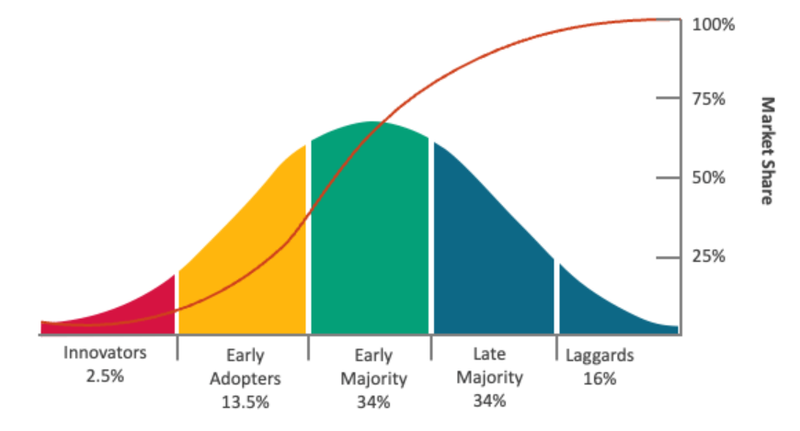
- Another approach is to focus on lead users, or innovators.
- The idea here is that some users have more experience and stronger needs with respect to an emerging technology than general users.
- A lead user may be a social media influencer, a journalist, or a member of a community of practice.
- As such, they can provide earlier and deeper information.
Variety
- Another approach is to deliberately look for variety in user groups.
- The underlying motivation is that we want to understand users and their activities with as much nuance, complexity, and diversity as possible because these may challenge us to create better designs.
- This also ensures that the target audience you've selected is relevant, since it contains almost all possible types of users, not just the "average" ones.
Stakeholders

- In addition to direct users of interactive systems, other people are often affected by the systems, indirectly involved in their use, or benefiting from them.
- These people are called stakeholders, as they also have a stake in how the design is made.
- Although less prominent than direct users, the participation of stakeholders is necessary to answer questions related to the power, interest, and relationships between users and stakeholders.
Stakeholder Analysis
- Stakeholder analysis refers to a systematic attempt to identify stakeholders.
- The goal of such analysis is to identify groups and organizations that affect or are affected by the system.
- Mitchell et al. proposed three relationship attributes to start defining a stakeholder group:
Power
- Refers to a relationship in which one group of users can get another group to do something.
- The more influence and control a stakeholder has over a design, the more relevant of a stakeholder they are.
- For example managerial power in a company for whose workers a new service is being designed.
Legitimacy
- Refers to the legal or normative basis of a stakeholder group.
- For example hackers and bots are illegitimate stakeholders in many network systems, and designers must often make their designs unusable for them.
Urgency
- Urgency refers to how time-sensitive a relationship is.
- Urgency can also be thought about by considering criticality:
- What is the opportunity loss of not addressing this group versus the gain from addressing it?
- Urgency is about the timeliness and criticality of a group.
Difficulties With Stakeholder Analysis
- Stakeholder analysis has not gained my popularity outside of academia due to its complexity and perceived unimportance.
- However stakeholders are important to consider for many of the same reasons users are important to consider.
- Some stakeholders may be dormant and only triggered in special circumstances.
- For example legal experts may only be become stakeholders of a design in case of an accident or crime.
- Stakeholder analysis is further complicated by the fact that some stakeholders are not humans.
- There is increasing interest to consider animals and the natural environment stakeholders in design, where they have been traditionally overlooked.
Sampling
- To do user research, specific participants should be chosen.
- There are numerous considerations that affect how and why we chose participants.
Statistical Considerations
Representativeness
- One consideration is representativeness:
- Does this user group represent the target audience or a valid segment of other stakeholders?
- This is an important consideration. Failing to sample representatively can produce a skewed dataset and lead to bias or failed designs.
Variability
- Another consideration is the variability in the sample:
- Will we learn about the breadth and variety of the target audience’s attitudes and work?
- We are interested in covering varied situations to get the full complexity of users’ worlds.
Statistical Power
- Will this sample size be large enough to draw reliable conclusions about it?
- Often, a larger sample is better, provided it is representative.
- However, this is costly, so we prefer to only get a sample that's large enough.
Practical Considerations
Access and Availability
- Are these users available to study?
- Some users might be difficult to communicate with or access for research due to social, economic, political or other reasons.
Cost Efficiency
- Is this user group providing enough information for design relative to the cost of studying them?
Participation Costs
- Does participating in the user research present any cost or danger to the participants?
User Research Methods
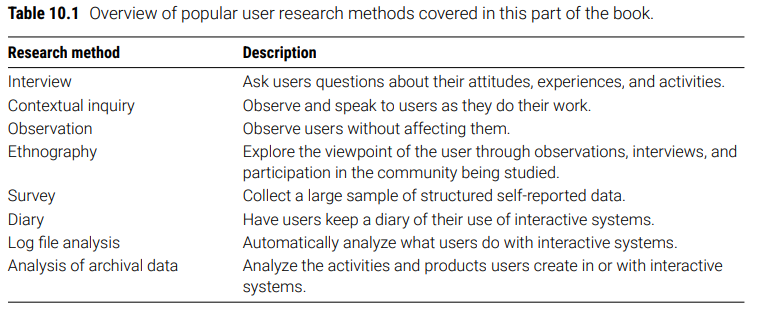
- Research methods in user research aim to obtain empirical knowledge about users, including research-based instruments, techniques, and procedures for collecting, analyzing, and reporting insights.
- The goal of user research is to obtain accurate and defensible knowledge about the subject under study.
- Research methods can be qualitative or quantitative, and can be open- or close-ended.
Research Strategy
- The research strategy concerns how to select one or more research methods for gathering insights about users.
- The selection of research methods depends on what the user researchers think is important to obtain insights about.
- On the one hand, the outcomes from using a particular method should be useful for the problem at hand.
- On the other hand, the resources needed for the method must also be considered.
- McGrath introduced three general principles for defining a research strategy.
Produced Knowledge
- The first principle states that research methods bound what we can empirically learn.
- All methods have certain flaws and advantages.
- There is no universal correct method. Instead, research methods are chosen based on which fits the situation best and produces the desired knowledge.
Trade-Offs
- The second principle of McGrath states that the research strategy is about trading off conflicting criteria.
- The criteria are as follows:
- Realism
- Concerns how similar the situation being studied is to the situations that the researcher wants to gather insights about.
- Studies that look at user-initiated behavior in its naturally occurring surroundings, such as field studies, are high in realism.
- Precision
- Concerns how much accuracy and detail one obtains about the users’ behaviors and attitudes, and how much control there is over variables and circumstances of no interest.
- For example, user studies that track every detail of people’s hand movements with motion-tracking equipment are high in precision.
- Generalizability
- Refers to how well the findings generalize to other people or situations.
- Studies that collect input from a lot of users, such as surveys, are often high in generalizability.
- All of these criteria work against each other and it is generally impossible to maximize all three at once.
Triangulation
- It refers to the combination of multiple research methods to study the same phenomenon.
- If all research methods are limited in different ways, then their combination should be able to mitigate some of those limitations.
- The following checklist helps researchers understand the requirements for triangulation:
- Addressed Question
- The approaches chosen for the study must address the same underlying question.
- For example, users’ beliefs about interaction can be studied with interviews, surveys, and possibly observations but may not be studied via log analysis.
- Inherent Biases
- For each approach, the inherent biases should be analyzed and made explicit.
- Every method has a tendency to focus on particular facets of the world, ignoring others; hence, bias.
- Being aware of such observational biases, we can better select methods that complement each other.
- Bias Mechanisms
- Mechanisms that produce bias should be understood and acknowledged.
- For example, researchers tend to use terminology in interviews and surveys that are understood by user groups that are similar to the themselves.
- Shortcomings
- Critical shortcomings should be compensated for.
- For example if one method is more susceptible to the researcher’s own biases, this should be compensated by adding a method that compensates by being less susceptible.
- Comparison
- The results from using the two methods are compared and assessed to understand how the methods affected the results.
- When reporting the results of a triangulated study, we should be systematically aware of the limitations of the methods that produced the observations.
- In triangulation different methods may:
- Agree with each other and offer converging evidence.
- Offer complementary evidence and highlight different phenomena or relations.
- Disagree with each other, often revealing mistakes or bias in one or more research methods or an unrealized phenomenon.
Methodological Quality
- Research methods have different strengths and weaknesses.
- They can be characterized by their realism, generalizability, or precision.
- In addition, methods may be used well or poorly.
- This is judged by the four dimensions of methodological quality.
Validity
- Validity refers to whether the conclusions drawn from a study are justified.
- Threats to validity are anything that could go wrong and threaten the validity of the conclusions drawn.
- Classically, there are four types of validity:
Internal Validity
- Whether a variable under the control of the researcher.
- For example, user groups, devices, or tasks, has an effect on observations.
Construct Validity
- Whether a measurement that is supposed to measure something, such as user experience, actually measures it.
Statistical Conclusion Validity
- Whether the conclusions drawn from the data are statistically reliable.
External validity
- Do the conclusions hold for other participants and settings?
Reliability
- The reliability of user research and empirical research in general concerns whether the research gives consistent results.
- That is, we want our methods to produce the same results if they are applied again to the same context in the same way.
Transparency
- The transparency of user research refers to the idea that researchers should make their design, data, analysis approach, and derivation of conclusions accessible and inspectable.
- Transparency is often associated with open scholarship and a desire to increase the replicability and accessibility of research.
- Several practices are associated with transparency, such as sharing data, planning decisions before reviewing data, conducting careful analysis and reporting, and maintaining a chain of evidence throughout the study.
Ethics
- Doing user research requires the person conducting the research to carefully consider what is right and wrong in collecting, analyzing, and reporting data.
- Ethical concerns also consider stakeholders, the prospective users who participate in the research and the client for whom the research is conducted, the professional standards of the field of HCI, and the researcher’s responsibility toward society at large.
Data Analysis and Representation
- A key challenge in user research is transforming the results obtained into a useful and actionable form.
- Thus, both the analysis and representation of results are important in user research.
- For representation, the key issue is to synthesize the results of user research in a way that is helpful for design.
- A representation is helpful if it brings forward critical insights from user research clearly and transparently.
- It can also be vital to communicate within design teams and with stakeholders.
Types of Data Representation
Personas
- Personas are profiles of fictional characters that describe representative users within relevant segments of the target audience.
Scenarios
- Scenarios are narrative accounts of what happens when users try to use a system to achieve their goals.
Artifacts
- Artifact and context models are descriptions of key objects and their contextual relationships within a situation.
Quotes
- Quotes are rich representations of users’ attitudes and needs.
Journey Maps
- Journey maps are temporal accounts of users’ encounters with a system.