Introduction to Design
- Almost every feature of everything we use has been designed by someone, even if we often do not think about it.
- Every aspect, from high-level concepts to the smallest details, is the outcome of a series of design decisions.
- Design matters for people, but also for innovation and businesses. It is also a central driver of the renewal of societies and economies.
- The design of services that are more lucrative, accessible, efficient, and fair is a key consideration in both industry and the wider society.
Four Views of Design
Design as a Product
- First, design, as a noun, describes some artifact or plan that is the outcome of a design activity.
- It is the ultimate particular that designers arrive at the end of a design project.
- This could be a concept, plan or artifact.
- An artifact could be a system, a service or a physial product.
- According to Gaver, ultimate particulars are about possible worlds.
- To understand this concept, it is helpful to draw contrast to the natural sciences:
- “The natural sciences are concerned with how things are.
- Design, on the other hand, is concerned with how things ought to be”
Design as a Process
- Design as a verb refers to the activity of designing.
- Cognitively, solving problems is a central challenge in design in addition to the creation of new ideas.
- Design requires decisions and plans.
- Designers’ problem-solving is often characterized by extensive iteration, trial and error, and searching among possible solutions to problems.
Design as Research
- The generation of possible worlds produces new knowledge.
- Design can produce new and valuable knowledge.
- This knowledge may be a new perspective on a problematic situation, alternative futures, implications, or new insights about observed phenomena.
- Such insights can not only trigger further empirical or theoretical research but also challenge previously held assumptions.
- Knowledge produced in research through design may not always take the shape we expect when approaching research from a scientific angle.
Design as Change
- Design has transformative potential.
- Buchanan viewed design as a means of changing culture and human experience.
- Design is not merely an application of existing principles but a continuous search for new meanings and values in human life.
- This means that instead of aiming to fix problems, sometimes referred to as solutionism, design should aim to create new, transformative possibilities.
- Design can help challenge and rethink structures that limit us as humans.
- Designers' thinking becomes political, as they need to take a valued position on what is desirable in life and what is not.
- The most revolutionary possibilities in design may not be found through empirical observation since new possibilities are needed to reshape the existing state of affairs and create a better outcome.
Interaction Design
- HCI has two distinct characteristics: focus on interactive technology and human-centeredness.
- Thus HCI focuses on interactions between people and interfaces and understanding users and the situations they face.
- It is closely related to the field of interaction design.
- A central goal in interaction design is to create new potential for computing.
- To achieve that, designers need to create new relationships between artifacts, users, and contexts.
- While a designer can produce an artifact, that artifact only gains meaning in its context of use.
- While design is about creating the concrete artifact, it is also about its potential, which creates interactions that can lead to desirable outcomes.
- Simon distinguished the inner environment of the artifact, such as the parameters that define how an artifact behaves, and the outer environment, in which the artifact is used.
- When designing an interactive system, we can only design the inner environment, which should interact with the outer environment in some desirable way.
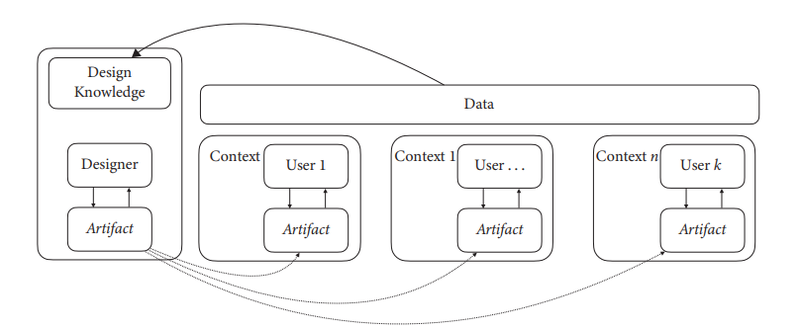
- The above diagram shows a simplified view of design.
- The designer with design knowledge designs an artifact, which is used by users in various contexts.
- These contexts then inform research resulting in data which can be incorporated into future design projects as additional design knowledge.
Role of HCI/Interaction Design
- Improving
- Design can improve the usability, accessibility, and experience of computing systems.
- Creating
- Design can create entirely new opportunities for people to use computing systems in contexts and ways previously not possible.
- Informing
- Design is the study of what is possible.
- By showing alternatives to the status quo, design informs decisions and creates the need for change.
- Producing Knowledge
- Design not only applies HCI knowledge but is also necessary to evolve knowledge.
- Knowledge about interaction can be advanced by testing ideas through interactive prototypes and designs.
Design vs Engineering
- It is important to understand how design in HCI differs from engineering.
- Two aspects distinguish interaction design from engineering:
- First, while problem-solving and creative ideation have a role in both, the emphasis in interaction design is on understanding problems and creating new ideas and artifacts.
- The focal point of interaction design is knowing what to design while engineering is concerned with knowing how to design.
- Second, interaction design can, but does not need to, commit to the use of the best methods available.
- Some designers consider themselves engineers, but they may also identify with creative professions and art.
- In design, theories and scientific methods are often perceived as primarily instrumental:
- They may provide inspiration and useful ideas, but they do not provide any attributable value beyond that.
User-Centered Design
- Human-centeredness is the idea that the primary motivation and aim in design is to improve human conduct.
- Artifacts are not produced for profit, algorithmic efficiency, or artistic pleasure, but with the goal of making a difference in the lives of people.
- User-centeredness is human-centeredness in the particular context of computer use:
- “The purpose of the system is to serve the user, not to use a specific technology, not to be an elegant piece of programming. The needs of the users should dominate the design of the interface”.
Principles of UCD
- User Focus
- Understanding and serving the user’s goals, tasks, and needs is the primary goal of design.
- When solutions are presented to users, they must be easily understandable and avoid technical jargon.
- User Involvement
- Representative users are actively engaged throughout the design process.
- Iterative and Incremental Development
- Iteration is necessary because it is practically impossible to know the specifics of what needs to be designed from the outset.
- Prototyping
- Early and continuous prototyping helps evaluate ideas before converging to a particular solution.
- Evaluation in Context
- Prototypes should be evaluated with real users in real contexts whenever possible.
- Holistic Design
- Understanding that all designed aspects of a product, from its advertisements to its social media presence and manuals, affect its use.
- Process Customization
- Avoiding a rigid process and ensuring continuous reflection and evolution of the process.
Generating Creative Ideas
- For an idea to be good, it is not enough for it to be novel; it must also meet objectives.
- Some of the most important goals relate to human considerations, such as usefulness, usability, efficiency and satisfaction.
- Tasks in design can often be approached from an almost infinite number of ways and requirements are often vague or unclear.
- Much of what designers do is develop and clarify the understanding of a problem.
- Afterthinking about the problem, designers must generate new ideas.
Problem Solving
- Problem-solving refers to attempts to create “a course of action aimed at changing existing situations into preferred ones”.
- Designers seek solutions that transform a situation in desirable ways.
- However, in any real-world design problem, there are numerous design options that may or may not be interrelated in complex ways.
- Problem-solving is about identifying alternative solutions to a problem and translating those solutions into reality.
- To explore options, designers need various forms of judgment.
- Judgment is needed to evaluate options and decide which options to explore.
- Designers may get sudden flashes of intuition or may rely on models and simulations to evaluate potential solutions.
- Representing problems and solutions is an essential part of design.
- In particular, efficient representation enables efficient problem-solving.
Solutionism
- Viewing design as being solely about problem-solving has been criticized as solutionist.
- This view assumes that it is possible to define a desired state of affairs and then simply search for the best option.
- While problem-solving is an essential aspect of design, it is not the sole purpose of design.
- Designers often learn about the objectives and the design space at the same time.
- This means designers tend to develop solutions and address problems at the same time.
- For example, underdefined problems can motivate an inquiry that leads to a new design and a new design situation with a better-understood problem
Creative Ideation
- Design is a creative activity whose objective is to produce a novel and relevant artifact or service.
Combinatorial Creativity
- Identifying a combination of decisions within a given conceptual space when it was previously believed that such a solution would be unlikely.
Exploratory Creativity
- Finding a new conceptual approach that helps identify an idea that was earlier considered impossible or not considered at all.
Transformative Creativity
- Transforming or replacing a conceptual space, thus allowing for an entirely new perspective to think about a problem space.
Design Thinking
- Instead of relying on a creative individual, a “design hero,” the key message in design thinking is emancipatory: Creativity is something that anyone can develop and foster.
- Design thinking offers methods for convergent and divergent thinking.
- In divergent thinking, the goal is to chart the options that are available.
- In convergent thinking, the goal is to narrow down the options to the most promising one.
- Design thinking emphasizes two types of knowledge-creation activities: creative activities (knowing what to design) and problem-solving activities (knowing how to design it).
Double Diamond Model
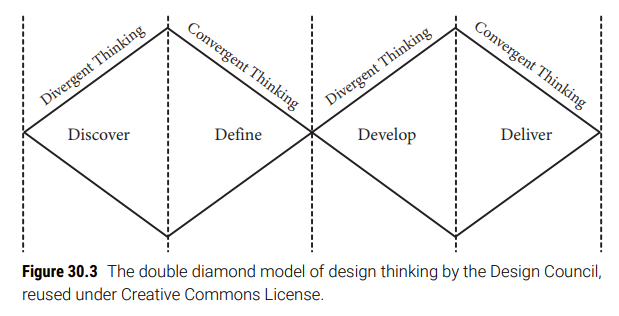
- The double diamond model is an integrative conceptual model of design that recognizes both divergent and convergent thinking in design.
- The first diamond is about understanding the problem.
- Rather than assuming what it is, designers carry out user research to discover and define the problem.
- The second diamond is about developing answers to the defined problem.
- The model encourages co-designing with other people, testing out solutions at a small scale, and quickly rejecting ideas that do not work.
- The model also promotes four design principles:
- Putting people, their needs, wants and capabilities first.
- Communicating visually and inclusively to help stakeholders gain a shared understanding of ideas.
- Collaborate and co-create.
- Iteration
Practicing Design
The Reflective Practitioner
- Designers develop vastly different ways of knowing and doing via practice.
- Professional designers reflect on their creations and study others.
- This kind of reflection is critical to the designer’s ability to understand the broader context of design.
- An important part of reflection for designers is trying to contextualize their work through placements.
- They deliberately or intuitively try to shape design situations, identify different perspectives, rethink issues, and develop hypotheses for exploration and development.
- These placements occur in cycles that eventually allow designers to make sense of design.
- The accepted view is that these two ways of thinking, reflection and placements, can be developed in parallel
Wicked Problems
- Reflection is also needed to attack wicked problems.
- A wicked problem is a hopelessly constrained or underdefined problem.
- For example: "innovating something for an automobile company" or "improving a preexisting design"
- They stifle creativity with impossible constraints.
- For example, budgetary, technological, or branding constraints can narrow the design space to the point where no outcome can meet the stated goals.
- Some wicked problems have indeterminacy, that is, no definitive conditions or boundaries for design.
- Through repeated reflection and contextual placement, a designer can attempt to iteratively crack wicked problems.
Practices of Participation
- Participatory design is a term used for design processes that involve stakeholders, especially end users, not only via user research and evaluation but also at the heart of the process in the generation of design ideas.
- The biggest change from other design processes is that the role of the researcher changes from translator to facilitator.
- Researchers and designers collaborate and facilitate the work of expert and non-expert users in design.
Co-Design
- Co-design is a development of participatory design.
- Instead of just involving stakeholders as participants in design, the entire process is rethought.
- Design becomes a collective process. Trained designers and researchers work with untrained stakeholders who represent or are the end-users.
Action research
- Action research challenges the role-based stance of participatory design by proposing a change-oriented approach to research.
- It suggests that to impact the world, the designer must become part of it.
- At its most extreme the designer should become part of the stakeholder group.
- Action research can be summarized into five principles:
- Researcher–client agreement:
- This is the basis for mutual commitment and role expectations.
- Cyclical process model:
- This involves diagnosing, action planning, action taking, evaluating, and specifying learning.
- Theory:
- Theory must play a central role in action research.
- Change through action:
- Action and change are indivisible research elements related to interventions focused on producing change.
- Learning through reflection:
- Reflection and learning allow the researcher to make both practical and theoretical contributions.
Managing Design Projects
Structural View
- According to the structural view of creativity, creativity is a rational activity that can be supported by management.
Design Processes
- Design processes are procedural prescriptions for organizing design efforts in collaborative settings, such as firms.
- An appropriate process guides designers to gather data, take perspectives, seek inspiration, study standards and checklists.
- There are many important features of design processes in HCI.
- Explicit statements are made about what the user-related goals of the system are based on verifiable evidence.
- Users are not “objects of study” but are engaged as stakeholders in a longitudinal, participatory process.
- The criteria for accepting or rejecting a design are based on empirical data from these stakeholders, who are thereby given agency in the process.
Situational View
- According to the situational view, creativity is something situated, an emergent and stochastic process that can be nurtured but not managed.
- A designer’s material, social, and mental contexts, as well as their life history, all influence the ideas that they generate and the techniques and practices that they develop.
What Should be Designed?
- The purpose of a user-centric design process is to produce knowledge and artifacts that improve computing for people.
- The outcomes of design must be demonstrably beneficial for users in ways that they approve of.
Value-Sensitive Design
- A design method that aims to build designs rooted in principles that users find important.
- A value is any principle that users consider to be important in their lives.
Critical Design
- The idea of recognizing ethical issues in design related to society and using these as the basis for emancipatory activities.
- Critical design can reveal hidden agendas and make people more aware of the structures in the world.