Experience
- Experience in design isn't actually about the sensations and emotions we feel during the act of something. Experience is what we tell ourselves and others, or how we remember an action or event.
- What we remember and how we recount our experiences are only indirectly linked to our experience.
- They result from a context-dependent process of creating experiences.
Significance of Experience in HCD
- Understanding experiences and how they are created is important to human-centered design (HCD) due to 3 main reasons:
Development of User Experience
- As HCI has expanded and developed, the user experience of those interacting with products became more emphasized.
- Modern computer systems offer much more variety and aren't specified to a singular task. They can also be used for enjoyment and relaxation and not just for work, making experience more and more prominent in how we use computers.
- The principles of how people experience help us understand the mechanisms behind their choices and the extent to which we may influence them via design.
Importance of Experiences
- Experience is important in all design fields, not only in HCD.
- All of our actions and the actions of others lead to experiences which can shape how behave in the future and understand the world around us.
- Ethically, positive experience constitutes an objective as important in design as anything else.
Experiencing vs Experiences
- Although they may sound similar, the act of experiencing and the experiences you create are two distinct constructs.
- Experiencing refers to the ongoing, moment-to-moment experiencing.
- For instance, experiencing of a computer system when using it.
- Experiences refer to aggregated accounts of an experience.
- For example how you would share something with a friend.
- Both constructs is associated with different methods of assessment, principles of development, and implications for design.
- In HCI, experiencing has been defined as:
- “momentary, mainly evaluative feeling (good–bad) while interacting with a product or service”
- Experiencing focuses on moment-to-moment feelings.
- In HCI, experience is commonly defined as:
- “a person’s perceptions and responses that result from the use or anticipated use of a product, system or service”
- Experiences serve as summaries of experiences and focus more on the whole.
Peak-End Rule
- The finding that people tend to anchor their assessment of experience to ends and peaks.
- Ends are the most recent experiences, say, the last time you used a particular information system.
- Peak experiences are the best or worst experiences associated with the system.
Duration Neglect
- The finding that pleasure ratings are insensitive to the duration of those sequences.
- Even very short experiences can have a strong influence on the stated experience.
Creating Experiences
- Experiences are created from an active interpretative process shaped by mood, context, attention, goals, and attitudes, among other factors.
- At any given moment, there are many facets of experience that could be used to form a view about experience.
- For example, you could infer it based on emotions, previous experiences, peak–end experiences, socially shared beliefs, or any combination thereof.
Inference
- User experiences are created as a result of inference.
- When inferring, we form a representation of what our experience is.
- The inference process is largely unconscious unless we ask users to report their experiences.
- Inferences can happen in two ways:
Specific to General
- Creating an overall experience from its parts.
- For example, users may infer how great an application is based on momentary feelings of joy or disappointment they happen to recall.
General to Specific
- Inference can happen via a general assessment that spills over into specific parts of an experience.
- For example, users can make an overall evaluation of an experience of an interactive system, which may spill over into the evaluation of its components.
- This is called the halo effect.
- The “halo” of the product affects the inference of its parts.
- For example, if a user seriously dislikes a product, that might result in them negatively perceiving features that would be seen positively in another context.
Consequences of Experiences
- Experiences are generally regarded more significantly than material possessions and matter a lot to people.
- Studies frequently show that people are more affected by and enjoy experiences more than material possessions.
- Another argument for the importance and consequences of experiences on perception is that they are important for several high-level decisions.
- Our decisions are significantly influenced by our experiences: a trait shared by all people and almost all living organisms.
- Thus memories and experiences, and understanding how they influence people, are vital aspects of design.
- A third reason is that experiences provide material for communication and sharing stories with others.
- Since humans are inherently social creatures, this is an important aspect and mean that experiences have distinct social consequences.
Processes in Experience
- Experiences are complex, constructed phenomena that develop over time.
- McCarthy and Wright formulated a temporal model that combines these insights.
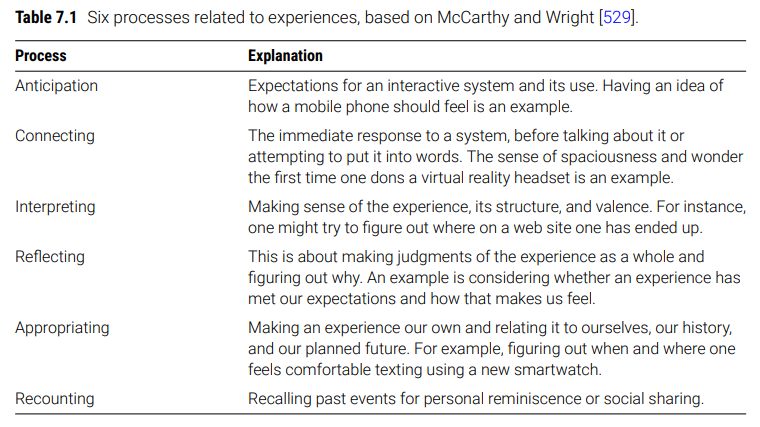
- This account highlights that experience encompasses all parts of our mental lives.
- It also means that attention to experience covers moments that do not include the actual use of a system.
- Experiences are also shaped by what happens before and after it.
- Anticipations shape experiences before it occurs.
- Reflection shapes experiences afterwards.
Types of Experience
Facets of Experience
- Research on experiences in HCI started by focusing on dissatisfaction from experiences.
- Early work focused on avoiding errors, interface features that annoyed people, and frustrating parts of the user interface.
- This can be called the deficit based approach to experiences.
- Later work on HCI and user experience has focused on positive experiences.
- For example enjoyment, meaning, and stimulation.
- This is an asset based approach to experiences.
- Another feature of HCI research on experience is that experience is considered multi-faceted.
- This means that researchers focus not only on the value of a product to accomplish tasks; they also focus on symbolic and aesthetic value.
Pragmatic and Hedonic Experiences
- Pragmatic experiences are those that concern practical matters and the achievement of goals.
- When interactive systems are simple, clear, and understandable, people describe having pragmatic experiences.
- In a general sense, the hedonic aspects of interactive systems and experiences are about stimulation, novelty, curiosity, aesthetics, and pleasure.
- They are not about what is being achieved, such as getting to the right destination quickly, but about the pleasure involved in getting there.
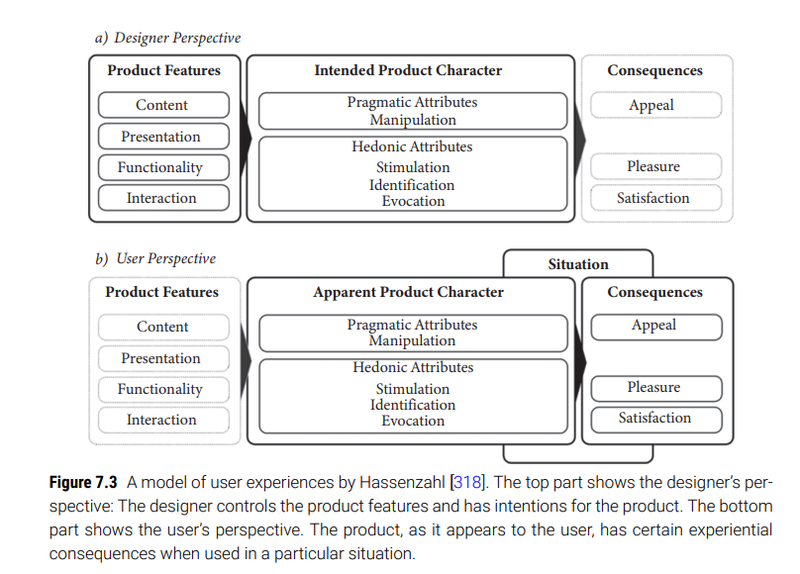
- According to the model, the combined perception of hedonic and pragmatic attitudes drives the overall evaluation of a product, such as its goodness.
- This is a form of inference, where individuals weigh together different types of perceptions of an interactive system.
Hedonic Attributes
- Stimulation is the extent to which interactive systems provide new impressions or opportunities, and thereby make us pay attention, feel curious, or be motivated.
- Identification is the way in which products help us express ourselves to others.
- Evocation is the extent to which a product reminds us about past events, thoughts, or relationships.
- Though important, this aspect has not been included in much work on the hedonic and the pragmatic.
Pleasure
- The experience of pleasure is a fundamental and positive emotion.
- It is related to other terms such as enjoyment, delight, and fun.
- Jordan presented an influential model of different kinds of pleasure in the context of interactive systems. He distinguished four kinds of pleasure:
- Physio-pleasure is the pleasure derived from the senses, such as the tactile quality of a keyboard or the smell of a car.
- Socio-pleasure is the pleasure that comes from our relationships with other people and groups.
- Psycho-pleasure is the pleasure from thinking and feeling.
- Ideo-pleasure is the pleasure derived from the values they embody or help us embody.
- This model is useful as it allows designers to target specific types of pleasure in their designs.
Emotions
- The feeling of whether something is good or bad is a fundamental evaluation that is central to our reactions to our environment, the objects in it, and the people who surround us.
- It is also fundamental to our experiences with interactive systems.
- Two approaches to understanding emotion have been prominent in HCI.
- One prominent model of core affect separates valence and arousal.
- The general idea of this model is that there are two fundamental dimensions:
- Valence, which describes positive versus negative emotions. Positive emotions are energizing emotions, such as being happy or proud.
- Arousal, which describes the level of energy involved or the degree of activation. High-arousal states are related to being alert or attentive.
- These dimensions capture what is called core affect—the essence of how we feel at any moment.
- Core affect is not directed at anything but is a fundamental evaluative orientation.