Tool Use
- To understand usability, it is important to understand how and why people use tools.
- What makes objects tools is that they are not attached to the body but can be held to bring about changes in the condition of other objects.
- The idea of tool use in HCI is that a computer system is a tool for controlling something else.
- Almost all interaction in HCI is done through the use of tools, whether it be a keyboard, a mouse, a scrollbar, a button on the screen or a microphone.
- More broadly, the view of interaction as a tool suggests three essential components:
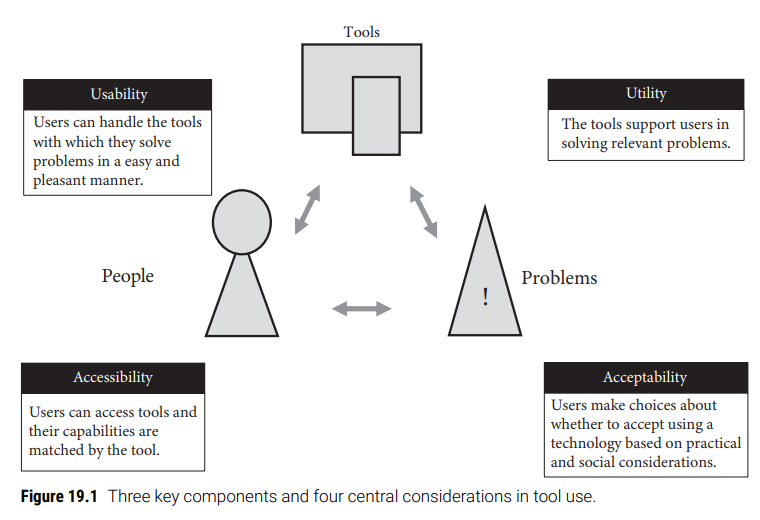
- Users actively repurpose tools and make them more personally usable and relevant.
- A good design should support such repurposing.
- Users have been found to be a lot more effective at creative tool use and repurposing when they have strong technical knowledge of a product, much more so than procedural knowledge inherited from other software or products.
Usability
- Usability is one of the best predictor's of the user's willingness to adopt software.
- Usability is often associated with effectiveness, satisfaction and efficiency.
- Ideally, a usable product should allow the user to easily solve the problem at hand.
- Some tools are easy to operate, understand and safely use.
- For computer-based tools, these considerations are described by the term usability, one of the key empirically measurable constructs that the field of HCI has developed.
- Usability concerns how easily computer-based tools may be operated by users trying to accomplish a task.
- Ideally, the user can use the tool without unnecessary effort so that the use is direct, transparent, and unnoticeable.
Characteristics of Usability
Usability is Relational
- Usability rises as an interplay between people, tasks (problems), and interactive systems (tools).
- Tools are usable as a consequence of their fit to people and tasks.
- A tool is useless without the right user and the right task.
- Usability is sometimes called quality-of-use to emphasize that it is a quality of interactive systems.
- However, it is important to consider users, tools and the task in usability discourse. Just focusing on one of the 3 aspects is a fallacy.
Usability is Measurable
- It is possible to quantify usability based on user's behaviors and opinions.
- Thus usability can be tested and evaluated.
- We may also use usability measures to experimentally quantify differences between user interfaces.
- We may measure the time used and errors made by a user while solving a problem with different tools and then compare the results
Usability is Multidimensional
- This means that in most settings, a valid characterization of usability will need to employ several dimensions and measures.
- For example, user preference for a system and their performance on that system are strongly positively correlated.
- One should pick multiple indicators of usability and assume that different aspects of usability should be measured separately.
- Examples of usability aspects include subjective and objective measures, performance, and outcomes.
Models of Usability
- The characteristics of usability have led to numerous models of usability, which can help identify some dimensions of usability that are independent.
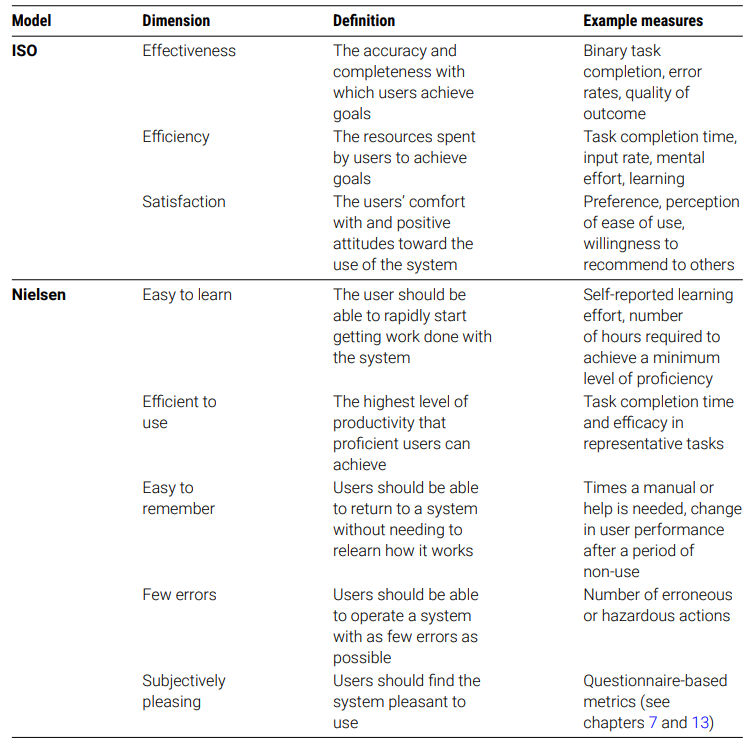
- One of these is the ISO 9241-11 model of usability.
- It defines usability as comprising effectiveness, efficiency and satisfaction.
ISO-9241-11-2018
- Nielsen's model of usability focuses on learnability, efficiency, memory burden, user errors and satisfaction.
Selecting Goals for Measuring Usability
- How does one select or prioritize between dimensions and measuresfor a particular case?
- The selection of usability measures requires careful judgment.
- It is a matter of determining the importance and validity of parameters.
- Newman and Taylor presented a concrete approach to selecting usability measures, which they called selecting critical parameters:
- “performance parameters that measure how well the system serves its purpose.”
- The critical parameters of a system allow designers and evaluators to establish whether an interactive system serves its purpose and compare designs.
- Some models, such as standardized questionnaires can be used to get an idea of necessary usability goals with little effort and consistent results.
Utility
- The utility of an interactive system concerns its match with the tasks of users.
- If the match is good, the tool has high utility; if the tasks that users want to do are not supported by the tool, the tool has low utility
- The tasks that users want to do using a tool may be existing tasks or some new tasks they have not yet realized.
- In general, utility centers what users want from a product.
- While utility is important to consider, it is not all that should be considered.
- Since utility considers what users want from a product, it can also hide important aspects required for a product to function if they go unnoticed by users.
- Users might want usefulness, functionality and usability, but not care much about security, privacy, experience or compatibility, since these are mainly features that are noticeable if they go wrong or are implemented poorly.
- While usability is about how easily a task can be accomplished, utility is about whether the goal is important to the user.