What is Survey Research?
- In survey research, the researcher designs a questionnaire and distributes it to respondents who fill it in, typically without the researcher’s presence.
- A questionnaire consists of a series of questions presented and answered in a structured way.
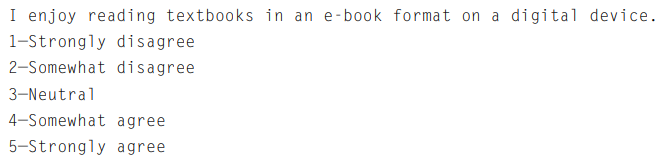
- For example, you have probably filled in questionnaires that use the Likert scale.
- In the Likert scale, a response must be given to a claim on a symmetrical 5 or 7 point scale usually ranging from strongly disagree to strongly agree.
Uses of Surveys
Understanding Users
- Surveys are widely used in user research and evaluation.
- They can be used to understand users’
- Behaviors in their activities
- Routines
- Use of interactive systems
- Experiences, such as their positive and negative experiences during computer use,
- Needs
- Desires
- Wants
- Attitudes
- Preferences
- Beliefs
Understanding Psychological Factors
- Surveys may also be used for understanding the psychological factors behind user behavior.
- Prevalidated questionnaires can be used to measure latent psychological constructs such as attitudes.
Generalizability
- The generalizability of findings is a distinct benefit of survey research over other user research methods.
- A carefully designed survey allows the researcher to statistically estimate the distribution of phenomena in a population.
- This is possible thanks to two key characteristics of surveys.
- First, the response data are structured and defined in advance.
- Every respondent answers the same questions using the same response options.
- This reduces heterogeneity in the data and lends them to statistical analysis.
- Second, the sample size in survey research can be large.
- Assuming the surveys are distributed efficiently, the cost per respondent can be moderate or low.
- If the sample is representative of prospective users, the generalizability of the survey findings can be high.
Difficulties with Surveys
- Designing a good survey is hard.
- A number of things can go wrong.
- First of all, the questions used in survey research must be understandable to the respondents.
- Poorly formulated questions can be interpreted by the respondents in different ways.
- The researcher typically cannot be present to clarify the wording of questions or quality-check the answers.
- Compared to the interview method, this is a significant price to pay for better generalizability.
- The answer options need to be comprehensive.
- If an answer option is missing, or the options are biasing the respondents, the resulting data will be biased, too.
- Survey results are also easily misinterpreted as representing the “true” behaviors or experiences of users.
- However, self-reports may not be truthful.
- This is due to a similar reason as the say-do problem.
- Moreover, distributing questionnaires to the population of interest may be hard.
- Surveys often have low response rates.
- Moreover, some users self-select to respond, which can introduce bias into the data by over-representing those respondents who, for some reason, chose to answer the survey.
Creating a Survey
- Survey research can be carried out in many ways depending on its purpose and constraints.
- However, the workflow typically consists of the following steps:
- Plan the survey research
- Establish the research focus
- Select the survey type
- Decide the sampling strategy
- Select a questionnaire
- Use an established questionnaire
- Design a new questionnaire, including the questions and their types, answer options, and order
- Piloting
- Collect the data
- Analyze the data
- Process the answers
- Describe the answers
- Carry out qualitative and statistical analyses
- Draw conclusions and report them
Design of Survey Research
- The design of survey research concerns establishing the focus of the research, selecting an appropriate type of survey, and figuring out who should receive the survey and how.
Research Focus
- The focus of the research needs to be clear and spelled out before a questionnaire is selected.
- Survey research is often appropriate for learning about behaviors (factual questions) and subjective experiences (attitude questions).
- The following list gives some examples of both.
- Factual Questions
- Research about users’ characteristics
- e.g., what is often called marketing or demographics research
- Research about users’ activities
- Including the use of existing interactive systems and how they spend their time.
- Attitude Questions
- Research about users’ perceptions of their activities, the technology that surrounds them, and the context they work in.
- Research about users’ attitudes toward future technology or future activities
- A second principled way to think about survey research is to consider questionnaires a measurement tool.
- The idea is that well-designed questionnaires can measure behavior or attitudes precisely and at scale.
- A third principled way to think about survey research is that it can help collect qualitative data at scale.
- The popularity of this purpose has increased with the use of crowdsourcing.
- There are distinct limitations to the data collected in this way, although such surveys have been used to study attitudes in depth.
Survey Types
- Two main types of surveys may be distinguished:
Descriptive Surveys
- Known from census, election surveys, and surveys on how people spend their time.
- The main use of these surveys is to describe and characterize attitudes or behaviors.
- Such questionnaires often contain “how many” or "what" questions
- “How many times do you experience frustration when using a computer?”
- “What content do you enjoy on social media?”
Analytic Surveys
- A deeper attempt is made to explain why a certain situation exists.
- This type of survey borrows some of the logic from experiments to answer “why” questions.
- Such as “Why do people like the app?”
- The idea is to analyze “what goes with what,” that is, to see how different variables are related to each other.
- Compared to experiments, which can include interventions to expose causal factors, surveys are poorer at exposing causality but better at generating initial ideas about mechanisms and factors.
- A central characteristic of analytic surveys is the attempt to relate answers to each other.
- Sometimes, such relationships are established by giving the same questionnaire to different people in so-called cross-sectional designs.
- Cross-sectional designs can deal with multiple factors at the same time, which makes them similar to the factorial design for an experiment.
- In longitudinal designs, respondents fill out the same questionnaire on multiple occasions. This may be done before and after an intervention, or it may be done to study the development of attitudes, learning, or expertise over time.
Sampling
- We can rarely ask all users in a population of interest to fill in a questionnaire.
- Therefore, we need to select a subset, or sample, of users and base our conclusions on the insights provided by them.
- To ensure we can generalize our findings to the target population, the sample has to be carefully selected.
- Sampling refers to decisions related to how people are approached to respond to a survey.
- Sampling can be done in multiple ways: via personal contact, email lists, advertisements, social networking groups, and so on.
- The goal of sampling is to acquire a sample of respondents that allows the researcher to draw valid conclusions about the target population.
- All actual and potential users are called the population.
- We can contact a portion of the population, the sampling frame.
- We then send our questionnaire to most or some of the users in the sampling frame, who constitute the sample of our study.
- Those who choose to fill out the questionnaire are the respondents.
- Each sampling step requires care on the part of the researcher, as unintentionally excluding users can impact the validity of the results.
Sampling Types
- We can distinguish two principled ways of thinking about the sampling frame:
- Randomization
- Sampling can be done at random from the population.
- This may be facilitated by panels of representative users from the population or by having your questionnaire distributed by opinion pollsters.
- Stratification
- Sampling may also be designed to ensure that certain types of users are represented equally.
- This is often referred to as quota sampling, cluster sampling, or stratification.
- In snowball sampling, each respondent shares the invitation with other participants in their network or with similar characteristics.
- That way, the sample of respondents grows like a snowball rolling down a hill.
- However, this may introduce unwanted (out-of-quota) characteristics.
- The reality of survey research in HCI is that many sampling frames are informal, being established through word-of-mouth, through one’s network, or by posting on online forums.
- Such so-called convenience sampling does not ensure that every member of the population is equally likely to be part of a study, making it harder to draw valid inferences.
Sample Size
- The question of which sample size to use in questionnaire research is difficult to answer.
- The practices in HCI research vary greatly.
- Published survey research in HCI can have as few respondents as six or as many as 50,000.
- A review of sample sizes concluded that the mean number of respondents in surveys in HCI papers is 371.
- The choice of sample size may also be informed by statistics
- In descriptive surveys, the appropriate sample size depends on the margin of error you are willing to accept in quantitative measures.
- For instance, if you accept a 10% margin of error in estimates of which browser people use, you may need to ask 100 or more people; if you accept only a 1% margin of error, you need to ask many more people.
- In analytic surveys, the sample size may be determined via power analysis.
Selecting a Questionnaire
- Survey research can be done by using existing questionnaires or developing new ones.
- Many questionnaires have been carefully validated and are known to be reliable.
- Designing a questionnaire from scratch is time-consuming and difficult, even for experienced researchers.
Finding Appropriate Questionnaires
- How to find existing questionnaires for user research?
- The key step is determining whether the constructs of interest have been developed into questionnaires.
- Previous research on the topic of interest and HCI handbooks are also great sources for finding questionnaires.
- Outside of HCI, many questionnaires have been developed, and their reliability and validity have been assessed.
- Such questionnaires may be found in:
- Handbooks
- Dedicated search engines for questionnaires
- By searching scholarly databases
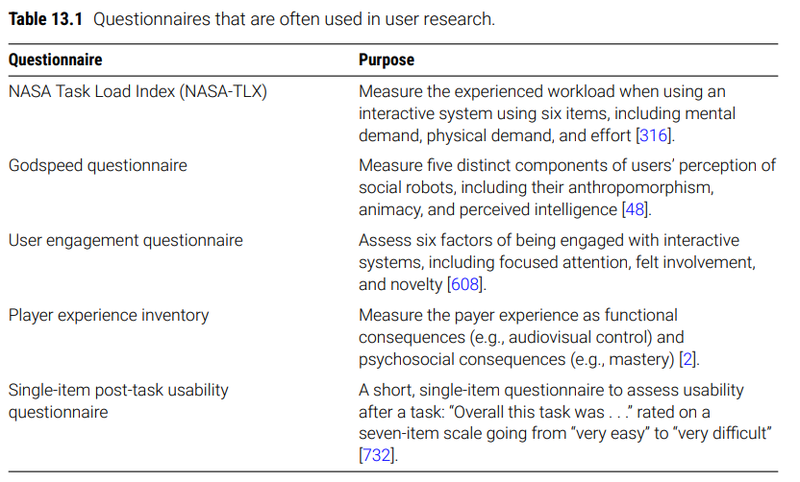
- The following table has some widely used questionnaires for use in HCI.
Developing Questions
- Generally it is best to use validated questionnaires when possible.
- Developing a questionnaire requires the careful creation, validation, and testing of the questions.
What do Questions Look for?
- There are two main categories of questions in questionnaires.
- Some questions are about events and behaviors.
- They concern how often something is done, which types of activities were done at some point, the frequency of use of a system, and so on.
- These questions are formulated so that they have an accurate answer in principle, even if the respondent may not be able to provide it.
- Some questions are about subjective phenomena, including:
- Attitudes
- Intentions
- Wants
- Values
Wording Questions
- If done sloppily, the wording of questions may lead to answers that are invalid and unreliable.
- A question should be easy to understand specifically and different respondents shouldn't interpret it differently.
- These examples suggest some general principles for thinking about how to craft valid and reliable questions.
- The principles are in many ways similar to those of interviews.
- Use language that respondents understand:
- Questions should be user-centered, that is, use terminology that users are familiar with and that they find clear and straightforward.
- Avoid hard-to-parse questions, including those that use difficult words, double negatives, and excess words.
- Ask one question at a time:
- Questions that ask multiple things at the same time are called double-barreled and should be avoided.
- Ask neutral questions:
- Questions should be formulated so as to not impose the researcher’s views or ideas about the answers on the respondents.
- Avoid leading questions.
- Avoid making assumptions about the respondents:
- Making assumptions about the respondents might lead to unanswerable questions.
- Ask specific questions:
- Questions should be specific so that the respondent is clear about what is being asked.
- Specificity is particularly important for objects and events.
- Specificity is also relevant with words and phrases that are assessed relative to a personal standard.
- Be aware of response biases:
- It is well known that participants may have biases when answering questions.
- Effective questions are worded so that they mitigate these biases as much as possible.
Question Types
- Two main types of questions exist.
- With closed questions, respondents are offered a choice between different answers.
- With open questions, respondents have free choice for their answer, usually writing out text.
Closed Questions
- Closed questions can have many different forms, including the following:
- Single-choice questions
- Offer a list of alternatives from which one may be selected.
- Multiple-choice questions
- Offer a list of alternativesfrom which one or more may be selected.
- Ranking questions
- Allow respondents to rank alternatives.
- Rating questions
- Offer a textual or graphical scale that the answer is given on.
- The scales can have different steps and anchors
- i.e., descriptions of the endpoints
- One benefit of closed questions is that they are easy to analyze:
- Because the options for answering are restricted, statistics are straightforward to apply to the answers.
- The drawback is that such questions may be too crude and not capture all the relevant options for respondents.
- While generally recommended, including options such as “I don’t know,” “non-applicable,” or “other” does not remove this issue.
Open Questions
- The other main type of question is open questions, also called free-response questions or free-text questions.
- Open-ended questions are useful when it is not clear how respondents want to answer, such as in exploratory work where the closed questions are not yet known.
- Open questions allow respondents to answer freely and spontaneously.
- Often, sensitive or socially disapproved behaviors and the frequency or form of behaviors are better investigated through open questions.
- However, open questions are “easy to ask, difficult to answer, and still more difficult to analyse”.
- The decision between open and closed questions is a trade-off between the research objectives and the pros and cons of these different types of questions.
Question Order and Presentation
- Nowadays most surveys are done online.
- Online surveys are easy to deliver to a large number of respondents.
- However, there are two main drawbacks.
- First, online surveys require a digital device.
- Those who do not have access to a digital device are excluded, which can lead to bias in the sample.
- Second, computer terminals can differ in the way they present the same survey, creating variability in the responses
Instructions
- A questionnaire should start with instructions for the respondents.
- This should include covering the broad context of the study.
- It should also instruct the respondents on how to interpret and respond to the questions.
- Such instructions are sometimes shown one by one to ensure they are not glossed over.
Order
- The order in which the questions are presented matters.
- Funneling refers to the practice of starting with broad questions and then moving toward more specific ones.
- The argument is that broad questions help jog respondents’ memory on the topic of the questionnaire.
Clarity
- Surveys must be designed for visual clarity and ease of use.
- The response options should be quick to choose with the terminals used by the respondents.
Scales
- One key issue in survey research is reliability.
- Unfortunately, single-item questions can be unreliable, particularly when investigating subjective experiences.
- More generally, using single questions to uncover attitudes or experiences is risky, as a particular question may be vague or otherwise unclear to respondents.
- They may also missclick the answer option.
- One solution to this issue is to use sets of questions, sometimes called scales.
- A scale consists of items that are about the same underlying construct (or constructs if the scale consists of multiple items).
- Some popular scales used in HCI research include:
- The Likert scale, which consists of a claim and a symmetric negative-to-positive range (typically 1–5, 1–7, or 1–9) with the “neutral” option in the middle.
- Semantic differentials, which provide a scale between two adjectives (e.g., “exhausting” and “effortless”).
- Semantic differentials are often used to measure attitudes and opinions.
- Graphical ratings, in which several options are presented in a symbolic fashion (e.g., the pain measurement scale).
Biases
- A question should be thought of as a measurement.
- It probes the respondent and records a response.
- The validity of this measure depends on several things we have discussed above, including biases.
- Many types of biases threaten validity, including the following:
Acquiescence bias:
- Tendency to respond in a positive manner.
Social desirability:
- Tendency to mirror socially desirable behaviors and views.
- For example, if a question asks to report if the respondent takes backups, some responses might overstate this.
- The first and last parts of a questionnaire tend to elicit different behaviors, especially in long questionnaires, where fatigue effects may be more apparent.
Neutral item bias:
- items in the middle of the scale (e.g., “neutral,” “I do not know”) tend to be overused.
- By contrast, the extrema (lowest and highest values) tend to be underused.
Demand bias:
- Users who know about the purpose of the study may start behaving according to their expectations regarding the study.
- For example, if you tell participants you are going to measure their knowledge of phishing attacks, they may pay more attention to those during the study.
Piloting
- Piloting refers to small-scale rehearsals of a questionnaire.
- You could for example, test out a digital questionnaire with 10 people from the target group to learn about potential flaws before sending it out to thousands of people.
- All questionnaires should be piloted, especially if they are modified from existing questionnaires.
- This includes the questions as well as the questionnaire instructions.
- One overarching principle for creating good questions is to consider the experience of answering them.
- This principle has direct implications for the piloting of questionnaires.
- One adaptation of such studies is to use them to get insights into how respondents experience the questions and the questionnaire instructions.
- With such insights, the questionnaire may be revised to address discrepancies between the idea of the question and participants’ experiences.