What is Perception?
- Perception is fundamental in practically every daily task.
- It is the ability to collect and organize information about the environment through physiological sensory systems. .
Percepts
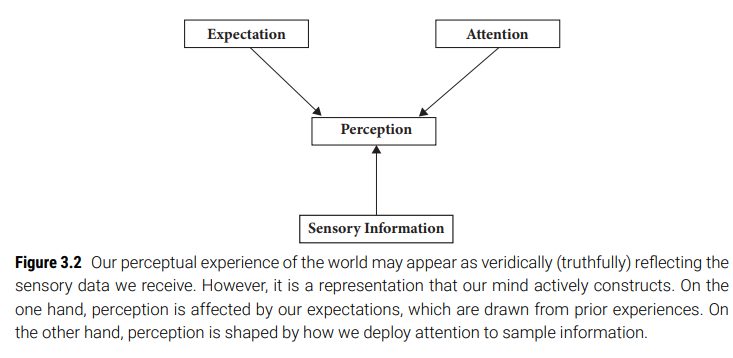
- Using our perception of our environment we can construct percepts.
- Percepts have structure. Some objects are in relation to each other.
- For example, certain elements appear as being in front of others or belonging together.
- These percepts ensure that when we search for something, it happens in an orderly and efficient way.
- We focus our attention not on random elements but on elements that have a higher probability of being the ones we are looking for.
- This process is affected by both the content of the percept itself and expectations that we have unconsciously learned from previous encounters.
Sensory Information
- One component is the sensory information that our sensory systems produce.
- A sensory modality is a biologically specialized system dedicated to a type of transduction.
- In sensory transduction, a form of physical stimulation is transformed into neural events.
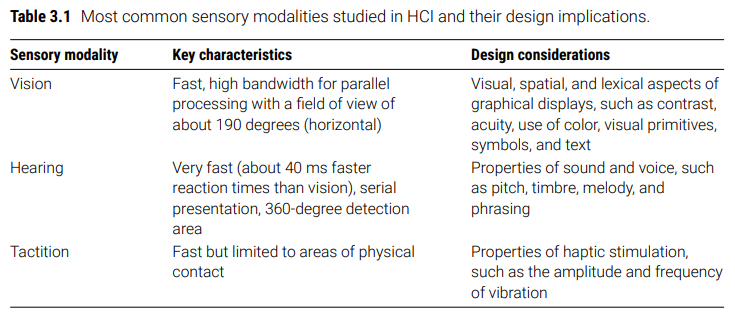
- Sensory modalities commonly used in HCI include:
- Vision
- Hearing (audition)
- Touch (tactition)
- There is also experimental research on smelling (olfaction) and tasting (gustation).
- Moreover, we can rely on the sense of our body, or proprioception.
- It refers to the knowledge of the position of our limbs in space.
Expectations
- Over years of interacting with the world, we have accumulated experience.
- This enables the brain to project its expectations back to the world.
- To achieve this, perception utilizes internal representations to constantly make guesses on how the world might be.
- Internal representations allow us to deal with the fact that sensory stimulation is relatively poor.
Attention
- Attention refers to the ability to focus our processing power on a select portion of the full perceptual scene.
- The decision on what to attend to is strategic: At any given moment, you could be attending to almost anything in your vicinity, but you only attend to one thing at a time.
Sensory Modalities
- Sensation is a physiological process that produces information about the environment for perception. Sensation feeds perception.
- From a biological perspective, sensation is about transduction.
- A sensory system transforms energy in one form, such as light or physical contact, into electrochemical events in the brain that produce the experience of sensation.
Comparing Modalities
- Human sensory modalities are served by three basic types of transduction:
Mechanosensivity
- Examples of mechanosensitivity are kinaesthesia (sense of own movement), touch, hearing, and equilibrium.
- Here, the energy of physical contact istransduced, for example, through hair cells in the ear.
Chemosensitivity
- Examples of chemosensitivity include gustation and olfaction.
- Here, chemical properties are transduced, for example, by taste buds on the tongue.
Photosensitivity
- Examples include the retina.
- Here, the stimulation by photons is transduced into electrochemical events in the rod and cone cells.
Exteroceptive and Interoceptive Modalities
- Exteroceptive modalities sense stimuli outside our body.
- They include vision, hearing, feeling, smelling, and tasting.
- Interoceptive modalities sense stimuli inside our bodies. They include proprioception and the vestibular sense.
- Information rate:
- How much information can be sensed per unit of time? This is tricky to measure, except for visual and auditory perception.
- Parallelism:
- How much parallel processing of information can occur?
- For example, vision is highly parallel; audition can also do parallel processing, though to a lesser extent.
- Sensitivity:
- The minimum intensity of physical stimulation that a receptor needs to exceed its sensation threshold.
- Vision has high speed and sensitivity.
- Such properties can be measured and modeled using psychophysics.
- Receptive field:
- The size of the region that produces an integrated feature.
- It is a measure of the association between neurons and receptors.
- Adaptation:
- The tuning of outputs to attenuate non-informative signals.
Constructing Percepts
- Two main processes are used to construct percepts from sensory information: integration and adaptation.
Integration
- A sensory system consists of receptors and neural code and brain regions dedicated to integrating information over the distributed sensing inputs.
- Some sensory modalities, like vision, are projected to central neurons in the brain.
- Their neighboring relationships are preserved.
- Convolution is a special type of projection in visual perception where receptive fields of increasing size form an interconnected hierarchy.
Adaptation
- A sensory system is adapted to maximize information gain within its sensing limits.
- In habituation, a sensing threshold adapts to continued stimulation.
- We often grow numb to sensations that are continually the same, such as the feeling of sitting on a chair or a small background noise.
- The opposite of habituation is strategic adaptation.
- Perception shows sensitivity to the statistical structure of the environment.
Functions of Perception
Multimodal Perception
- Everyday interaction requires the integration of information not only within a modality but also across modalities.
- Thus vision, hearing, and touch (as well as other modalities) work together to create a percept of the environment.
- For example, during a conversation we rely not only on hearing the other person, but also on lip-reading and facial expressions and cues.
Elementary Functions of Perception in HCI
- Our perception is built through a combination of our physiological adaptations as well as learned behaviors over our lifetime.
- HCI mainly focuses on the functional understanding of perception and less on the biological processes behind it.
- The concept of a perceptual task is central to the functional understanding of perception.
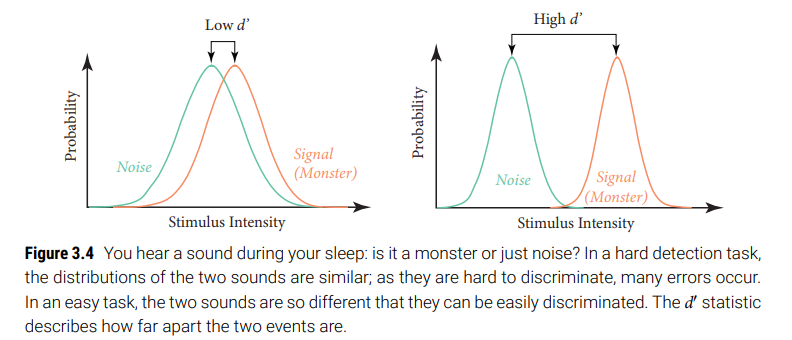
Detection
- The task of telling whether an event of interest occurs in the environment.
- In a detection task, the user must decide whether an event has occurred or not.
- Detection can vary in difficult based on how distinct stimuli are.
- Detection models can inform the design of displays to help people better detect events
Discrimination
- The task of telling whether a difference occurs in sensory stimulation.
- In a discrimination task, the user must decide whether a level of stimulation is available or if that level has changed due to some reference.
- Psychophysics refers to the study of psychological (psycho) responses to physical (physics) events.
- Its core aim is to measure an observer’s ability to distinguish differences in physical stimulations, often done through specific models.
- For example, Weber's Law is a well-known psychophysics model.
Recognition
- The task of categorizing a stimulus.
- In a recognition task, a stimulus must be classified as one out of a number of classes.
Estimation
- The task of estimating a property of an object or event in the environment.
- Estimation is the task of assessing a property of an object from stimulus information.
- According to cue integration theory, our prior experiences affect our estimations.
- Over time, users become more sensitive to how likely different properties are.
Search
- The task of localizing an object of interest.
- In search tasks, the location in space of some object must be determined.
Visual Perception and Attention
- Visual perception refers to perception through the sensing of stimulation by light and is one of our most powerful sensory modalities.
- It is fast and can be formed within milliseconds.
- It has very high parallel processing potential.
- No physical contact is required.
- The human visual system is proposed to involve three neuroanatomically distinct pathways.
- What:
- The ventral pathway encodes the identity of visual objects, such as tools, faces, or animals.
- Where and how:
- The dorsal pathway encodes the locations of visual objects and actions related to these objects.
- Who:
- A more recent discovery, the superior temporal sulcus specializes in dynamic social processing.
- It processes the actions of moving objects and bodies, such as their expressions, gaze, intentions, and moods.
Hierarchical Structure
- Visual primitives, such as the shape, size, orientation, color, and motion of objects, are extracted in massively parallel processing in low-level areas.
- The low-level areas feed into high-level areas that recognize objects and encode their identities.
- These, in turn, are projected back to the low-level areas.
Limits of the Visual System
- The concept of visual windows can be used to describe physiological limits posed to visual perception.
- There are four types of visual windows important to HCI:
The Visible Spectrum of Light
- We can only perceive a limited range in the spectrum of light, from about 380 to 780 nm.
- Additionally our eyes can only see three chroma of color (red, green and blue).
- Thus displays are limited to a certain range of light wavelength.
The Field of View
- Our field of view is limited to about 190 degrees horizontally and 125 degrees vertically.
- Thus displays are limited to certain sizes and shapes.
Contrast
- Contrast refers to the differences in luminance and color that make something in the field of view stand out from the rest.
- Contrast sensitivity refers to our ability to distinguish between levels of contrast.
Foveated Vision
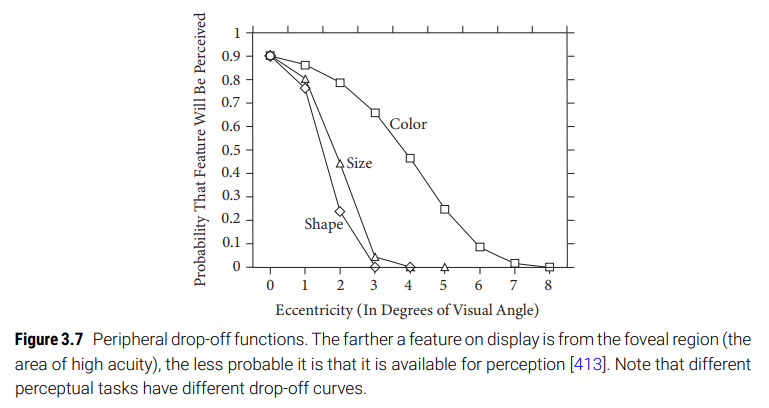
- The retinal image is limited and very non-uniform. It loses accuracy at the periphery.
- Vision is physiologically divided into two regions:
- Foveal Vision
- Refers to a narrow but precise, high-fidelity perception around the point on which you fixate.
- This area spans only 2 degrees of angle, roughly corresponding to the size of your thumb held out at arm’s length.
- Peripheral Vision
- It refers to the rest of the field of view, which has decreasing fidelity the further it is from the foveal area.
Visual Impairments
- Visual impairments that limit a person’s ability to view computer displays are surprisingly prevalent.
- Examples include: color blindness, low-level vision, blindness, and deficiencies in controlling eye movements.
- Color blindness, or color deficiency, manifests itself as difficulties in perceiving differences between colors, the brightness of colors, or different shades of colors.
- Red-green color deficiency is one of the most common types.
Eye Movements
- The human oculomotor system controls eye movements.
- It offers three main modes of controlling where we look:
Fixations
- They encode information about the visual scene consisting of multiple micro-fixations, each lasting a few tens of milliseconds.
- What eye trackers do is cluster micro-fixations into fixations of 200–400 ms.
- The type of information we look for during a fixation is task-dependent.
Saccades
- Saccades move the gaze point in ballistic leaps that are not perceived during the scene.
- They are ballistic in the sense that the target of the saccade is not changed after the onset of the movement.
- They are also blind in the sense that no information is sampled during a saccade.
Smooth Pursuit
- It is used for following moving targets, such as when following an animated character moving on the display.
- It is much slower than saccading but tracks information and the path can be changed to follow the target.
Perceptual Organization
- Displays in reality only consist of a grid of differently-colored pixels.
- We use perceptual organization to group them into clusters based on different features the pixels have in common or in contrast.
Figure/Ground Perception
- Figure/ground perception refers to the organization of visual experience in a visuospatial hierarchy.
- That is, some objects belong to an object in front (a figure) while others belong to objects in the background (the ground).
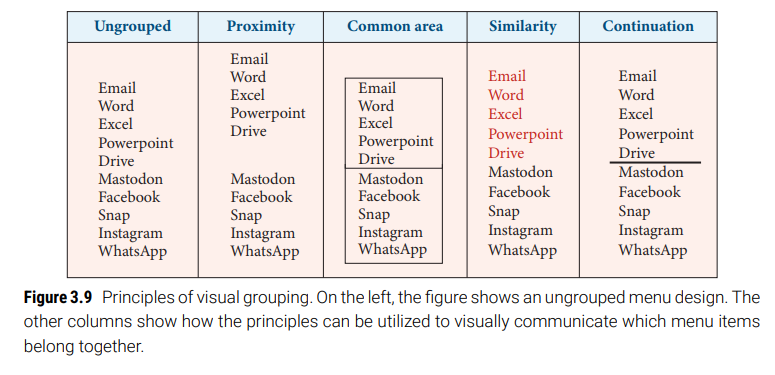
Visual Grouping
- Visual grouping refers to the tendency of people looking at elements on a display to organize them in visual groups.
- Four commonly used principles of visual grouping are:
- Proximity:
- The closer some elements are to each other and the farther they are from other elements, the stronger they are grouped together.
- Common area:
- Elements that are located in the same closed region are grouped together.
- Similarity:
- Elements that are similar (e.g., in color, size, or orientation) are grouped together.
- Continuation:
- Elements that are connected by the continuation of flow are grouped together.
- Generally visual grouping helps users to find elements quicker and more easily.
- These heuristics are called the "Gestalt Laws" as they originate from a German branch of psychology from the early 20th century.