What are Interviews?
- One way to learn about users is to speak with them.
- However, just talking to people is not research.
- Everyday conversations are undirected, scattered and not planned.
- Interviewing, in user research, concerns learning about the subjective experiences of users.
- The purpose is to learn about how their view their:
- Tasks
- Values
- Experiences
- Practices
- And what their wishes are for interactive systems.
- The purpose of learning this is primarily to understand users and secondarily to inform design and decision-making related to technology.
- Interviews may also be used as a general research strategy in HCI, aiming to obtain insights about users rather than input for a particular design.
- An interview is where the researcher meets the user.
- An interview aims to elicit first-person views on a selected topic from a particular user while avoiding omissions and biases.
- In interviewing, an interviewer talks with an interviewee following a planned script or list of questions.
- The session can be organized as a structured series of fixed questions or as an open-ended but thematically defined conversation.
- The systematic nature of interviewing makes it different from everyday talk.
Techniques and Goals of Interviews
Scientific Principles
- Interviews are often misinterpreted as easy or unscientific. In reality, interviewing is a skill that is developed over years and relies on many underlying scientific principles.
- Learning to ask questions and listen to answers to uncover meaningful insights is a craft.
Gaining Understanding
- The fundamental idea behind using interviews for research is that they allow interviewers to gain an understanding of the lives of other people.
- The strength of the interview lies in capturing the interviewee’s own attitudes and interpretations of the world in which they live and work.
- To do this interviewers shouldn't impose their own beliefs onto the interviewee.
- They shouldn't argue or give advice during an interview.
Empowering People
- Interviews can also empower people by giving them a way to directly express themselves.
Use-cases of Interviews
- It is important to understand when to use an interview and when not to.
- Interviews are not suited for obtaining numerical or statistical information.
- Instead, interviews are typically used to gain an understanding of beliefs, attitudes, and experiences.
Forms of Interviews
- At a high level, interviews can be divided into structured, semi-structured, and unstructured.
Structured Interviews
- A structured interview has two fundamental variants: quantitative and qualitative.
- The purpose of a quantitative structured interview is to collect statistical survey data; accordingly, the format of the interview and the sequence of questions are predetermined.
- Quantitative interviews are often used as part of demographic or market surveys.
- A qualitative structured interview consists of a set schedule and a set sequence of questions.
- Unlike in quantitative structured interviews, the main purpose is not to learn about the distribution of answers but rather their content.
Unstructured Interviews
- An unstructured interview, or non-directed interview, is an interview where there is no fixed schedule or sequence of questions.
- Questions may or may not be prepared in advance.
- Unstructured interviews are an important research methodology in some fields but aren't frequently used in design.
Semi-Structured Interviews
- Semi-structured interviews, or open-ended interviews are a mix of structured and unstructured interviews.
- This variant does not impose a rigorous schedule or a fixed sequence of questions, but it is also not completely loose in its structure.
- Semi-structured interviews tend to follow a loose structure and are discussed more below:
Open-Ended Interviews
- Open-ended interviews are the most common form of interviews in HCI.
- They are called open-ended because the questions asked during the interview are not fully planned in advance and they are developed and adapted based on the interviewees’ answers.
- This way, the interviewer can further investigate unexpected but interesting answers or adapt the questions to help the interviewees.
- Open-ended interviews try to minimize the influence of the interviewer on the interviewees’ answers.
- Open-ended interviews are sometimes called responsive interviews to highlight that the structure and the questions develop as the interview progresses.
- However, they are still based on a certain theme and structure.
Characteristics in Common with Conversations
Flexibility
- The interview is flexible in content and structure, just as a conversation may freely develop.
Adaptation
- The interviewer adapts their questions based on what is being said; they follow up on answers and may pursue new information with additional questions.
Continuity
- The interview has a certain continuity; the conversation partners understand where the conversation is going.
Understanding
- The interview is about understanding what the conversational partner says.
- If you do not understand what the interviewee says, you follow up and probe with additional questions.
Clarification
- If you are not being understood, for instance, if your interview questions are unclear, you should clarify them.
Attention
- The interview needs the full attention of the interviewer and, ideally, of the interviewee.
- Minimize the attention paid to notes and note-taking, other people, and the environment.
Respect and Confidentiality
- The interview requires conversational partners to treat each other with respect and protect private information.
Characteristics in Difference with Conversations
Asymmetry
- The interview is initiated by the interviewer for the purpose of doing user research.
- There is asymmetry in the conversation that needs to be carefully managed so that the interviewee feels valued and can follow the purpose and content of the conversation.
Preparation
- The interviewer has carefully prepared, and the questions are thoughtfully designed.
- This is the result of preparation to:
- Identify a theme for the interview
- Design the interview
- Carefully word the questions
Listening
- During the interview, an interviewer often spends more time listening than in an average conversation.
- Listening closely, noting the relation between what is being said and what is left unsaid, is a craft far beyond most of the conversations we have most of the time.
Recording and Analysis
- An interview may often be recorded to be analyzed in depth later.
- Some follow-up questions may be posed in anticipation of that later analysis.
Phases of Open-Ended Interviews
- User research with open-ended interviews typically consists of four phases:
Themes
- The basis of any interview is the development of the themes of the interview.
- The themes refer to the topics the interviewer wants to learn about.
- For example, themes may concern practices of using an existing system, patterns of collaboration in an organization, perceptions of implantable devices, or exceptionally thrilling experiences with computers.
- Themes can be specific or broad.
- They may focus on a specific system, event, or use situation.
- Or they may be broad and cover the totality of the interviewee’s life and aspirations.
- Existing interview studies in HCI provide examples of the outcomes of developing themes.
- In addition to technology-centered themes, an interview can also be centered on research questions or more closely formulated hypotheses.
- These interviews can attempt to verify, build or challenge theories.
Questions
- Given a set of themes for an interview, the next phase consists of finding effective ways to ask about those themes.
- In open-ended interviewing, you want to ask simple questions that allow the interviewees to give complex answers.
- Three types of questions may be distinguished:
- Main questions
- Probes
- Follow-up questions
Main questions
- Directly correspond to the themes of the interview; typically, a study has a few of these questions.
- Each of these questions can be asked to start a conversation.
- Main questions are often broad and allow the interviewee to cover the basics.
- A few types of main questions can be differentiated.
- Tour questions
- In a tour question, the interviewee is asked to give a tour of the interview topic.
- For example a workplace, an interactive system, a work task, or a location.
- One may ask:
- "walk me through what happens when X"
- "show me Y"
- "tell me about Z"
- Grounded questions
- In a grounded question, the interviewee is asked to give a specific example that grounds their answer.
- For instance, the most recent file they downloaded or the worst mistake they have made in sending out a social media message.
- Your-experience question
- In a your-experience question, the interviewee is asked to explain their beliefs or attitudes regarding a certain topic or event.
- Key concept question
- In a key concept question, the interviewee is asked to explain a certain topic as they understand it.
- Stage question
- In a stage question, the interviewee is asked to account for the stages or chronology of an event.
- Comparison question
- In a comparison question, the interviewee is asked to compare or contrast events, technologies, or anything else that is of interest to the interviewer.
- This isn't a strict list of question types and depending on what the interview is looking for, completely different main questions may be asked.
Probes
- Designed to make the interviewee comfortable and continue to talk.
- Probes have no explicit link to the themes of a study but are simply tactics for moving the conversation forward, asking for elaboration and clarification, or returning to the indented point of a main question after a digression.
- For instance, the interviewer may say:
- “mmh, then what . . .”
- “please go on”
- “what hapened next?”
- “tell me more about that.”
- Non-verbal cues like nodding and smiling may work similarly.
- Sometimes the interviewer can simply echo what the user says.
- If the interviewee says
- “but the system does not work as intended,”
- The interviewer may echo
- “does not work as intended.”
Follow-Up Questions
- Aims to extend the answer to a main question.
- The intent is to ensure the conversation resulting from a main question is thorough and deep and to explore new ideas and concepts that the interviewee brings up.
- Some follow-up questions can be prepared in advance based on likely answers.
- They may also be improvised during an interview when new information or interesting stories are shared.
- Some examples of follow up questions and their purposes are:
- Clarify answers
- Follow up on undefined terms or unclear explanations.
- For instance
- “You said that the system was X; what do you mean by X?”
- “What you said there seemed very important and I want to be sure that I understand it; please explain it again."
- Get concrete answers
- Follow up on answers that oversimplify, lack depth, or are abstract.
- For instance
- “Could you give me an example?”
- Compare or contrast answers
- You may follow up on answers by asking the interviewee to compare or contrast them to previous answers.
- For instance
- “Earlier you said that X; how does that situation compare to what you just told me?”
- Understand variation
- Here, you follow up to understand how responses vary based on the circumstances.
- For instance
- “Do you always do it this way?”
- “How has this changed over time?”
- Ensure thoroughness
- You may follow up when answers do not cover all the aspects of a main question or when you feel that information is missing.
- For instance
- “I think we have not covered X much; please tell me about that.”
- Understand personal attitude
- Follow up on questions where it is unclear how the interviewee thought or felt.
- For instance
- “Why was this important to you?”
- “How did you feel about that?”
Neutrality of Questions
- The wording of main and follow-up questions is crucial in interviews.
- The right wording keeps the interview on track and ensures the questions do not bias the interviewee.
- The questions should be as neutral as possible.
- Avoid wording that could influence the answers in a particular direction, introduce bias, or give cues for answering.
- For example, instead of asking
- “How much did you like the system?” which is highly biasing
- You can ask “Can you tell me about your experiences while using the system?”
Pace of Questions
- Questions should be asked one at a time; avoid double-barreled questions.
- For example
- “Let me know how you normally do the same task when at home and what kinds of features you use in your toaster.”
- Should be split into two separate questions instead.
Expression of Questions
- The questions should be clearly expressed.
- Make them short and be sure to use appropriate, jargon-free, and culturally appropriate terms
- If in doubt, ask in an open-ended manner and learn the clearest terms and ways of questioning.
Leading Questions
- It is important to avoid leading questions.
- A leading question is a question that implies there is a specific set of “right” answers to a question.
- Consciously or unconsciously, asking leading questions is a frequent source of error in user research.
- Avoiding leading questions requires constant awareness and ensure you are being a neutral interviewer.
Experience Focused
- Questions should be focused on recent experiences or impressions.
- People are poor at predicting the future, so asking them about it is not meaningful.
Specific Questions
- It is important to avoid having interviewees extrapolate from their own understanding of their behavior.
- People’s understanding of their behavior often does not correspond to their actual behavior.
- A question such as “Is handwriting recognition useful?” may be understood by the interviewee as a question on whether handwriting could be useful for someone in some hypothetical situation.
- The interviewee is unlikely to know the answer and is likely to speculate.
- A better way to phrase such a question is to simply ask “Is handwriting recognition useful to you right now?”
Judgmental Language
- Questions should also not use judgmental language.
- Similar to leading questions, interviewers should not get the impression that they are expected to answer in a specific way.
Why Questions
- Although the question “why?” is simple and often seems a good interview question, use it carefully.
- It may prompt participants to give a simplified answer or offer justifications when they cannot provide a more thorough answer.
- “Why?” questions should be used sparsely and carefully.
Conducting Interview Conversations
- An interview conversation consists of several parts.
Interview Structure
Introduction
- Both the interviewer and the participant introduce themselves, and the interviewer explains the purpose of the interview.
- Typically, the interviewer wants to establish themselves as neutral but sympathetic.
- It is often a good idea to start interviews with a bit of casual chat to create a relaxed, conversational atmosphere.
- Show people that they are competent and noteworthy.
- Introduce yourself and your focus.
Warm-up
- The objective is to make the participant step away from their normal life and change their focus to consider the objective of the interview.
- This part typically includes some easy questions to start the conversation and make the interviewee comfortable.
- The questions may be about background information, for example, the theme of the interview.
General Issues
- The interview is centered around direct experiences and related attitudes and expectations with the product, system, or service in question.
- Asking these types of questions early in the interview prevents adverse effects from the interviewer inadvertently skewing the interviewee’s perception as the interview progresses.
Deep Focus
- In the fourth phase, the central focus of the interview is introduced.
- This is the key part of the interview, where the main questions are asked, prompts are given, and follow-up questions are used to deepen the interview.
Retrospective
- In the fifth phase, the interviewee has time to reflect on the broader issues of the discussion.
- This is also an opportunity for the interviewee to relate the general issues identified earlier with thoughts that arose in the deep focus phase.
- Another purpose of this part may be to minimize any intellectual or emotional tension in the interview to ensure it ends on a relaxed note.
Wrap-up
- In the sixth phase, the interviewer completes the interview to avoid interviewees feeling left hanging at the end of the interview.
- This includes thanking the interviewee for their time and answers.
- Typically, the interviewer also explains what will happen next.
- For instance, if they expect to send the whole or parts of the interview, or the analysis of the interviewee’s answers, to the interviewee for comments or approval.
- It may also cover other plans for staying in touch, such as sending a final report to the interviewee.
Interview Features
Pleasant
- An important objective for an interviewer is to be pleasant, polite, and appear to be enjoying the conversation.
Time
- Interviews generally last about 1 hour.
- Anything less is unlikely to give detailed results and anything more might be discouraging and unreasonable for interviewees.
Recording
- Generally interviewers might take notes, but this might be distracting for the interviewer and may appear to the interviewee as if they are not paying attention.
- If the interviewer does not take any notes, they can pay full attention to the conversation.
- However, they will not be able to analyze what the participants actually said or easily discuss the interviews with persons who were not present.
- The interviewer may record the conversation to transcribe and revisit it later.
- Usually, an audio recording is enough.
- Video does not add much unless the talk is about artifacts or practices that are better explained through visual demonstrations.
Interview Guides
- Interviews are often supported by an interview guide.
- Such a guide contains the main questions and a list of anticipated prompts and follow-up questions for each of them.
- For novice interviewers it is recommended to write a guide in full.
Analysis of Open-Ended Interviews
- The analysis of interviews transforms the interview conversation into insights.
- The recommendation for open-ended interviews is to do this as soon as possible after the interview.
- The point is to keep as much of the conversation and the accompanying hunches and associations clear when the interview is analyzed.
Structured Interviews
- Structured interviews have predefined questions and structures, which makes them more rigid than open-ended interviews.
- They are easier to conduct and require less improvisation.
- It also simplifies analysis.
- They are relatively similar to surveys.
- Structured interviews can provide both general and specific information.
Analysis of Interviews
- Concerns how we turn the data collected from interviews into insights about people, their activities, and the contexts of use.
- As in other user research, the goal is to make sense of the participants’ world from their perspective.
Four-Phase Approach
Transcription
- During transcription, the audio or video of the interview is typed so that text analysis may be performed.
- The level of detail of the transcription can vary, ranging from cursory notes to detailed annotations of rhythm, pauses, and intonations in speech.
Analysis
- During analysis, the interviewer performs rich readings of the transcripts while trying to organize and condense the data.
- The focus is on the meanings the interviewees have assigned to their behaviors and the world around them.
Verification
- During verification, the interviewer may return to the participants for clarifications and to check if the interpretations are correct.
- While this is not always possible, it may provide valuable input and increase the validity of the findings from the interview.
Reporting
- During reporting, the interviewer writes up the outcome of the interviews.
- This may be in the form of a research paper or representations of users, such as models of work sequences or personas.
Expanding Meaning
- In the expansion of meaning, analysts aim to expand the interpretation and meaning found in particular parts of interviews.
- If one pays enough attention, a multitude of interpretations and implications can and do follow from one sentence.
- Interpretation demands comprehensive yet sufficiently detailed readings of relevant interview data.
- Such readings might be supplemented by:
- Asking further questions
- Comparing answers within and across participants
- Seeking to understand the answers relative to the themes of the interview
- Comparing the answers to what is known.
- Because it is difficult to identify and expand meanings in interviews, this phase is often completed in collaboration with other researchers.
- This approach also increases result reliability by reducing the influence of a single analyst on the final result.
Condensing Meaning
- Rather than to expand the possible meanings and interpretations of the interview, the aim here is to reduce what is being said to patterns or concepts in an organized and manageable structure.
- The main strategy for condensation is coding.
- Parts of interview transcripts are assigned one or more codes that describe important aspects.
- Such codes can be identified from the data in so-called bottom-up coding or from a set of a pre-made codes, for instance, from a relevant theory.
Analysis as an Ongoing Process
- Analysis may be done at two different times:
- after all the interviews are done or between the interviews.
After Interviews
- Most commonly, it is done after all the interviews are completed.
- However, some researchers find that “analysis is not a one-time task, but an ongoing process”.
Between Interviews
- Intertwining interviews and analysis brings many benefits.
- It allows researchers to change their questions based on insights from analysis and test early conclusions in later interviews.
- This approach is often combined with open-ended interviews.
- No matter when analysis is done, insights may be formed at any time during research.
- Therefore, it is good to take frequent notes.
Affinity Diagramming
- Affinity diagramming is a simple technique to identify themes from interviews and other data.
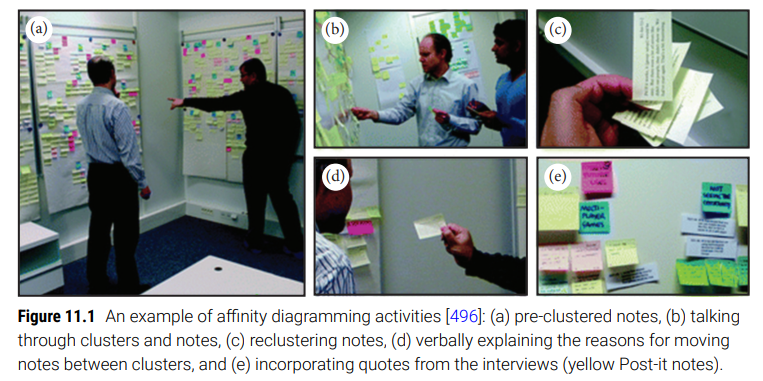
- The basic idea is to do a collaborative bottom-up coding of parts of interviews or other data based on any affinity (similarity) between those parts.
- Here it is demonstrated as a 4 phase process.
Creating Notes
- The interviews become manageable distinct notes.
- These notes may come from transcriptions, subdividing interviews into sentences, question–answer pairs, or other segments that contain an understandable point.
- The notes may also come from people who were present at the interviews and contain insights or interpretations of what was said in the interviews.
- If affinity diagramming is used on other sources of data, these are similarly segmented into small, meaningful units.
- Notes may be put on Post-it notes or small pieces of paper
Clustering Notes
- The group doing the clustering first reads all the notes, either together or individually.
- Then, the group begins to form rough clusters of related notes, for instance, on a wall or table.
- As the clusters begin to form, the group explains the reasons for placing notes in particular clusters.
Walking the Wall
- The group looks over the entire organization of notes.
- This is called the wall because the notes may be stuck on one.
- Clusters may be merged or split up to better organize the notes.
- The group may also discuss the content of the wall and add notes, split notes that contain multiple themes, or clone notes that contain multiple ideas.
Documenting
- The group transfers the organization of the wall to some digital format for future use.
Thematic Analysis
- Thematic analysis is a systematic approach to data analysis that helps identify and organize insights and meanings derived from qualitative data.
- The data may come from interviews, surveys, online content such as blogs or social media posts, or physical documents.
- Thematic analysis can be organized into six steps:
Familiarizing
- Familiarizing yourself with the data.
- Read the interview transcripts or whatever form the data are in.
- Form a first opinion about interesting parts of the data based on active and critical thinking about the data.
- What does what is said or written mean?
Generating
- Generating initial codes.
- Codes are the building blocks of analysis; they label features of the data that might be important.
- Codes may be based on what the participants said, the researchers’ conceptual framework, factual aspects of the data, or deep interpretations.
- Coding may happen at any level, from individual sentences or words up to long segments of an interview.
- Coding happens as one goes over the data.
- Therefore, be generous in creating codes; at any stage of reading, it is difficult to know if something is relevant.
- Make several passes over the data to develop your codes as you learn more about the data.
Searching
- Searching for themes.
- This step requires the analyst to generate themes from the codes.
- A theme captures a pattern of meaning in the data that is important to the research question.
- Searching for themes is an active, interpretive process.
- In practice, this happens through the collapsing or clustering of codes based on similar features.
Reviewing
- Reviewing themes.
- This step begins to consolidate and quality-check the themes relative to the entire dataset.
- Such checks may concern overlaps among themes, if a theme is interesting given the research question, or if a theme has sufficient and substantial data to back it up.
- As a result, themes may be merged, split, discarded, or developed in different ways.
Defining
- Defining and naming themes.
- This step is about ensuring the themes have a clear focus and address the research question by defining and naming them.
- Often, participants’ words and phrases are used to define and name a theme.
Reporting
- Producing a report.
- This step aims to combine a coherent argument with a narrative of the themes, excerpts from the data, and the existing literature.
- It is about describing and staying close to participants’ words and what they said.
- It is also about interpreting the interviews as answers to the research question.
The Say-Do Gap
- Is it possible to obtain accurate information about users’ practices by asking them?
- The say–do gap poses a practical obstacle to the aim of interviews.
- This gap refers to the discrepancy between what an interviewee says and what they do.
- For example, when asked whether they wash their hands after using the toilet, most people answer that they do.
- However, according to one study that directly observed handwashing behavior, 15% of men and 7% of women do not wash their hands after using the toilet (ew).
Reasons for the Say-Do Gap
- Users might not remember correctly or at all.
- Users might be embarrassed to disclose information.
- Especially if it is taboo sensitive.
- Inability to imagine the future.
- Questions relating to the future often lead to guesses or speculation.
- Inability to articulate knowledge.
- Tacit knowledge can be used in the right situations, but is difficult if not impossible to communicate verbally.
- Instead it can be exposed by acting out.
- Users may deliberately exaggerate or omit aspects of their behaviors.
- They may want to give a positive impression of themselves or avoid negative social consequences.