What is Field Research?
- One potential source of insight into users is their exhibited behavior in their natural environment while they attempt to achieve their goals.
- Field research, refers to the collection of data on users in their real-world contexts.
- In much field research, users are observed doing things that would also occur without the researcher being present and with minimum bias due to the researcher being present.
Strengths of Field Research
Realism
- A key strength of field research is its realism.
- Field research provides insights into how users act, collaborate, and communicate in their natural environments.
- This is why it is sometimes called naturalistic research.
- In the array of user research methods, field research is vital for capturing aspects of use that other methods might miss.
Openness
- Due to its openness, field research sheds light on the complexity of the social and organizational settings in which an interaction is accomplished.
- By being unstructured and not having premade commitments, field research can uncover factors that might not be discovered through other means.
Understanding Relationships
- Field research also produces knowledge about the practices of stakeholders and how they understand those practices.
- It also teaches us about the relationship between prescribed procedures and how work actually gets carried out.
Empathy
- Field research may also be used to inform the design of new interactive systems, serving as a way to build empathy with prospective users and gain background knowledge about them and their practices.
- It may also help inform decisions about whether to adopt a system or not.
Questions of Field Research
- Generally, field research should address three questions:
Focus
- What to focus on?
- In any complex real-life situation, there are several things to observe; the researcher needs to decide what to pay attention to and what to ignore
Data Gathering
- How to gather data? In particular, how to plan and conduct observations.
- The way this is done affects everything from the recorded data to access to sites and ethics.
Analysis
- How to analyze the data?
- Field research often produces a substantial amount of data.
Observation
- In HCI, observation is a method of data collection where the researcher is positioned to observe and take notes on activities related to the use of an interactive system.
- The goal in collecting such notes is to account for relevant types of events, their frequencies, and patterns occurring over time.
- One ideal in observation is to interfere as little as possible with what is being observed.
- The researcher should be positioned in such a way that there is little interference or bias due to their presence.
Etic Observation
- This type of observation is sometimes called an outsider’s or etic view.
- For instance, etic observation could be relevant to study the following:
- How much time people spend doing something, for instance, looking at interactive exhibits in shopping windows
- How virtual reality users engage with strangers
- How a team of air traffic controllers responds to unplanned events.
- Etic observation allows the researcher to describe events from an outsider's view.
Emic Observation
- In emic observation, the goal is to immerse oneself into a community to describe it from an outsider's perspective.
Focus
- What to look for in observation is largely prescribed by the goals of the user research.
- It is also influenced by how much is already known.
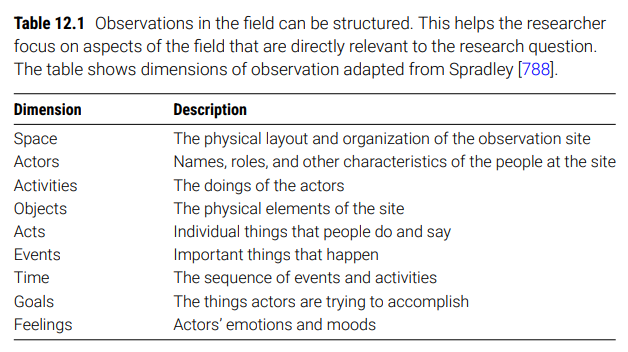
- The above table shows 9 dimensions that may be the subject of observation.
- The observations might be about how users use the space or interact with artifacts, what they do and how they do it, etc.
- Other frameworks highlight other dimensions that may be considered in observations.
- Goetz and LeCompte suggested looking at:
- Who is present
- What their role is
- What is happening
- When something happens
- Where it happens
- Why it happens
- How the happening is organized.
- Others suggest looking at:
- The physical setting
- The activities
- The social environment
- The formal interactions among people
- The informal and unplanned activities
- Nonverbal communication
- The things that do not happen but might happen
Gathering Data
Finding a Site
- An early question faced by field researchers is where to observe users, including how to obtain access to the observation site and whether the participants should know the observations will take place.
- Picking the observation site relates to the purpose of the user research.
- The site should reflect that purpose.
- Different observation sites allow for different types of observations to be made.
- Poor site selection will result in limited or skewed observations.
- Another concern is the effect of the selected site on the observed individuals.
- Reactivity refers to the impact of the observer on the observed individuals.
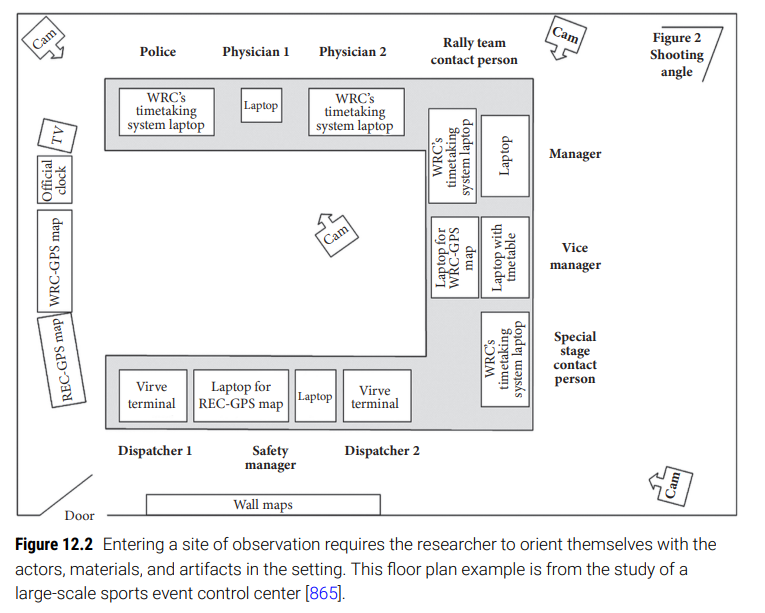
- The first task upon coming to a site of observation is to orient oneself.
- The observer should understand the structure of the site, including the positions of the individuals being observed and relevant physical and digital artifacts.
- The following questions should be answered:
- Who are the actors in this space and what roles do they have?
- What are the relevant material or digital artifacts in this space?
- What are some typical or probable locations or routes of the relevant actors?
- How am I and my recording instruments positioned in this space?
- If the use of computers needs to be recorded, is everything positioned correctly to do so?
Shadowing
- Rather than settling on a fixed site of observation, particular people may be followed.
- This is known as shadowing.
- Observation may also be covert so that users do not know they are being observed.
- In virtual environments, for example, covert observation is easy to perform since the observer may not need to have an embodied presence in the space that is being observed.
- In public and semipublic spaces, video cameras may be used to collect data covertly.
- With sufficient permission, data can be collected from participants using wearable cameras.
- However, this may result in altered behavior.
- It is important to note that outside of institutionally cleared circumstances, covert observation can be illegal and ethically precarious.
Data Capture and Note-Taking
- Observations in the field should be recorded for later analysis and verification.
- Observations may include audio, video, photos, and textual descriptions.
Field Notes
- Field notes are recordings of remarks made in the field.
- They are the raw data of field research.
Field Diary
- A field diary acts as a log of observations that are typically recorded using pen and paper or digitally using a mobile device.
- A diary entry may relate, for example, an observation of the time of occurrence of an event.
- However, diaries might suffer from being inconsistent and sporadic.
Structured Notes
- Structured notes are field notes recorded into a previously defined observation structure.
- Compared to the diary method, this structured method better guides observations and facilitates the discovery of patterns that occur over time.
- It is also easier to do qualitative analysis.
- The structure evolves as the study progresses.
- Non-structured field notes maybe also be recorded that can help create or update a structure.
Analysis of Observations
- There are a few shared principles to consider when analyzing field notes.
Immediate Recall
- When in the field events pass quickly.
- A field researcher often has to choose between immersing themselves in the ongoing event and writing notes about it.
- Since even the most comprehensive recording offers only a glimpse into what transpired, field research almost always relies on the observer’s memory.
- It is therefore critical to analyze observations quickly after they are recorded.
- Knowing when to observe, when to take notes, and what to remember from an event are some of the key skills that one develops as a field researcher.
Thick Description
- Important events should get more attention in analysis.
- To this end, a field researcher should try to recall as much as possible of an event and write it all down, answering questions such as:
- What was observed?
- What does it mean?
- Why does it matter?
- This can produce a rich account, or a thick description, of an event.
- A researcher can also jog their memory.
- For example, by revisiting audio or video recordings orreviewing representations of events, such as floor plans.
Coding Data
- Data coding should strive to be reliable and reproducible.
- The categorization of observations should be based on definitions that are as unambiguous as possible.
- Such definitions, ideally with examples and counter-examples, should be recorded in a coding manual.
- When statistical reliability is important, the inter-rater reliability should be measured and reported.
- This refers to statistical metrics that quantify how reliably two or more raters, working independently of each other, end up with the same coding given the same materials and the same coding manual.
- Since coding an entire dataset can be time-consuming, raters are usually asked to code overlapping samples to both gain coverage and be able to measure the inter-rater reliability.
- When the conclusions drawn from a study are quantitative, low reliability is a serious concern and calls for rethinking the coding manual.
Validation with Participants
- Conclusions that are drawn based on field research are statements made about users.
- From this point of view, users are stakeholders in field research.
- For them, these statements may be wrong in multiple ways:
- Irrelevant
- Biased
- Partial
- Incorrect
- Even in the case of covert observation, it is their lives, opinions, and practices that are being described.
- Validation can help verify conclusions and correct misinterpretations.
- It can also provide some agency to users.