What is Evaluation?
- A key challenge in design is assessing whether a design is or will be “good” for people, work as intended, and not have adverse effects.
- We must ensure that systems are:
- Practical
- Usable
- Accessible
- Can deliver the value envisioned by the designers to the users.
- In HCI, such assessments are called evaluations.
- While user research typically happens before anything is designed, evaluation usually occurs after a design is made, to determine its quality and usability.
- However, some empirical methods can be used for both evaluation and user research.
- What differs is the intention of the researcher in applying the method.
Reasons for Evaluation
- It is worth being clear on why we evaluate systems.
- Evaluation has become part of most models of human-centered system development for several reasons, including the following:
Evaluating Prototypes
- It is nearly impossible to build optimal systems on the first attempt.
- Gould and Lewis pointed out that everyone builds a prototype; some evaluate it one or more times, while others simply deliver it to the customer or the marketplace.
Profits
- Evaluation is profitable.
- The literature on the return on investment of evaluations is unequivocal.
- When money is spent on an evaluation, it is returned many times over.
Involving Users
- Evaluation can involve and engage users.
- Involving stakeholders in the design and evaluation of interactive systems leads to better adoption of the systems and helps maintain a “continuous focus on users and their tasks”.
Prevents Flawed Designs
- Early evaluation helps prevent poorly thought-out or developed ideas from being designed and introduced to people.
- This also saves resources.
- Early evaluation of usability may thus help prevent failures and disappointments.
Quality
- A lack of evaluation can negatively reflect on designers and their organizations.
- The Association of Computing Machinery’s code of ethics states that a computing professional should:
- “Strive to achieve high quality in both the processes and products of professional work.”
Goals of Evaluation
- Evaluations may be performed for a variety of reasons.
- In general, those reasons shape what is done in an evaluation, how it is carried out, and how it is interpreted and reported.
- Therefore, being upfront about the goals of an evaluation helps to make the appropriate choices and plan the evaluation in the best possible way.
Improving Designs
- A primary reason for performing an evaluation is to improve a design.
- This is a frequent activity in the practical development of interactive systems.
- Most software companies have people trained to conduct human-centered evaluations of their software.
- These evaluations may identify features of the system that unexpectedly do not work well for a particular group of users, a particular task, or a particular use situation.
- We may then change those features in a future version of the system.
- Evaluations made for this purpose are called formative because they help shape a system.
- Formative evaluation is essential in the iterative development of a system because it provides information on what to improve in the upcoming iterations.
Measuring Performance
- The other main reason for conducting evaluations is to discover how well an interactive system performs given some objective.
- The goal here is not to inform the design but to ensure the system satisfies the objectives.
- The objectives may be part of a requirements specification, be included in a contract, or be used to select a system for procurement or establish a superior design. This use of evaluation is often called summative.
Identifying Strengths
- Another important goal of evaluation is to identify system features that work well.
- This goal complements the two main evaluation goals discussed previously and can help us confirm whether our expectations of a particular design have been fulfilled.
- Moreover, pointing out the positive features of a design has been found to be a good way to make stakeholders, such as developers of interactive systems, appreciate the evaluation.
User Research
- Evaluations can also teach us about factors outside the evaluation criteria.
- They may teach us about users and their tasks.
- For instance, a user in a think-aloud study may react to a task by saying “We do not usually do it that way,” which can be important information.
- In other words, evaluations can provide information that we would normally obtain through user research.
Yardsticks of Evaluation
- Evaluations strive to attribute value to a design.
- Such attribution requires someway of measuring value for end-users.
- To do this we need to define some metrics we can use to determine whether the design accomplishes the goals it should.
- A defining characteristic of evaluation in HCI is that neither people nor technology can determine the outcome of an evaluation alone, as what is valuable emerges through interactions between people and technology.
- Yardsticks are typically derived from our view of what a good interaction is or from the design objectives of user interfaces.
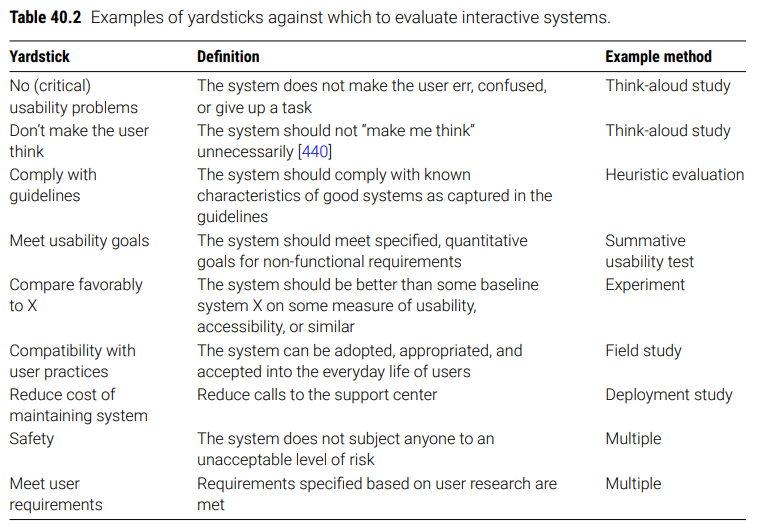
- Yardsticks can be absolute, pertaining to a single design.
- They can also be relative, such as compared to a competitor design or an earlier version.
Using Yardsticks
- To use a yardstick for evaluation, it should be operationalized.
- That means that general constructs need to be turned into a procedure that allows us to measure a system against the yardstick.
- For example usability tests may measure what percentage of tasks can be completed in a certain time frame, or a user error test may record the number of errors such as inaccurate presses or misconceptions.
- That means that general constructs need to be turned into a procedure that allows us to measure a system against the yardstick.
- Then we need to make conclusions based on the data obtained.
- Many HCI constructs are about:
- Good interaction
- Uability
- Accessibility
- Autonomy
- Awareness
- Memory load
- Many HCI constructs are about:
- Obtained data will likely give an idea of how usable your product is, but it's important to determine at which point it becomes usable enough.
- For example if 6/10 users can complete a task, is that good enough, or do you still need to iterate and develop the product?
Evaluation Methods
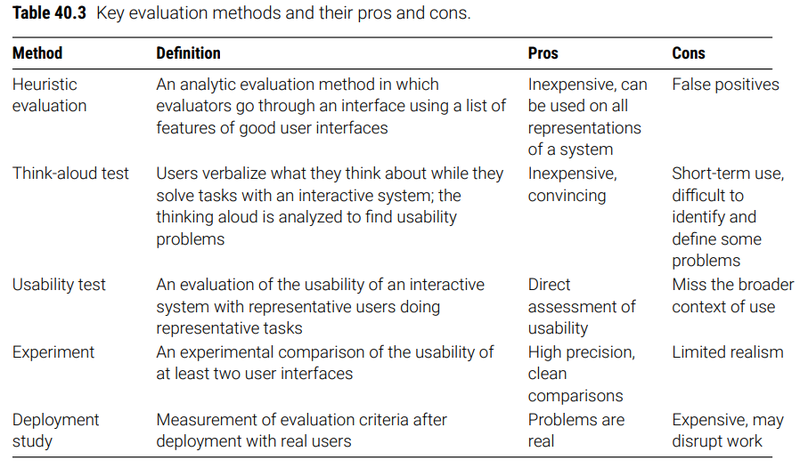
- Evaluations are done following established systematic procedures called evaluation methods.
Properties of Evaluation Methods
- Evaluation methods contain:
- A yardstick for evaluation
- A process for performing the evaluation
- Tools to support the evaluation
- A standardized way of reporting the evaluation
- Evaluation methods can be distinguished in three mains ways.
- Analytical vs empirical
- Laboratory vs field
- Representations
Analytical Evaluation Methods
- In analytical evaluation methods, an evaluator compares an interface to guidelines, principles, or theories of good interaction.
- The assessment of the interface does not involve users.
Empirical Evaluation Methods
- In empirical evaluation methods, users’ interactions with the interactive system form the basis for evaluation.
Laboratory Evaluations
- Laboratory evaluations are done in an artificial environment, away from the users’ context of use.
- They may therefore be done on interactive systems that are incomplete.
- The laboratory also allows for experimental control.
- However, it lacks in realism.
Field Evaluations
- By contrast, field evaluations are carried out during the actual use of a system.
- They offer fewer options for control and emphasize realism.
Representations
- Evaluation methods also differ in the representations of designs they may be based on.
- Early representations of designs, are
- Use cases
- Scenarios
- Storyboards
- Paper prototypes, high-fidelity prototypes, and interactive systems that have been used for years may also be evaluated using some methods.
- Evaluation methods are available for all types of representations.
Tailoring Evaluation Methods
- Evaluation methods are not generic to all people, activities, technologies, and contexts.
- They may be tailored to particular instances of those, just as understanding people may provide insights about a specific group of people or a certain domain.
Choosing an Evaluation Method
- Due to the diversity in designs, user goals, and use contexts, there is no single evaluation method you can always use.
- Professional evaluators master a toolbox of methods and tailor them for specific cases.
- Some of their considerations revolve around the goals of the evaluation relative to the pros and cons of each method.
- For instance, analytical methods work best for relatively simple designs and assume that experienced evaluators are available.
- Due to their high false negative rate, they should not be trusted for complex or safety-critical systems.
- For the novice evaluator, think-aloud testing is often a good choice.
Validity, Reliability and Impact
As with user research methods, evaluation methodsraise several fundamental questions about the quality of their output.
Validity
- The validity of an evaluation is about whether the evaluation result reflects the real value of the design.
- In general, the results on the validity of different evaluation methods are mixed.
- However, a couple of findings stand out:
- First, analytic evaluation can detect problems that cannot be detected in think-aloud studies.
- Second, the usability problems found in think-aloud tests might not be severe if the users experiencing them in a test find a workaround that they can apply every time they subsequently face the problem.
Reliability
- The reliability of an evaluation refers to whether the evaluation findings would be different if the evaluation were repeated or involved different evaluators.
- If it were to be different, the trustworthiness of the findings is reduced, and it is unclear if action should be taken on the problems, as they might disappear upon repeating the evaluation.
Impact
- Impact is about ensuring that the evaluation results can be used for their purpose, in particular, with regard to formative evaluation.
- Impactful results will help change systems for the better by being convincing and offering concrete input or ideas on how to solve problems.
- John and Marks compared the so-called persuasive power of usability evaluation methods.
- This refers to whether a developer, upon reading a description of a usability problem, actually changes the interactive system.
- Usability tests were quite high in persuasive power, as developers could see users struggling with their product through videos or in person.