What is Cognition?
- Cognition refers to the thoughts and processing occurring in one's mind.
- Like perception, most of our cognition goes unnoticed in our daily lives.
- In fact, many designs go out of their way to make cognition as seamless and as easy as possible during use.
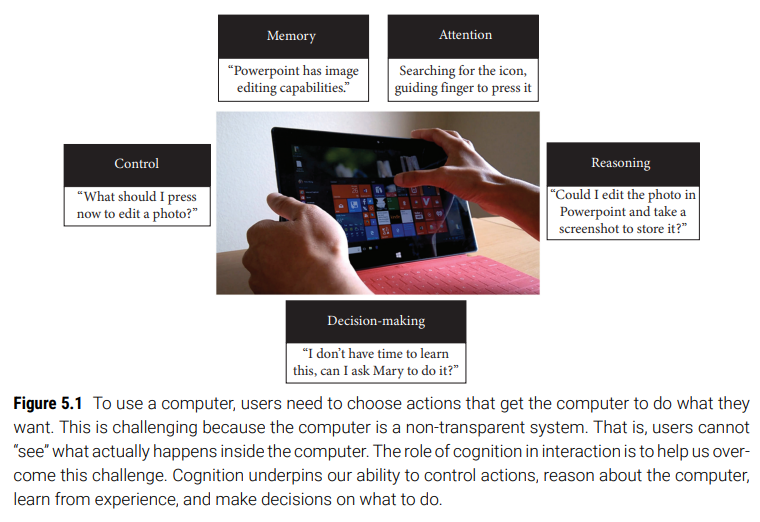
- The main function of cognition in human–computer interaction (HCI) is to help the user control a computer to do what they want.
- Attention is needed to find elements, memory to learn and recall their properties.
- Linguistic abilities to understand text and generate command names.
- Reasoning to make use of the knowledge obtained so far and deduce what happens inside the computer.
- People vary greatly in cognitive capability since it is shaped by physiological factors but also the environments and contexts people adapt to.
Elementary Cognitive Capabilities
- There are five elementary cognitive capabilities relevant to HCI:
Cognitive Control
- Adaptively deciding goals (what to do), allocating cognitive resources to tasks, and changing the course of action as needed.
- For example, cognitive control is needed when a user decides to multitask by looking at their phone while biking.
Memory
- Forming, maintaining, and accessing beliefs about objects that are not directly perceivable.
- For example, long-term memory (LTM) helps users locate previously seen icons more quickly.
Attention
- Selectively processing part of the perceptual field.
- For example by deploying visual attention on a screen or by sensing a tactile display by sweeping fingertips on it.
Reasoning
- Applying transformation rules to beliefs to form new beliefs.
- For example, reasoning is needed to infer if software can do certain things when one cannot recall it doing that before.
Decision-making
- Interaction often requires decision-making.
- For example, a user might decide to install application A and not application B because A appears to have a more favorable cost and better features.
General Findings About Cognition
- Many researchers have investigated cognition.
- The following summarizes some key findings about cognition relevant to HCI.
Goal-Setting and Focus
- Cognition helps us set goals and maintain focus on them.
- A goal is some desirable state of affairs.
- In HCI, a goal often refers to something that people would like the computer to do for them.
- For example goals could be sending a message or changing privacy settings.
- Goals affect how cognition processes information.
- Human memory is less about storing experienced events accurately and more about offering access to memories that may be useful for a given task at hand.
- Goals set expectations about how the world is structured and what might happen next.
- An important phenomenon related to visual attention is inattentional blindness.
- If users are given a goal related to one part of a user interface, they recall features related to that part and largely ignore the other parts.
- They will not notice or retain information about parts not related to the goal.
Limits
- Human cognition is limited.
- For example our working memory and long-term memory are both limited.
- We can only store so much information at a time and may forget unused information in the long-term.
- Visual attention and our capability for abstract reasoning and planning are also limited.
Internal Models
- Cognition is based on internal models of reality.
- Cognition supports our ability to reason about things that are not directly perceivable.
- This ability necessitates the construction of internal models of reality that can be used to formulate goals and plans.
- A common example includes metaphors, which are used frequently in HCI.
- Our "desktop" and "files" and the "recycling bin" on a computer are all metaphors comparing a computer terminal to an office workspace.
Learning and Adaptation
- For some time, it was believed that human action is driven by plans and reasoning.
- That is, we plan sequences of actions and execute them.
- Suchman challenged this view in studies of repair and maintenance personnel of Xerox photocopiers.
- Suchman found that even in a highly regulated profession, a worker’s action is not heavily scripted but requires constant adaptation.
- While planning is carried out, such plans are often noncommittal sketches that need to be revised and updated.
- The present understanding is that our cognitive, motor, and perceptual processes are constantly adapting.
- We are continually forming beliefs, trying new tactics, and fine-tuning.
- Our adaptability and dynamic thinking methods are very important to consider in not only HCI but all design fields.
Energy and Effort
- Cognition requires energy and effort.
- Mental effort refers to the use of energy for controlling thinking to achieve our goals.
- Mental effort has two main components.:
- Task effort
- Refers to the additional energy required in response to an increase in the computational demand.
- This can occur when we face a novel environment, for example, when learning to use a new user interface.
- State effort
- Refers to the energy required to protect performance from physiological fatigue, which can be caused by sleep deprivation, among other factors.
- Effort may sound like a negative concept as it limits performance, but in reality the feeling of effort is a key survival adaptation that prevents us from over-consuming energy on less important activities.
Cognitive Control
- Cognitive control refers to our ability to direct thinking and action toward achieving some goal.
- When using a computer, cognition must decide between possible actions to reach a goal.
- It must activate the right representations for achieving that goal.
- The basic problem of cognitive control is the following:
- At any given time, countless stimuli bombard our senses, and we have several options for sharing our limited resources among them.
- The problem is deciding what to focus our attention and effort on and when.
Activating Goals
- Cognitive control is also needed to activate the right subgoals at the right time.
- Faced with a complex task with multiple goals, cognition breaks it down into simpler, more manageable parts.
- Altmann and Trafton explained this with a goal activation model.
- Contextual cues prime subgoals.
- For example, when we see a familiar intersection on the way home, it subconsciously activates our next subgoal.
- Priming is about the subconscious activation of concepts by perceived cues.
- However, previously activated goals can interfere with the activation of the relevant goal and might need to be suppressed instead.
- Cognitive control is required to suppress the activation of interfering goals.
- The model can explain post completion errors, which result from the user forgetting to carry out an action that should be taken after achieving a goal.
Activating Task Representations
- When a task is performed, cognition needs to make relevant task representations available.
- Cognitive control operates through two mechanisms:
- The activation of relevant representations in memory and the inhibition of irrelevant representations.
- This allows you to focus on what you expect to be important and avoid unnecessary details.
- For example, if you were looking to cancel a subscription, you would check think about checking your subscription details and avoid checking the accessibility settings.
- The inhibition of return.
- Without this ability, you would be constantly revisiting locations, which would make the search less efficient.
- This kind of regulation is important in information-rich environments.
- Inhibitory control is needed to avoid attending to every flash or blink on an interface and maintain focus on the task at hand.
- This allows us to control which stimuli are important and which are irrelevant.
Choosing Actions
- Cognition is necessary to choose what to do.
- A central problem in computer use is that rewards are delayed.
- We cannot immediately obtain what we are interested in.
- Instead, we must choose one action now, then another, and so on.
- Instant gratification and the reduced need for effort is one of the main reasons why generative AIs are so widely diffused despite their social, ethical and environmental costs.
- An essential ability for effective interaction is to evaluate actions by considering their long-term rewards.
- There are two key mechanisms underpinning decision-making.
- First, through experience, users learn to associate an action with recurring contextual cues.
- Trying things allows users to learn value estimates of actions available in a particular state.
- This allows users to develop and understanding of the features that are most useful to them.
- The associative learning of such value estimates occurs subconsciously over time and is automatic.
- The other mechanism is reasoning about and simulating possibilities in the mind.
- This requires cognitive control and thus effort.
- You need to activate representations and compare your options.
Multitasking
- We often need to carry out multiple tasks at the same time, which is when cognitive control is essential.
- The problem for cognitive control in multitasking is how to allocate limited resources among the tasks we want to perform simultaneously.
- Multitasking is a resource-sharing problem.
- The resources include those defined by attention, the motor system, and working memory.
- Some of these resources can only be shared in an all-or-nothing fashion, whereas others can be shared in a graded manner.
Multiple Resource Theory
- The multiple resource theory (MRT) of Wickens provides a rough but useful heuristic for understanding how resource conflicts arise in multitasking.
- The MRT model can be used to understand whether multiple simultaneous tasks will result in cognitive resource conflicts.
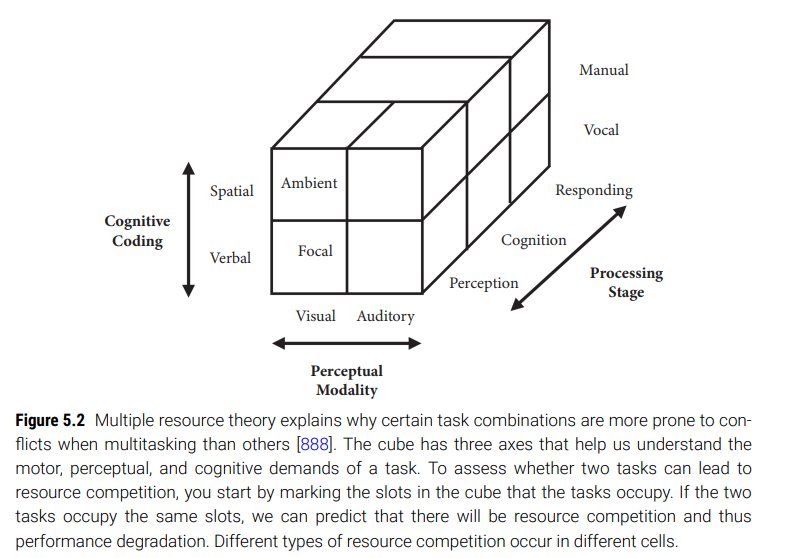
- To apply MRT, you mark all the segments that the tasks need, shown in the diagram as blocks.
- If two or more tasks occupy the same block, then conflict will emerge and reduce performance.
- In a case where there is a resource conflict, the brain must choose to allocate the resource to one of the two or more tasks.
- For example, imaging checking your phone for notifications while playing a video game.
- They both rely on visual cues, so there is a resource conflict.
- You can either ignore the notifications or disconnect from the game.
- Alternatively, you can spend a few seconds looking at your notifications and a few seconds playing the game.
- However, time is lost when switching between tasks and risk forgetting details of the task.
- Switching to another task for too long may also incur excessive costs.
- This is because the longer a user is prevented from working on a task, the longer it typically takes to resume that task later on.
- Cognition seeks to perform switches at natural breakpoints.
- It is easier and more efficient to postpone the switch to interruptions or natural boundaries.
- Uncertainty is a prevalent characteristic in almost all multitasking environments.
- Many tasks we need to complete in everyday life are dynamic.
- This means that tasks change on their own, even when we do not attend to them.
- At any given time we are not attending to them, we are uncertain about their state.
- The longer the interval, the higher the uncertainty.
Predictive Control
- When the task environment is dynamic, that is, changing on its own regardless of the user’s actions, cognitive control needs to be proactive.
- Instead of waiting to be triggered by the right stimulus, it needs to anticipate the need for a representation even before the event occurs.
- To enable this, the cognitive controller requires an internal model of the world.
- The internal model should be able to predict what might happen if an action were taken.
- This internal model should not determine actions, as perception is also important for choosing the correct action.
- One hypothesis about how we do this is called the Bayesian brain.
- The hypothesis states that the brain is a statistical estimator that assigns probabilities to hypotheses about the state of the world.
- As the brain receives new information, it updates the probabilities.
- The brain uses past information to anticipate new experiences.
Cognitive Workload
- Maintaining cognitive control is tiresome.
- It can be especially noticeable when we are taking in lots of new information, such as when learning a new software.
- Having to continuously decide what to do is mentally demanding, and doing this for an extended period of time can cause fatigue or stress.
- Users also often act under uncertainty and some level of risk, which further increases stress.
- The experience that follows from such effort and stress is called cognitive workload.
- The perceived workload can be measured with the NASA Task Load Index (NASA-TLX) which is a standardized questionnaire.
- Over time, with experience, people develop minimum effort task strategies.
- They are routines that diminish the perceived workload.
- Cognitive workload also reduces with automaticity, as users learn a skill and it becomes more automatic and effortless.
Memory and Learning
- Memory is critical in all aspects of daily life.
- We need memory to keep track of things, reason, recall, and recognize.
- According to dual process memory models, there are separate neural processes for conscious and unconscious remembering.
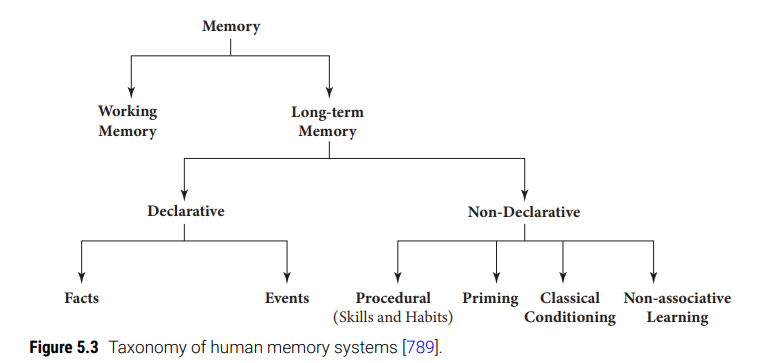
- Currently there are several types of memory that are recognized, each with different capabilities and use cases.
Working Memory (WM)
- Working memory refers to the temporary maintenance and manipulation of representations in the mind that are needed for action.
- We can only maintain a few items at a time in our WM.
- Early research suggested that our WM is limited to only two to six items at a time.
- This was initially known as Miller’s magical number 7±2.
- This means the average person can keep anywhere from 5 to 9 items in their WM.
- Generally when designing interfaces, designers try to stick to the lower end of this range so that the design is accessible to as many users as possible.
- Trying to hold more items in the WM can result in some of them being lost due to two main reasons:
- It would exceed the capacity of the WM.
- The items would not be actively rehearsed, which is needed to keep things in the WM.
- Access to the items fades quickly unless it is actively maintained.
- Currently, it is thought that the capacity of WM is even smaller than what Miller estimated, perhaps just three to five items in young adults.
- Most modern estimates give a number around 4±2, so ranging from 2 to 6 items at a time.
- WM is argued to not consist of memory “slots,” and its limits emerge due to the inability to maintain several active representations in associative memory networks.
- Thus items in WM are not fully “lost” when we stop rehearsing them.
- They just lose their active state and it becomes increasingly harder to reactivate them.
- We rely on WM for numerous tasks in daily life.
- It is also needed to juggle around interruptions and prevent them from completely stopping our workflow.
Long-Term Memory (LTM)
- LTM refers to memory systems that are responsible for using past experiences.
- Declarative memory refers to long-term memories that can be consciously experienced, or explicit memory.
- By contrast, non-declarative memory refers to implicit memories that affect our behavior without conscious recollection.
- For example, if you've ever struggled remembering the spelling of a word, you might have tried simply writing it out by hand.
- In such a case you're relying on your non-declarative memory of having written out the word numerous times.
Declerative Memory
- The declarative memory system contains the semantic and episodic subtypes.
- Semantic Memory (Facts)
- Responsible for propositional knowledge.
- It is fact based.
- For example:
- "Folders contain documents"
- "Doorknobs should be turned"
- Episodic Memory (Events)
- Can be thought of as mental time travel.
- It allows us to relive events from our past to inform a current similar situation.
- It is event based.
- For example, when printing, you might think about what you did last time you tried to print A3 size.
Non-Declarative Memory
- Non-declarative memory systems are further divided into procedural, priming, conditioning, and non-associative learning.
- Non-Associative Learning
- Refers to reflexes.
- Such as retracting the hand from a hot stove.
- Procedural Memory
- Refers to learned sequences of actions and thoughts.
- Instead of controlling actions one by one, the user can trigger them as a sequence.
- After extensive repetition, actions become associated to a larger extent, and the entire sequence is remembered as a whole.
- Priming
- Refers to the unconscious effect of previously seen stimuli on responses to subsequent stimuli.
- Priming has an important role in preparing us to respond in a manner appropriate to the given context.
- Contextual cues “prime” or make us more ready to give certain responses.
- Priming affects our readiness to act.
- (Classical) Conditioning
- Refers to the learning of actions that are triggered (conditioned) by the environment.
- Conditioning is an unconscious association between the environment (the cue) and the response.
- The strength of this association can be affected by reinforcement.
- Positive reinforcement is a reward given for desirable behavior
- Negative reinforcement is a penalty or punishment for undesirable behavior.
- When reinforcement is removed, a specific behavior can be inhibited and eventually removed.
- Conditioning is one mechanism that can be used for behavior change.
A Three-Stage View of Memory Functioning
- Both declarative and non-declarative LTM can be understood in terms of three stages organized in time:
Encoding
- Memory traces are formed during interaction.
- Encoding affects what we can remember later on.
- The type of encoding depends on how much attention is paid and how deeply we process information.
Storage
- The traces are retained between encoding and retrieval; some are forgotten.
- The levels of processing (LOP) effect refers to the association between the depth of mental operations carried out during the task and the strength of the encoded memory trace.
- The deeper you process something the better you remember it.
- Information that is just glanced at is encoded in a shallow way and quickly forgotten
Retrieval
- The traces are retrieved at a later stage.
- For example, when using the same user interface again.
- To retrieve a memory trace, we need some cue.
- The cue can be something you see, feel, or do.
- Depending on the type of cue available, three types of recall can occur.
- Free recall
- Refers to an attempt to retrieve a trace by self-generating cues without relying on externally presented cues.
- For example, when studying for a test you might ask yourself to repeat information you learned prior. This is often more difficult than being asked about that information in a question, where there is more context.
- Cued Recall
- RRefers to trace retrieval via external cues and is generally much easier than a free recall.
- Success depends on the cues.
- Recognition
- An extreme version of a cued recall where the whole object is presented instead of its part.
- Our visual recognition memory is amazingly good.
- You can easily recognize hundreds of faces but free recalling all of the names of those people would be very difficult.
- GUIs use similar and recognizable icons to take advantage of visual recognition.
Forgetting
- Between retrieval and encoding, memories can be lost.
- Not all memories are forgotten in the same way.
- Our encoding and forgetting processes adapt to the statistical structures of our environments.
- If all previous memories were competing for attention, we would have difficulties retrieving what we need.
- We need to forget in a way that keeps the most important memories available.
- Several theories explain some ways we may forget memories.
Decay Theory
- Memory traces lose their activation or strength over time.
- Events in the recent past usually have more pronounced importance for actions in the present.
- The more time has passed since a memory was activated, the less likely it is that it can be retrieved.
Interference Theory
- Memory traces get confused with each other.
- When we try to retrieve a memory trace, another (false) memory is activated at a similar level.
- Memories are not simply forgotten; they become mixed up.
Ecological theory
- Ecological theory suggests that human LTM evolved to help survival by anticipating the important events.
- It is evolutionarily important to remember things that are important for survival and thriving.
- The expected value of remembering it in the future should gain priority in how deeply something is encoded in memory.