What is Accessibility?
- One prominent definition of accessibility is given by ISO 9241-171, which defines it as:
- “The usability of a product, service, environment or facility by people with the widest range of capabilities.”
- Accessibility differs from usability, which is about the relationship between users, tools and tasks, and utility, which is about whether a tool may be used to complete a task.
- Accessibility aims to bring usability and utility to as many people as possible.
- There is a range of communities with accessibility issues.
- A comprehensive literature survey of accessibility research in HCI identified the following groups:
- Blind or low-vision,
- Deaf or hard of hearing
- Autism
- Intellectual or development disability
- Motor or physical impairment
- Cognitive impairment
- Older adult
- General disability or accessibility
- Other.
- However, each user manifests these factors at different degrees and in different combinations.
- The variety of disabilities, and understanding disabilities is a key challenge in accessibility research.
- There are many disabilities, and solutions that work for one community or a particular disability may not work for others.
- Users may also have multiple disabilities, resulting in more or stricter design requirements.
- Even the definition of a disability might be controversial.
- For example, the above list defines old people as disabled, framing it as a problem designs need to overcome.
- Is this really a correct perspective on aging? Or even towards actual disabilities for that matter?
Reasons for Designing Accessible Systems
Ethical Reasons
- Disabled people are people just like any other.
- It would be unethical to ignore their specific needs when designing.
Large Userbase
- When taking into account all disabilities, a large amount of the total population is disabled in one way or another, with some having multiple disabilities.
- According to the World Health Organization, over 1 billion people have some form of disability.
- To ignore accessible design would mean ignoring a very large userbase.
Legal Requirements
- Many jurisdictions require designs to be accessible to some degree.
- For example wheelchair accessible buildings mandated by law.
Improved Designs for All
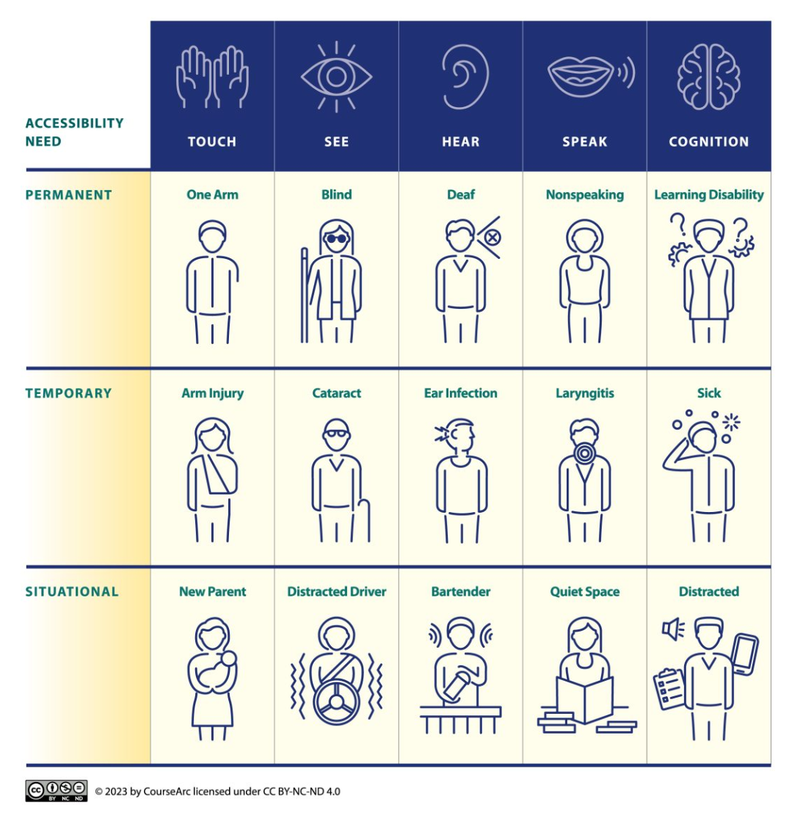
- When we think of accessible designs, we generally think of making designs that take into account those with physiological impairments.
- However, many non-disabled people can still have situational or temporary disabilities.
- Accessible design thus benefits all people by resulting in easier to use and more reliable designs.
Designing Accessible Interfaces
- A large survey on disability research in HCI identified three main strands of research:
- Increasing access to digital tools by offering users new forms of technology
- Understanding users’ needs, preferences, and abilities
- Increasing access to the physical world
- A significant proportion of HCI research is focused on arriving at technological solutions and designs for specific problems.
- Several approaches to accessibility design and research have emerged:
Ability-Based Design
- Involves adopting a design stance in which a design is specifically tailored to the end-users’ needs and abilities.
- Ability-based design thus requires a deep understanding of the target groups.
- Practices like co-design and action research may be used to involve users.
Inclusive Design
- A design method for ensuring products and services are usable by a very wide spectrum of users.
- Inclusive design is process-oriented and adopts, modifies, and extends several product design processes originating in engineering design.
- It advocates the use of specific methods and toolkits to achieve inclusivity, such as the inclusive design toolkit.
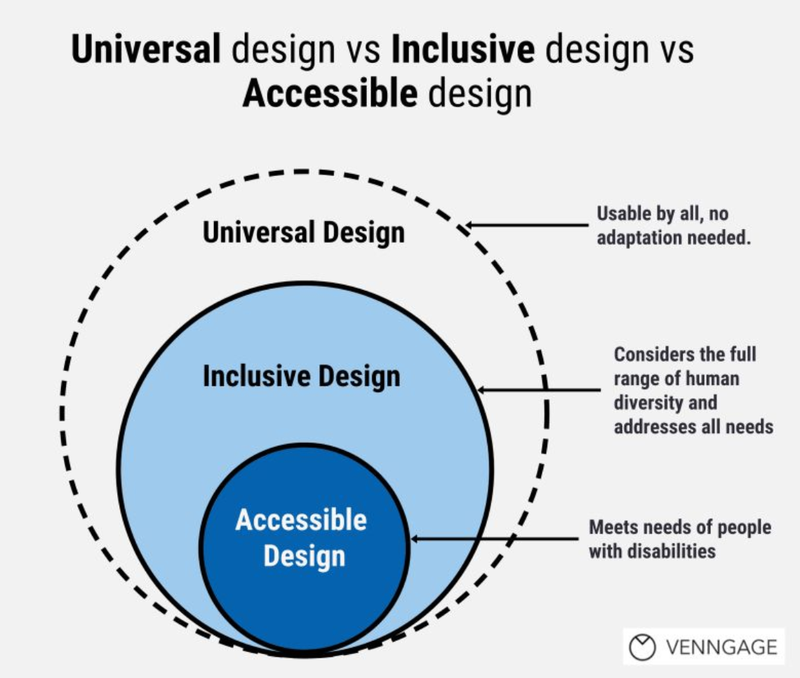
- An important aspect of inclusive design is obtaining accurate statistics on relevant characteristics of the user population.
- These parameters are then fed into various toolkits used by designers to ensure a wide range of users with varying abilities can be accommodated.
- For example height, grasping strength, or item capacity in working memory.
- Inclusive design is desirable because, when consistently applied, it ensures many widely used products and services can be used by as many people as possible.
- At the same time, there is often a limit to how broad a range of users a product or service can be designed to accommodate.
- For example, augmentative and alternative communication (AAC) is concerned with supporting nonspeaking individuals with motor disabilities.
- AAC users rely on speech-generating devices (SGDs) to communicate.
Designing Speech-Generating Devices (SGDs)
- SGDs vary depending on the needs and wants of the user.
- An illiterate AAC user typically relies on a symbol or picture-based interface.
- A literate AAC user enters letters, words, and sentences that are then communicated using speech synthesis.
- As AAC users rely on their SGDs, many aspects of this speech output are important, such as the tone and accent of the speech synthesis voice.
- For literate AAC users, many text entry mechanisms are available, such as physical keyboards and touchscreen keyboards.
- These ordinary keyboards are usually coupled with word, phrase, and sentence prediction tools intended to increase the text entry rate.
- Other SGDs may use muscle twitches such as eyebrow movements or eye-tracking with a digital keyboard instead of a keyboard for those with motor disabilities.
- Eye-typing is limited as it does not know whether a user is simply looking at a key or wants to type it out.
- This is known as the Midas Touch problem and is usually solved by making the key typed if the user fixates on it for some time. This makes speech very slow however.
- Modern advancements have helped eye-typing to be quicker and thus more efficient.
- Eye-typing is limited as it does not know whether a user is simply looking at a key or wants to type it out.
Tools Change how We Think and Percieve
- Using a tool for extended periods can fundamentally change the way a user thinks and perceives both the tool and the world.
- Using a tool for an extended period can result in the cognitive integration of the tool.
- Cognitive integration means that we internalize the operation of the tool.
- We not only act but also start thinking as defined by the unique constraints and mechanisms of the tool.
- Gestures and movements related to the tool change how we think of ideas and problems.
- It takes time to adapt and un-adapt from these changes in cognition.
- The second influence from using tools, is that it may change the way we perceive the world.
- The tool itself may become "transparent" and we start perceiving "through it".
- In philosophy, a tool is argued to be “ready-at-hand.”
- The tool itself is forgotten, and we construct percepts of the environment through it.
- For example blind people rely on canes to understand their environment.
- Research shows that sighted users, when given a cane, also used it in a similar way, resulting in them exploring their environment differently.
- However, tools can sometimes result on over-reliance and the degradation of our own skills.
- Galletta et al. warned against the effect of spell checkers on verbal ability.
- Having a spell checker in a word processing program may make users overly rely on the tool even if it makes several mistakes.
- After testing, they found that students with the spell checker tended to have more mistakes than those who didn't as the checker only fixed the most obvious errors.
- A similar situation occurs with navigation software.
- They remove the need for understanding a spatial representation of an area, maintaining a mental map, recognizing landmarks to orient oneself.
- This decrease in the need for spatial cognition also reduces our skill for it.
- Obviously this isn't permanent. Our brains are very adaptable and lost skills can be just as easily rebuilt.
- However, then next time you decide to consult an AI chatbot, think about which skills you might be giving up.
- Galletta et al. warned against the effect of spell checkers on verbal ability.
Sources
https://www.coursearc.com/accessibility-content-fundamentals/