Knowledge
Science and Beyond
- Scientists have shaped and defined our world.
- But science isn’t perfect, there are significant environmental and structural societal problems that cannot be solved by science alone.
- These are examples of wicked problems.
- Wicked problems are complex, multifaceted problems that are difficult to define, have multiple causes, and no clear solution.
- To grapple with wicked problems, we need to embrace non-scientific, and more creative and exploratory ways of thinking.
- The arts and humanities offer an alternative way of approaching problems.
- Artists, scholars and philosophers use the philosophy of interpretivism.
Interpretivism
- A philosophical position that opposes the positivism of natural science.
- An approach to research that emphasises subjectivity and interpretation.
- An alternative approach to logical positivism.
Logical Positivism
- A philosophical movement of the 20th century stressing linguistic analysis and rejecting metaphysical theories.
- An approach to research that emphasizes observation and logical analysis.
Scientism
- Scientism is an extreme offshoot of logical positivism.
- The opinion that science and the scientific method are the best or only way to render truth about the world and reality.
- Excessive belief in the power of scientific knowledge and techniques.
Making and Eggs
Tacit Knowledge
- Tacit knowledge is fundamental to our lives and used daily.
- It refers to the unconscious knowledge we can use in practice but cannot define when asked to recall it.
- Knowledge that is difficult to transfer to others through written or verbal communication and is often acquired through personal experience and intuition rather than formal training or education.
- For example, a recipe to make an omelette relies on tacit knowledge about knowing how to crack eggs, beat them, and add them to a pan on medium heat.
- Even then, many people make an omelette differently due to having different tacit knowledge on how an omelette is made.
- Tacit knowledge is often difficult to articulate and is specific to every individual.
- Through several processes we can work towards acquiring and understanding tacit knowledge.
- Experimentation
- Practice
- Trial and error
- Trying and failing
- Building and rebuilding
- Making and remaking
- Learning through doing.
- Through several processes we can work towards acquiring and understanding tacit knowledge.
Designing and Knowing
- Design is a very broad term.
- It can be:
- A practice
- An action
- A discipline
- A profession
- An artifact/thing
- A business
- It can be:
- In the business of doing design, designers generate value.
- Practical value
- Economic value
- Aesthetic value
- Social value
- In the process of doing design, designers also generate knowledge.
- This knowledge takes many forms.
- Design has the potential to change the world, but also to change ourselves and how we see and understand the world.
- Design encapsulates knowledge and through design we can explore different ways of knowing.
- Movements in the mid 1900s have attempted to distill design into a formulaic process.
- However recent designers recognize that more complex problems call for more exploratory approaches.
- In the 1980s, influential designer researcher Nigel Cross described this exploratory approach as being enabled by designerly ways of knowing.
- It includes skills such as:
- Abductive reasoning
- Forming a plausible explanation based on limited evidence.
- Synthesis
- The process of combining ideas to create something new.
- Reflection
- Honing insights through reflection and practice.
- Abductive reasoning
- It includes skills such as:
Design Thinking
- Design thinking attempts to resolve the ambiguities in design by distilling the design process into a formula, similar to older approaches.
- Design thinking has been greatly popular, although critics feel that by simplifying the design process into a series of steps, it limits the potential of design.
Design Research
The Cornucopia
- Also called:
- Critical design
- Speculative design
- Alternative design
- Research through design
- It is a creative/design process that results in new knowledge.
- Christopher Frayling splits design research into 3 main types:
- Research into design
- Research for design
- Research through design
- Christopher Frayling splits design research into 3 main types:
- Anthony Dunne and Fiona Raby published their manifesto, A/B, which positioned their critical design practices in relation to more classical understandings of design.
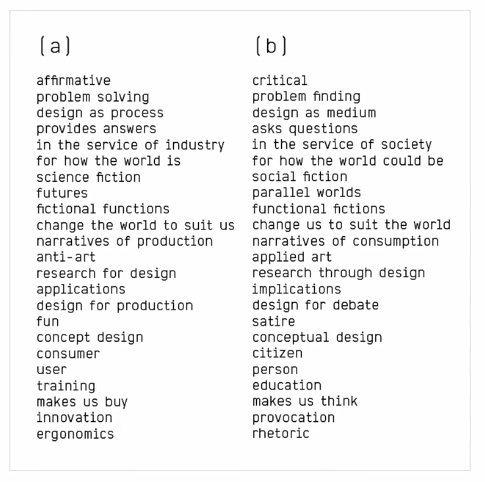
- While the B side has been widely used, both sides of the manifesto are important.
Permission to Muck About
- Research through design has been described as pre-paradigmatic.
- This means that efforts that might be spent doing it were instead spent debating it.
- Nowadays there are numerous organizations trying to answer questions about how design research is done, shared, reviewed, discussed and disseminated.
Night Science
- Even nowadays, science is often seen as a single monolithic entity whereas in reality it is fuzzy and rife with disagreements.
- Where science is systematic and formulated, the arts and humanities are much more intuition based.
- Francois Jacob, split science into day science and night science.
- Day science
- Systematic adherence to procedures and methods.
- Night science
- Journey of intuition where you imagine what is possible.
- Often where unique ideas and “eureka moments” occur.
- While the ideas might not be completely grounded or applicable, they are useful as the insights gained from night science are those not possible to acquire through strict logical thinking.
- Day science
- Exploratory thinking and trial and error can transform a wicked problem into a scientific problem that can be more easily addressed.
The Future
Evolution
- Even though designers don’t all agree on what design research is and how it should be done, design research can still be applied and built on.
- Design research is ‘nomadic’.
- A nomadic approach means that designers deeply engage with areas outside of design.
- Design research doesn’t have to be unempirical, unmethodical or unrigorous.
- Empirical
- Based on, concerned with, or verifiable by observation or experience rather than theory or pure logic.
- Method
- A particular procedure for accomplishing or approaching something, especially a systematic or established one.
- Rigorous
- The quality of being extremely thorough and careful.
- Generally uses established or detailed methods.
- Valid
- The quality of being logically or factually sound.
- Empirical
- Design research works on a different theory of knowledge, which means two researchers can answer the same question completely differently.
- Pragmatism
- An approach that evaluates theories or beliefs in terms of success or their practical application.
- A philosophical tradition that views language and thought as tools for prediction, problem solving and action, rather than describing, representing or mirroring reality.
- Pragmatism allows for flexibility and researching without limiting oneself to a commitment.
- Iteration
- In a design context, a cyclical process of prototyping, testing, analyzing and refining a product or process.
- Based on the results of testing the most recent iteration of a design, changes and refinements are made.
- Pragmatism
- Design research projects often start with an exploration and drift outwards into different areas and answer different types of questions.
- Unlike traditional research papers, design research doesn’t often lead to a concrete answer to a single question.
- Individual design research projects might only produce intermediate understandings.
- However, numerous design research projects can come together to form a research programme which can give a new kind of understanding of the world.
- Design research is ‘inclusive’
- Design research can include community members and learn in ways that traditional research might not be able to.
- Design research allows designers to remove the social boundaries of being an academic and allows them to connect with communities and people on their level.
- Designers can also explore freely and “muck about”, without being limited by methods and structures.
Inventing the Future
- Design researchers all over the world are imagining better futures and drawing from and learning about science and engineering, insights from theory, traditions, scholarship, tacit knowledge from people and communities, lenses of intuition, creativity, art and design.
- However, design research is still stifled by scientism and the traditions of the industry and the academy.
- Science can’t tell us everything, and art should be valued as it is.
- Design research should be something that is accessible to everyone and free from limitations.
Sources