What are Waves?
- A wave is a movement of energy, as energy travels from one place to another.
- Thus a wave that makes energy travel is called a "travelling wave".
- The transfer of energy by waves is called the propagation of waves.
Models of Mechanical Waves
- Mechanical waves involve the oscillation of masses.
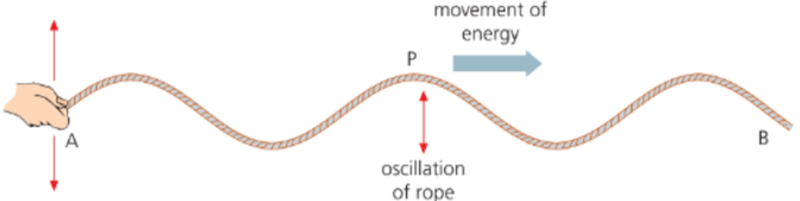
- Mechanical waves rely on the movement of particles, and thus require a substance to pass through in order to exist.
- This is called the medium of the wave.
- This is also why mechanical waves cannot occur in a vacuum, as there is no medium for them to travel through.
- For example, you cannot hear sound in space, as there is no medium for sound waves to travel through.
- You can imagine mechanical waves as transfer of energy through collisions for example, except now there are millions of tiny particles instead of just one or two bodies.
- As they all bump into one another, they transfer their energy, causing the wave to move forward.
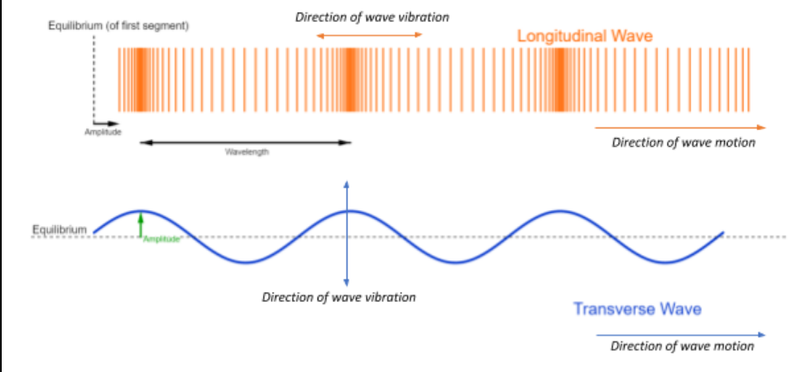
- Mechanical waves can either be transverse, or longitudinal.
Transverse Waves
- In a transverse wave, particles oscillate up and down, creating a motion that looks like wave.
- Imagine a singular particle going up and down, like how a person in their seat can sit down and raise their hands.
- On its own it doesn't look like much, but when a lot of particles are moving in unison, then it starts to look like a wave, just like how a bunch of people raising their hands in a stadium looks like a big wave!
- This tiny particle, and thus all the particles together, are moving in simple harmonic motion!
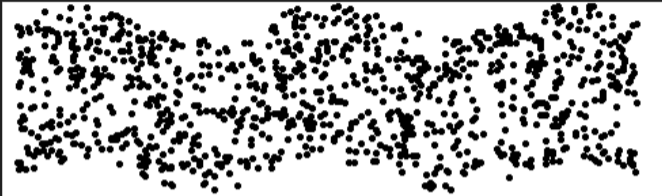
- Displacement is perpendicular to the direction of the wave.
- A transverse wave has maximum and minimum points, depending on the
Longitudinal Waves
- In longitudinal waves, the oscillation is along the wave, which means that particles move back and forth.
- Imagine a singular particle moving back and forth.
- On its own it doesn't look like much, but when a bunch of particles are moving back and forth together, it starts to look like a wave!
- Just like transverse waves, each particle is moving in simple harmonic motion.
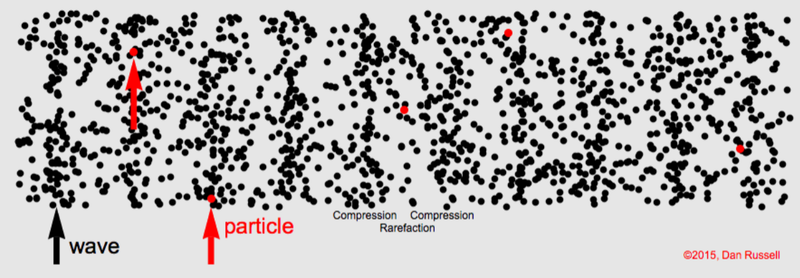
- Displacement is parallel to the direction of the wave.
- Areas where particles are densely packed together is called a compression, and areas where particles are less tightly packed is called a rarefaction.
- Compressions occur when a particle's displacement is the highest, as many particles move away from their equilibrium point and meet up at the compression ahead.
- It is similar to a maximum points in transverse waves.
- Rarefactions occur when displacement of a particle is the lowest, as particles move away from their equilibrium and meet up at the compression behind them.
- It is similar to a minimum points in transverse waves.
- Check out this link for a great visualization of Mechanical Waves.
Describing Waves
- Several terms can be used to describe all types of waves.
- These are similar to the terms used in simple harmonic motion.
Wavelength
- Wavelength, λ, is the distance between two adjacent crests of a wave.
- It is the shortest distance between two points moving in phase.
- Wavelength is measured in meters and can be found by finding the distance between two corresponding points on a wave.
- Generally, it is easiest to look at maximum and minimum points, although any two points in phase would work.
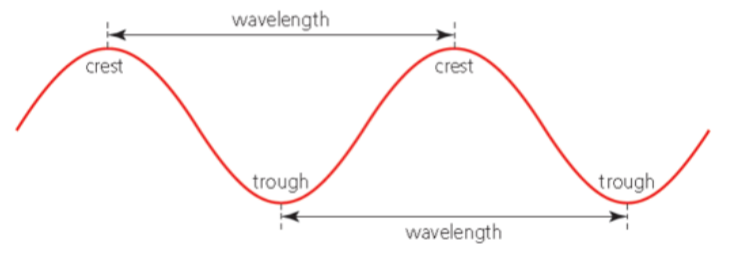
For a longitudinal wave, the wavelength is the distance between consecutive rarefactions or consecutive compressions.
Period
- Period is the time taken for one complete wave to pass a point.
- It is written as T and is measured in seconds.
- Similar to simple harmonic motion, period is the distance between two points in phase in a displacement-time graph, where time is the x-axis.
Wave Speed
- Wave speed is the speed at which energy is transferred by a wave.
- It is written as v and is measured in meters per second.
Wave Equation
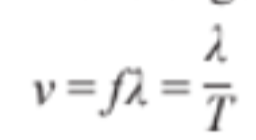
- Wavelength is measured in meters and is the distance between the end points on one cycle of wave.
- Frequency is measured in the reciprocal of seconds, s⁻¹, and is the amount of cycles completed in a second.
- The product of wavelength and frequency gives us ms⁻¹, and thus the wave speed.
Representing Waves Graphically
- Waves can be represented by displacement-position or displacement-time graphs.
- They both have similar sinusoidal shapes, except displacement-position graphs can show wavelength, and displacement-time graphs show the period.
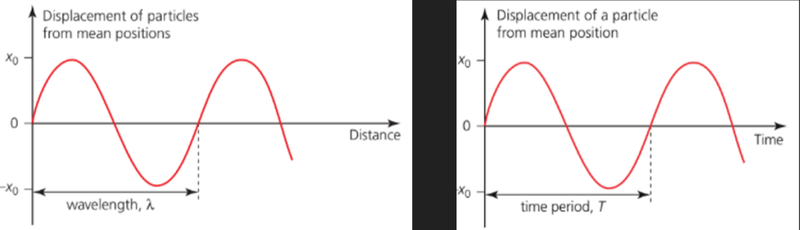
- Both graphs can show the amplitude, which is the difference between the minimum or maximum point, and the x-axis, which is zero.
Sources
https://www.acs.psu.edu/drussell/demos/waves/wavemotion.html