Time Dilation
- Time dilation is the phenomenon of time passing slower for an observer who is moving relative to another observer.
- Time is observed to be slower for an object moving relative to the observer.

- Imagine one observer on a spaceship, traveling close to the speed of light, and another observer standing still on Earth.
- Both hold stopwatches in their hands.
- The observer on the ground sees that their stopwatch is moving normally, but the stopwatch in space is moving slower.
- The same occurs the other way around, as the observer on the spaceship observes time to be continuing normally for themselves, but slower for the observer on Earth.
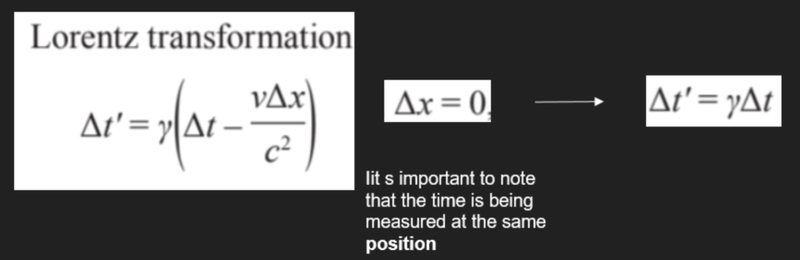
- Lorentz transformation equations can be used to calculate the degree of time dilation.
Length Contraction
- Length contraction, L, is the shortening of a measured length of an object moving relative to the observer's frame.
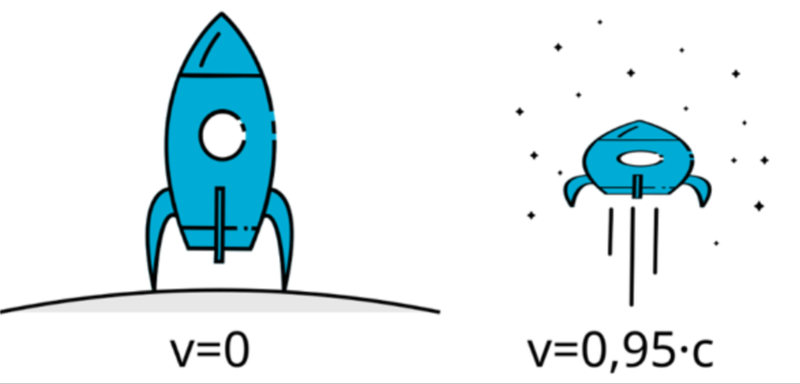
- For example, an observer on the ground would measure a rocket ship moving at 0.95c to be a lot shorter than if it were stationary on the ground.
- The same occurs the other way around.
- For an observer on a moving in the rocket, it is the observer on the ground that is moving relative to the.
- The observer in the rocket would measure the length of the stationary observer as shorter.

Muon Lifetime Experiment
- The muon-decay experiments provide experimental evidence for time dilation and length contraction.
- Muons are unstable particles that have a very short mean lifetime of about 2.2 microseconds before they decay into other particles.
- In this lifetime, they should not be able to reach the Earth's surface without going faster than the speed of light.
- Yet scientists are able to record muons reaching detectors on the surface of the Earth.
- From our reference frame, this is impossible.
- However, from the reference frame of the muons, the distance they travel is much shorter and the time taken is a lot less, allowing this to occur.
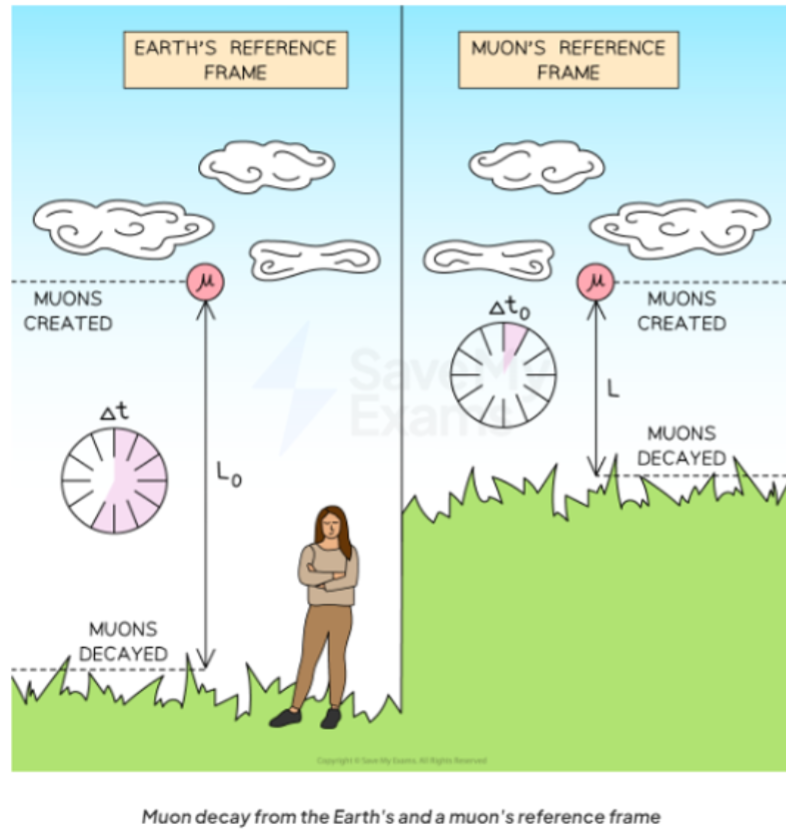
- From the muon's reference frame, the distance between the upper atmosphere and the surface of the Earth undergoes length contraction.
- This is because the muons are moving very quickly relative to the atmosphere.
- This shorter distance allows the muons to reach the Earth's surface.
- From the reference frame of scientists on Earth, the upper atmosphere and the surface of the Earth is measured as the proper length.
- This is because there is no relative motion between the scientists and the atmosphere.
- From the muon's reference frame, the lifetime of the muons is measured as the proper time, 2.2 microseconds.
- From the scientists' reference frame, the lifetime of the muons undergoes time dilation.
- This longer time allows the muons to reach the Earth's surface, as it appears that they are travelling for longer than they are from the muon's reference frame.
Space-Time Interval

- Δs is called the space-time interval.
- Different inertial observers may measure different time intervals and different distances between events, but they will agree on the space-time interval between events.
- We know that an event that is measured to have coordinates (x, t) in the S reference frame can have different coordinates (x', t') in the S' frame of reference.
- But both observers in both reference frames will agree that the space time interval is equal.

Space-Time Diagrams
- Space-time diagrams plot the movement of objects on two axes of distance.
- They help visualize:
- Time dilation
- Length contraction
- Simultaneity
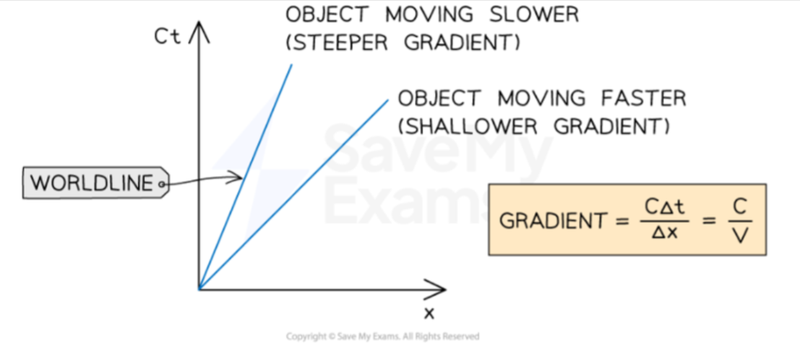
- This gives the spacetime diagram.
- Lines drawn on a spacetime diagram are called world lines.
- Instead of the usual distance-time graphs, both axes are dimensions of length.
- The horizontal axis is x.
- The vertical axis is c*t.
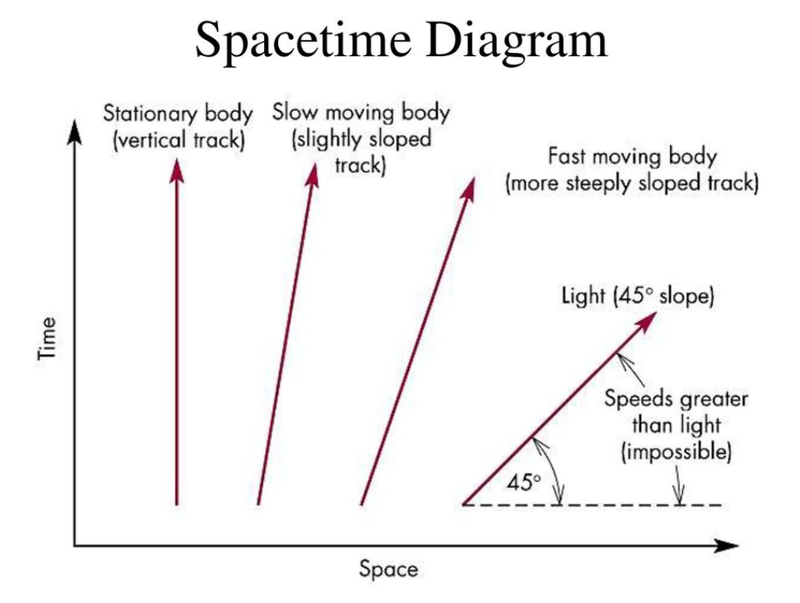
- The faster an object moves, the more its slope decreases, with stationary objects having an infinite slope.
- Stationary objects only move in time, not in space, so x is constant.
- A worldline at constant velocity has a gradient steeper than 1.
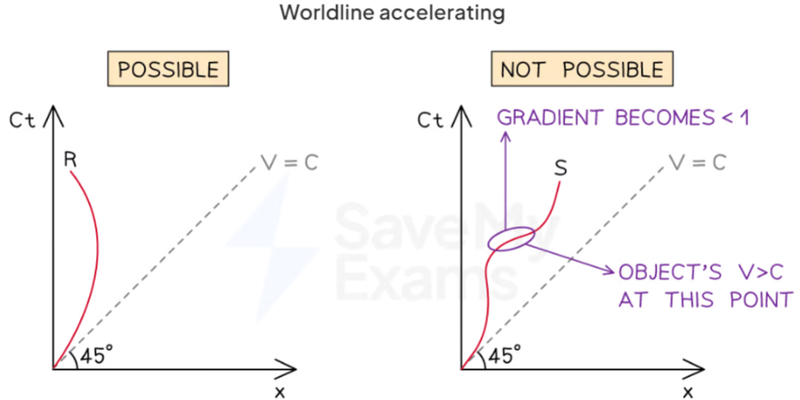
- Only light has a gradient of 1, and nothing can have a gradient less than 1.
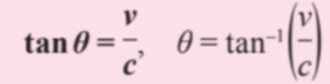
- The angle between the worldline and the x-axis, θ, can be used to determine the velocity of the worldline.
- Even for accelerating objects, the worldline can never have a gradient steeper than 1.
Multiple Reference Frame Diagrams
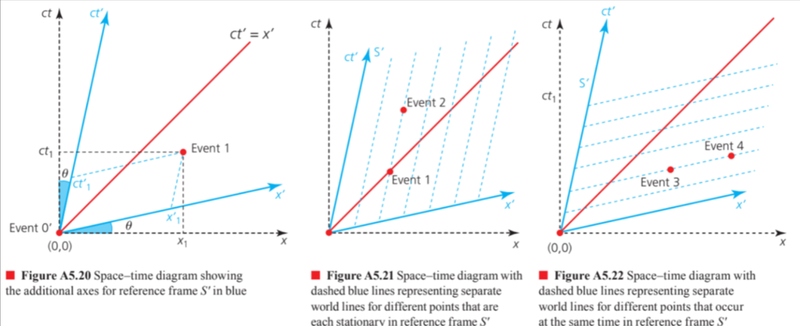
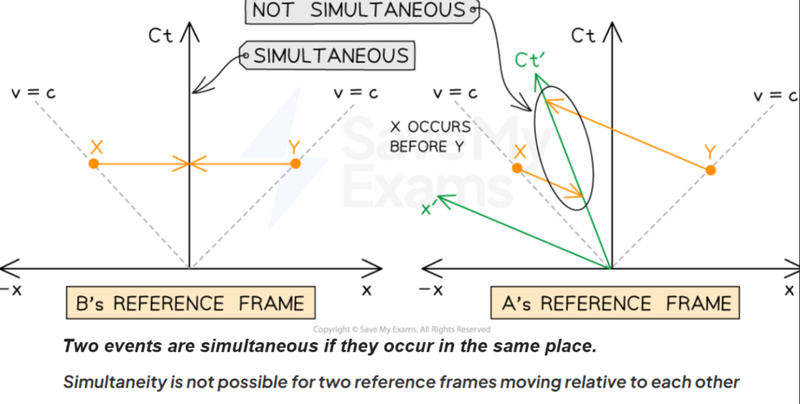
- While one spacetime diagram can only show the perspective of one reference frame, multiple spacetime diagrams can be used to show how different events appear from the perspectives of multiple reference frames.
- A spacetime diagram can show that two reference frames are simultaneous if they are equal distances apart from the y-axis.
- It does not matter whether the distance is positive or negative, only the magnitude is considered.
Time Dilation on Spacetime Diagrams
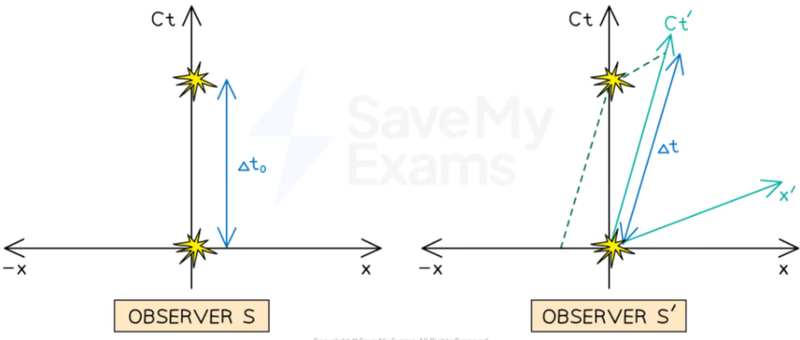
- Spacetime diagrams can also show time dilation in the y-axis.
- In the diagrams below, the observer S is stationary, and notices no time dilation for the flash.
- Observer S' is moving, so the flash appears to occur later than it does for observer S.
Length Contraction in Spacetime Diagrams
- Spacetime diagrams can also represent length contraction in the x-axis.
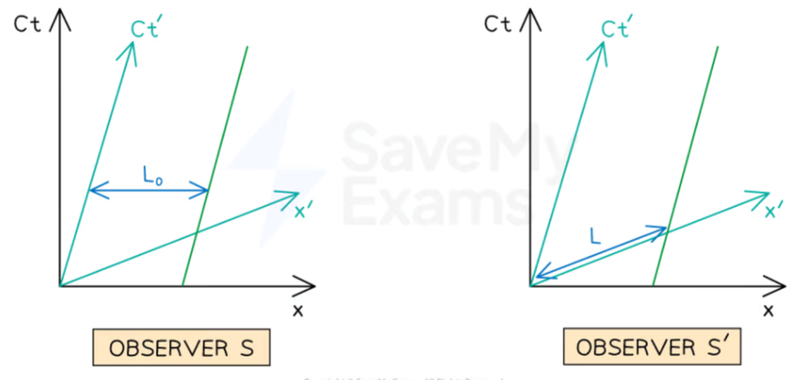
- Observer S notices no length contraction between 2 events so the observed length is parallel to the x-axis.
- Observer S' notices length contraction so the length observed is parallel to x'.