What is Galilean Relativity?
- Imagine a sailor on the crow's nest of a boat.
- If the sailor were to drop a ball, it would accelerate downward, but keep the initial horizontal velocity.
- As long as the boat isn't accelerating, the ball will fall down with the same horizontal velocity as the boat.
- According to Galileo, there is no way the sailor could identify whether or not the ship was moving by looking at the falling ball.
- The sailor could only determine whether or not the boat was accelerating.
- Newton's laws of motion are the same in all inertial reference frames.
- The idea that Newton's laws of motion remain unchanged in all inertial reference frames is known as Galilean relativity.
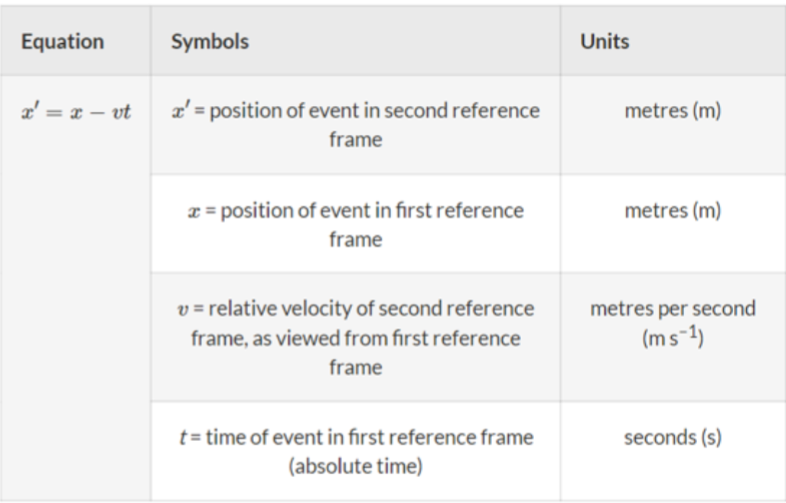
- This results in several equations we can use to determine the properties of objects moving in Galilean relativity.
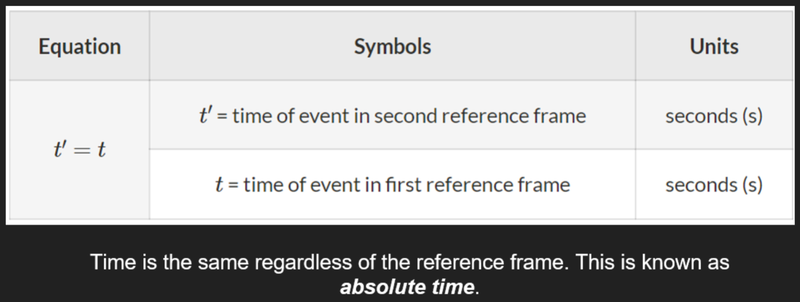
- t' is generally attributed to the "moving" or faster reference frame.
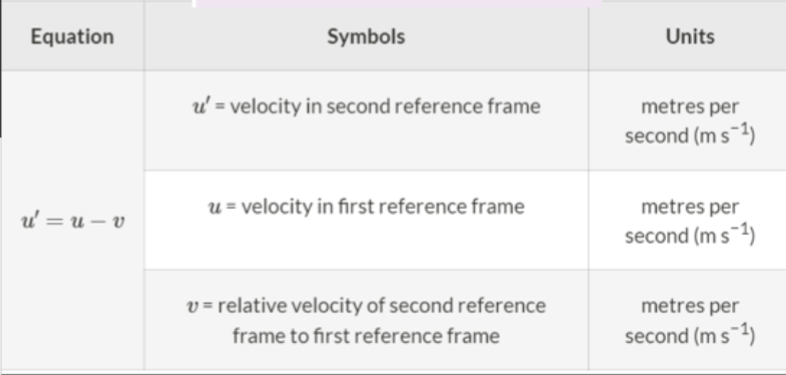
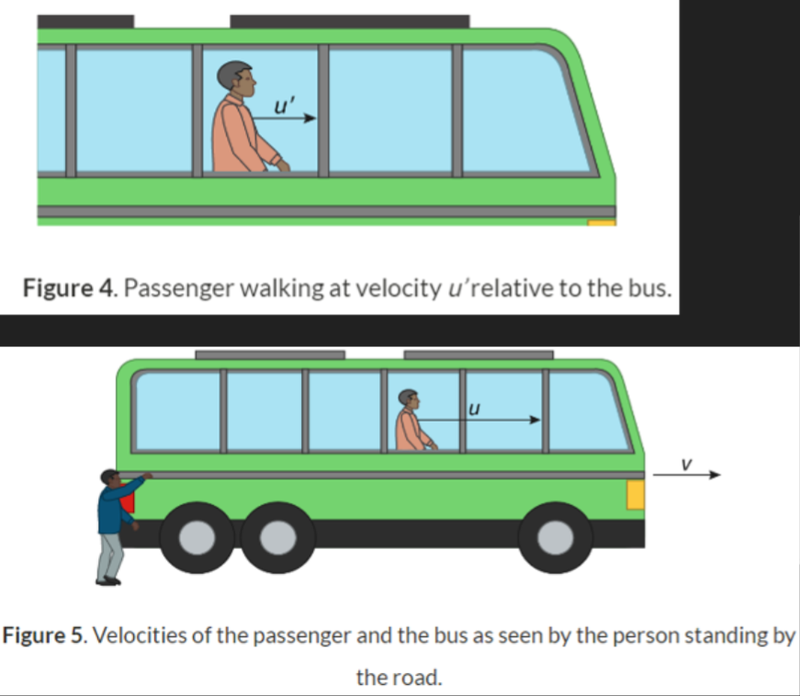
- Velocity addition is an equation which connects the velocities of the same object as observed in two different reference frames.
Limitations of Galilean Relativity
- Galilean relativity cannot be applied under all circumstances.
- Consider the Galilean velocity addition equation applied to light.
- If a beam of light was sent forward by a passenger on a train they would correct record the speed of light as leaving them to be c, where c is the speed of light.
- But using the Galilean velocity addition equation, we would find that an observer standing next to the train would record the speed of light as u' = c + v, where v is the speed of the train.
- This would result in u' > c, which is impossible as nothing can be faster than the speed of light.
- Thus we can determine that velocity addition only works with speeds much lower than the speed of light, c.