Star Stability
- The Earth orbits the Sun because of the gravitational force of the Sun on the Earth.
- The Sun is many times larger than Earth and has a much greater gravitational force.
- However, if the gravitational force of the Sun is so great, why does the Sun not collapse in on itself?
- The Sun is not a solid but a plasma with extremely high temperatures.
- It does not collapse in on itself because there is not a force imbalance.
- Otherwise, a force imbalance would have caused the Sun to contract over time as the gravitational force pulled the outer layers of plasma inwards.
- The force counteracting the gravitational force is produced by nuclear fusion reactions in the core of the Sun.
- This situation is called stellar equilibrium.
- Stellar equilibrium occurs in a star when the outward radiation (thermal) pressure is balanced by inwards gravitational forces.
Fusion in Stars
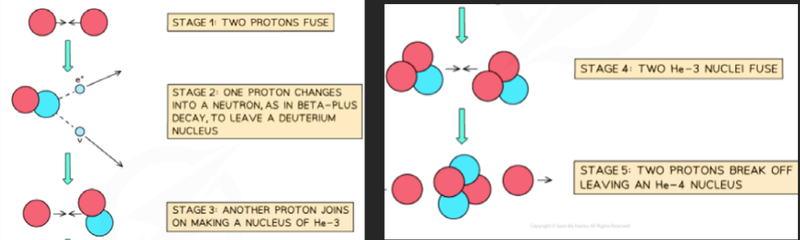
- In the center of a stable star, hydrogen atoms undergo nuclear fusion to form helium.
- A huge amount of energy is released in the reaction.
- This provides a radiation pressure that prevents the star from collapsing under its gravity.
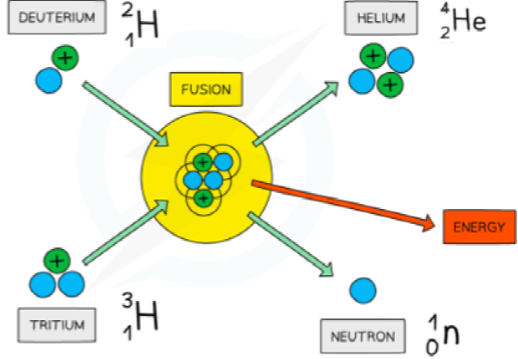
- The total mass of the helium nucleus is less than the total mass of the individual nucleons.
- Hence the reaction releases energy, which provides fuel for the star to continue the burning.
Conditions for Fusion
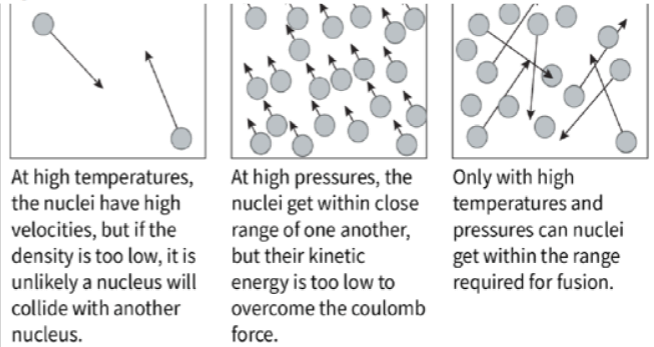
- For nuclear fusion to occur, both nuclei must have sufficiently high kinetic energy to overcome the electrostatic repulsion between protons.
- The conditions required to achieve this are:
- Very high temperatures.
- On the scale of 100 million Kelvin.
- Very high pressure and density.
- Very high temperatures.
- Main sequence stars are stable stars which are fusing hydrogen atoms into helium in their cores.
- Our Sun is a main sequence star, for example.
Life Cycle of a Star
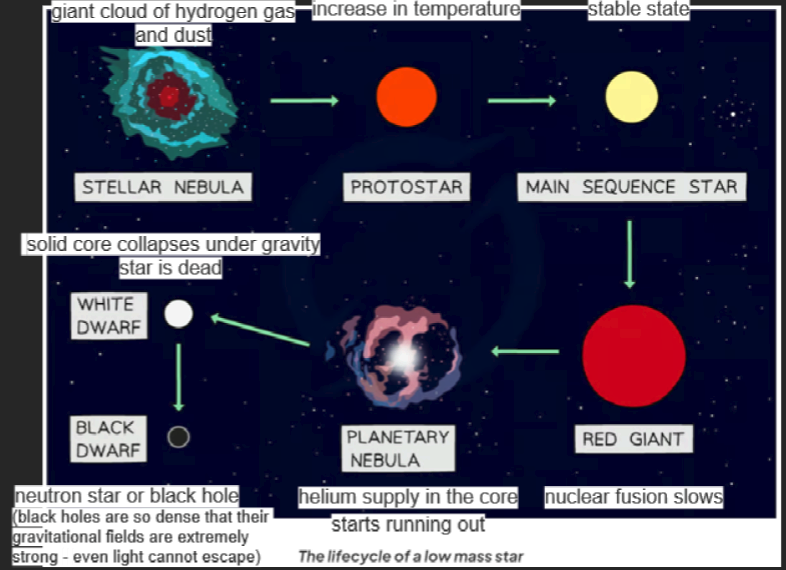
- The lifetime of a main sequence star is the duration for which a star is fusing hydrogen into helium, emitting radiation and maintaining stellar equilibrium.
- The rate of fusion in more massive (hotter) stars is so much greater that they have significantly shorter lifetimes.
Comparing Main Sequence Stars
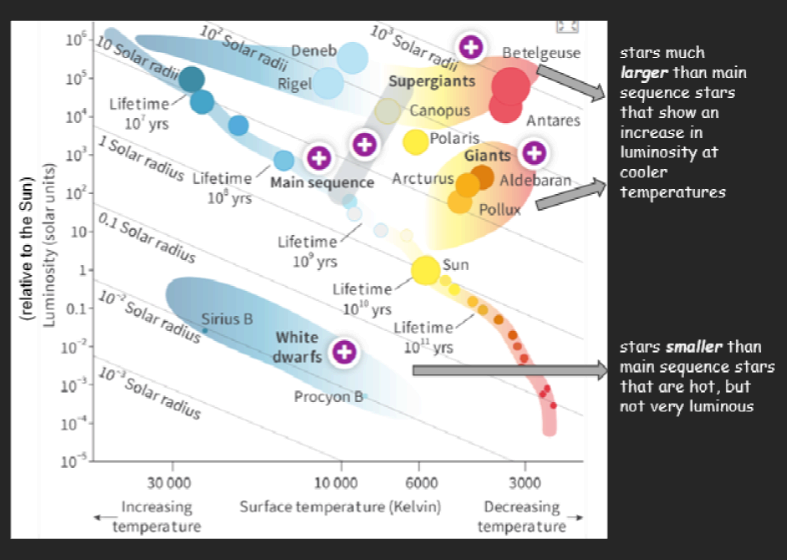
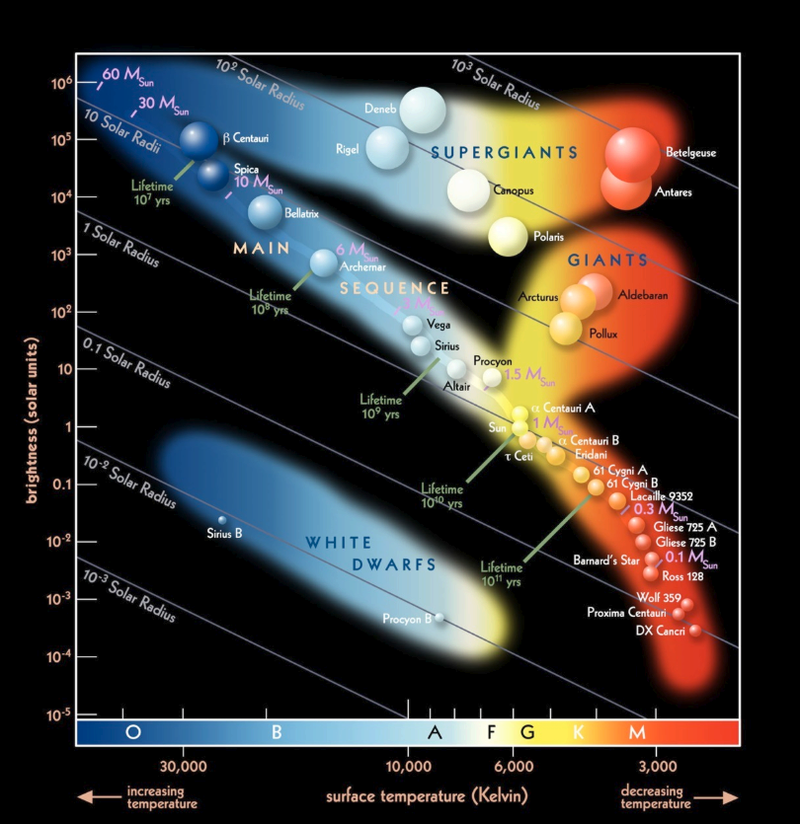
- The Hertzsprung Russel (HR) diagram plots the luminosity of stars onto their temperature.
- Certain regions of the graph are classified into specific types of stars where they form clusters.
- Most stars are clustered in a band called the main sequence.
Radius of a Star
- We can use the HR diagram to determine the radius of a star.
- This is done by combining the Stefan-Boltzmann equation for luminosity with the area of a sphere.
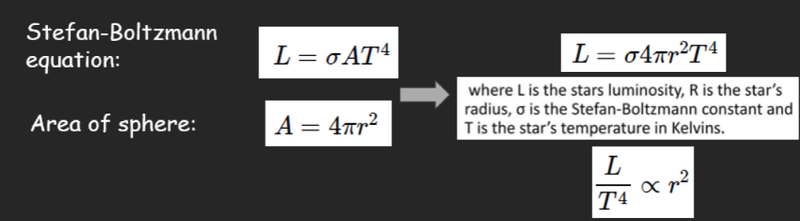
- The gradient of the HR diagram gives us a way to measure the radius of a star.
- On the HR diagram, the gradient is shown as lines of a constant radius.
Sources
https://chandra.harvard.edu/edu/formal/variable_stars/HR_student.html