Understanding the Evolution of Stars
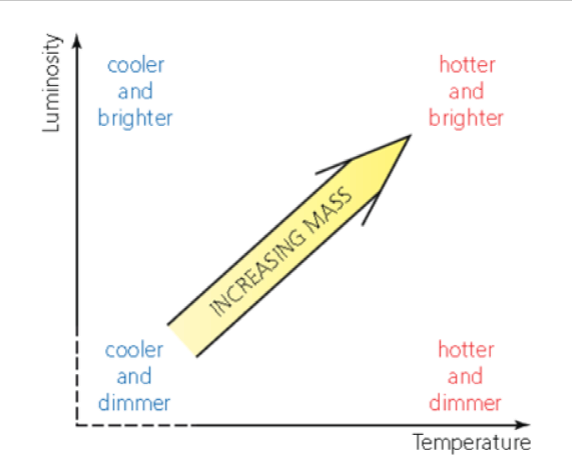
- Mass has a considerable effect on luminosity.
- For example, if star A has twice the mass of star B, it will have approximately ten times the luminosity.
- The graph below indicates the general trend between mass and luminosity.
Stellar Evolution
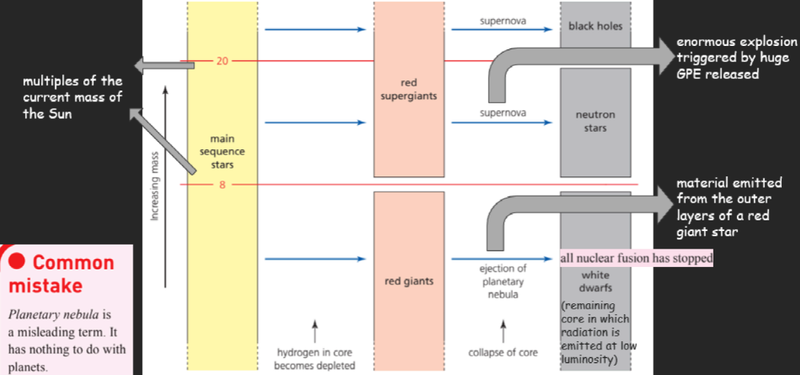
- Stellar evolution describes what happens to stars after the depletion of hydrogen in their cores.
- This occurs after the end of the main sequence lifetimes.
- The core begins to contract.
- Inwards gravitational forces are greater than outwards radiation pressure.
- The temperature rises significantly.
- Gravitational potential energy is again transferred to the kinetic energy of the nuclei in the core.
- Therefore, the fusion of hydrogen is caused by the outside of the core.
- The rate of fusion in the shell becomes greater than in the core.
- The resulting increased radiation pressure produces a significant expansion of the star.
- The star transforms into a red giant or red super giant.
- What happens afterwards depends on the mass of the star.
- Red giant stars and super giants are formed by the increased rate of nuclear fusion that occurs because of the greater temperatures created in the collapse of main sequence stars at the end of their lifetimes.
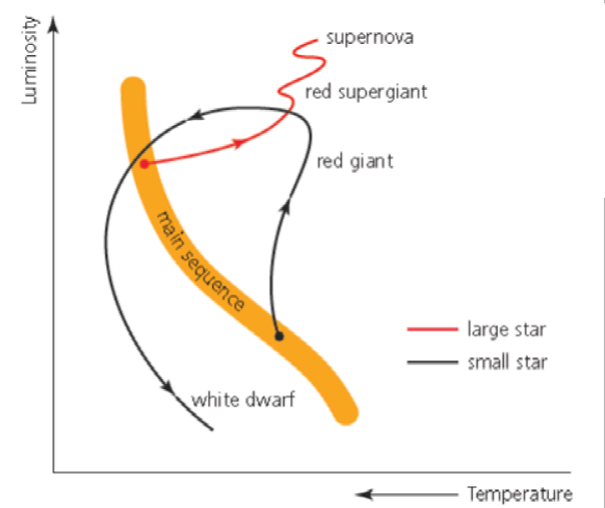
- The evolution of stars can also be seen on an HR diagram.
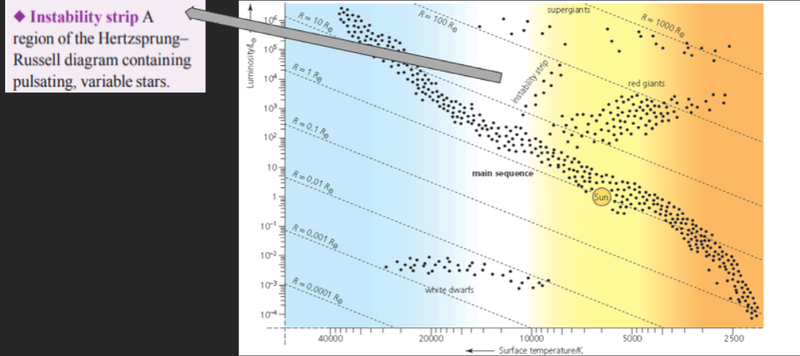
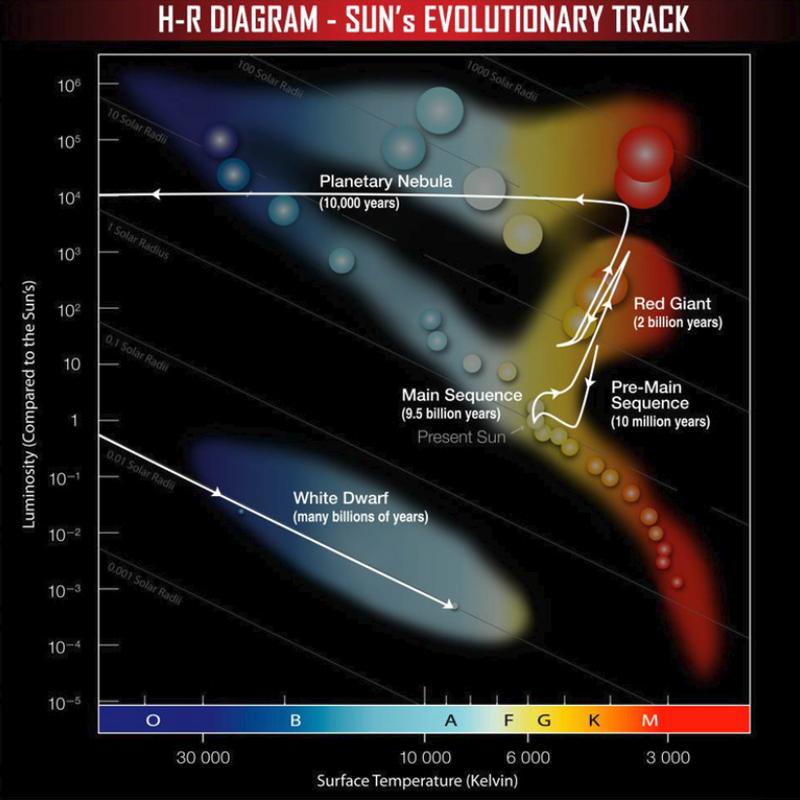
- The evolutionary part of a star shows the evolution of a star as drawn on the HR diagram.
- Throughout its evolution, the star will move to different points on the diagram.
Sources
https://chandra.harvard.edu/edu/formal/variable_stars/HR_student.html