Astronomical Unit Conversions
- Because distances between astronomical objects are so great, different units are used.
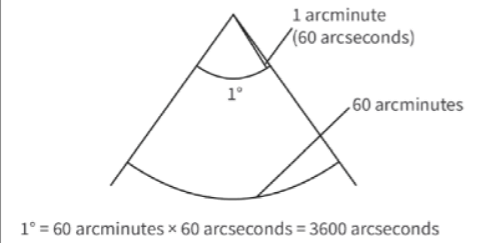
- Angles between astronomical objects that are smaller than 1 degree can be measured in arcminutes or arcseconds.
- Just like how an hour has 60 minutes and 3600 seconds, one degree has 60 arcminutes and 3600 arcseconds.
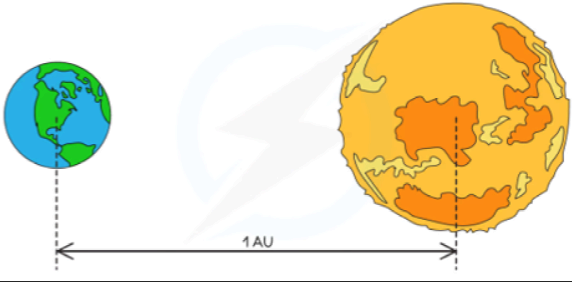
- For distances, astronomical units, given as AU, are used.
- One AU is the mean distance from the center of the Earth to the center of the Sun.
Parallax Method
- The apparent movement of the nearby star is called the stellar parallax.
- We use the idea of parallax to find the distance to other stars in our galaxy.
- Parallax is caused by objects further away moving in smaller distances relative to objects closer to us.
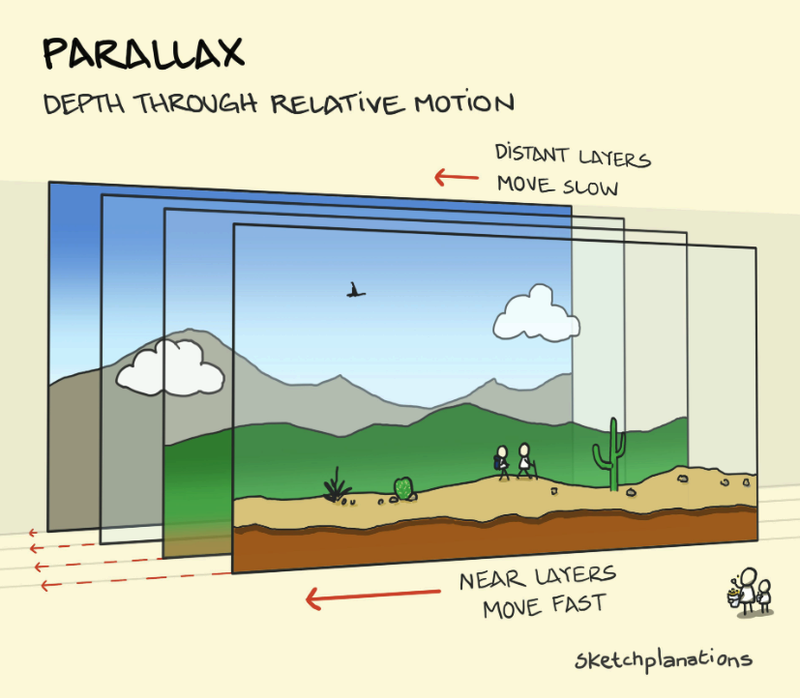
- As the Earth is moving in orbit around the sun, the position of a far away star from our perspective can be used to determine its distance.
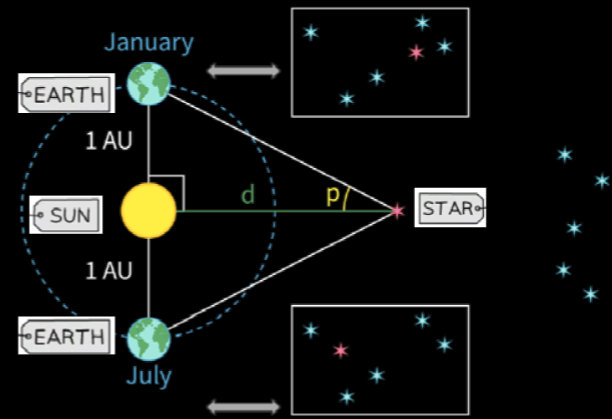
- The two boxes in the image above show the view of the stars from Earth in January and July respectievely.
- Notice that the position of the nearby star changes relative to the more distant stars.
- The parallax angle (measured in arcseconds) is labeled p.
- Stellar parallax is defined as the apparent shifting in position of a nearby star against a background of distant stars when veiwed from different positions of the Earth, during the Earth's orbit about the Sun.
Parsecs
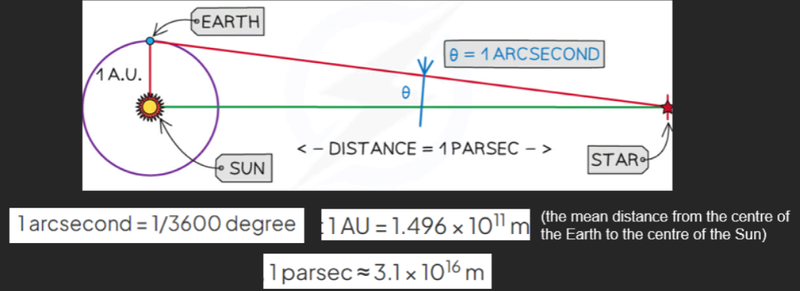
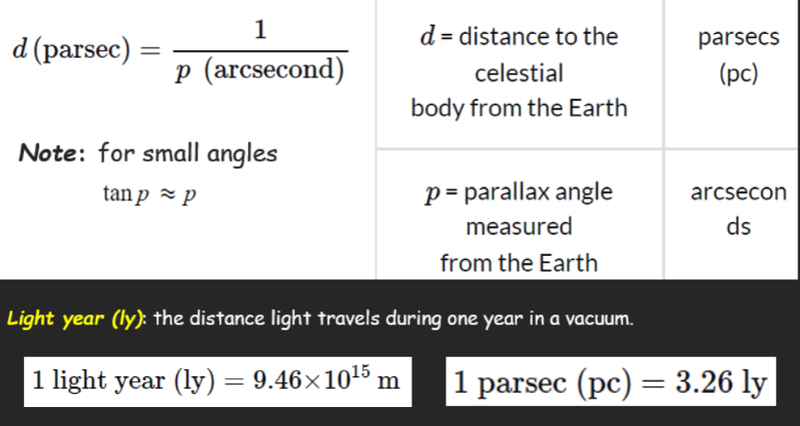
- Parsecs, denoted as pc, are a unit of distance that gives a parallax angle of 1 arcsecond, using the radius of the Earth's orbit (1 AU) as the baseline of a right-angled triangle.
Advantages and Disadvantages of Stellar Parallax
Advantages
- Very eas method of calculating distance to stars.
- Can be very accurate when using a satellite and for close objects.
Disadvantages
- When the angle is very small for far away objects, the accuracy of the calculated value is lower.
- Does not work at large ranges.
- Currently a 10,000 pc maximum.
- Due to atmospheric distortions, it is not a good method of calculation from the Earth for stars further away than about 100 parsecs.
Age of an Expanding Universe
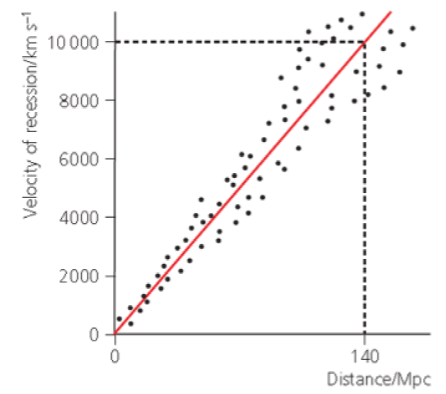
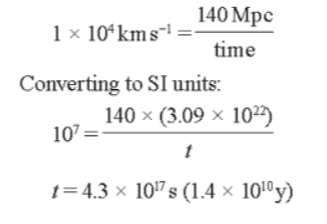
- Assuming that all the stars began moving at the time of the Big Bang, an estimate for the age of the Universe can be determined from the gradient of the graph below, by a use of the simple formula: velocity = distance/time.
Sources