What are Chain Reactions?
- Chain reactions are self-sustaining nuclear fission because each fission causes further fission.
- Note that the splitting was triggered by a single neutron that had just the right energy to excite the nucleus.

- Also during the split, two more electrons were released.
- If each of these neutrons splits subsequent nuclei, then a chain reaction occurs, as each splitting nuclei will cause yet more reactions.
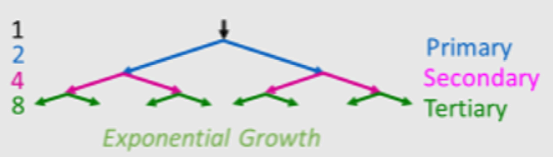
- Chain reactions will not normally occur.
- In order to maintain the chain reaction in uranium, the concentration of U-235 in the uranium fuel has to be high enough.
- Fuel-enrichment is the process of increasing the concentration of U-235, which is the fissile isotope in uranium fuel.
- This allows for the fuel to sustain chain reactions.
- In addition, the neutrons will disperse in random directions.
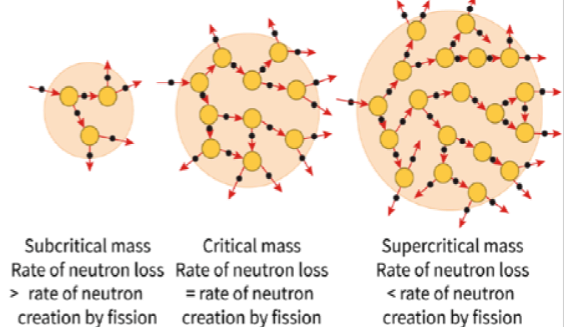
- If the amount of fissile isotope is too small, then not enough of the neutrons will be absorbed to sustain the chain reactions.
- Critical mass is the minimum amount of the fissile isotope needed to sustain a nuclear chain reaction.
Operation of a Nuclear Reactor
- Nuclear reactors rely on chain reactions in radioactive fuels such as uranium or thorium to generate energy.
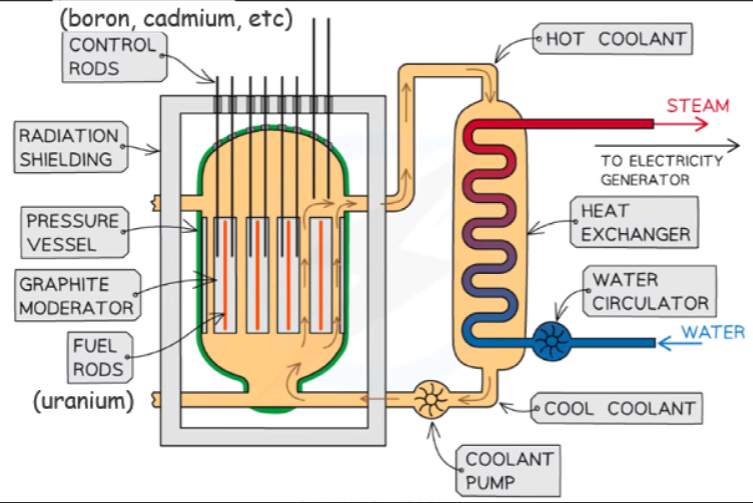
- Two factors must be controlled:
- Number of the free neutrons in the reactor
- Energy of the free neutrons
- The main components of the nuclear reactor are:
- Control rods
- Moderators
- Heat exchangers
- Shielding
Energy Transfers of a Nuclear Reactor
- Nuclear energy in the fuel
- Kinetic energy of fission products
- Internal energy of water and steam
- Kinetic energy of steam
- Kinetic energy of turbines and coils
- Electrical energy
Fuel Enrichment
- Fuel enrichment is increasing the percentage of uranium-235 in uranium fuel in order to make it of use in a nuclear power station.
Control Rods
- For a chain reaction and power generation, the percentage of uranium-235 has to be increased to around 3% to 5%.
- The purpose of a control rod is to absorb neutrons.
- The number of neutrons absorbed in controlled automatically by varying the depth of the control rods in the fuel rods.
- Lowering the rods further decreases the rate of fission, as more neutrons are absorbed.
- Raising the rods increases the rate of fission, as fewer neutrons are absorbed.
Moderators
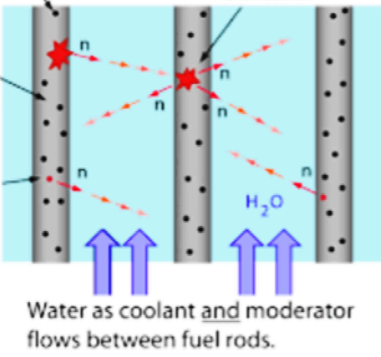
- The purpose of a moderator is to slow down neutrons.
- The moderator is a material (usually water) that surrounds the fuel rods and control rods, and is a poor absorber of neutrons.
- The fast-moving neutrons produced by the fission reactions slow down by colliding with the molecules of the moderator, causing them to lose some momentum.
- The neutrons are slowed down so that they are in thermal equilibrium with the moderator.
Heat Exchangers
- The purpose of a heat exchanger is to transfer thermal energy efficiently between the water systems of a nuclear power plant.
- The coolant is a substance (usually water) that is pumped into the reactor at a cold temperature to extract the heat released by the fission reactions.
- In the heat exchanger, the coolant transfers the heat to water that is pumped in externally to produce steam.
- This steam then goes on to power electricity generating turbines.
Shielding
- The purpose of shielding is to house the reactor and absorb hazardous radiation.
- The daughter nuclei formed during fission and the neutrons emitted are radioactive.
- The entire nuclear reactor is surrounded by materials, such as steel and concrete walsl that are generally about 2 meters thick.
- These walls absorb the emissions from the reactions to ensure that the environment around the reactor is safe.
Waste Materials from Nuclear Reactors
- Nuclear waste is the radioactive materials associated with the production of nuclear power that are no longer useful, and which may have to be stored safely for a long period of time.
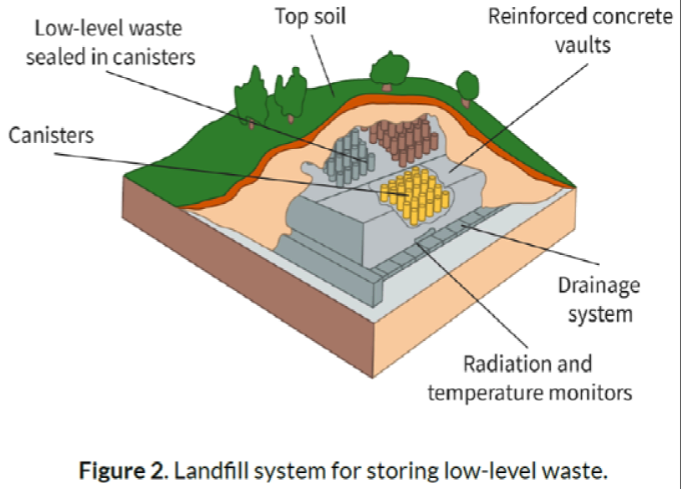
- Low-level waste (LLW) is waste that has been contaminated with radioactive materials.
- They only emit low levels of radiation.
- Can be disposed of safely in specific landfills with proper labeling and documentation.
- Clothes, tools or filters that have been contaminated are all examples of low-level waste.
- High-level waste (HLW) is waste that is highly radioactive.
- For example nuclear fuel rods.
- It can be stored in long-term deep geological repositories.
Advantages and Disadvantages of Nuclear Power
Advantages
- Extremely high energy-density.
- No greenhouse gases emitted during routine operation.
- Some scientists think that nuclear power may be the only realistic solution to global warming.
- No chemical pollution during operation.
- A reasonably large amount of nuclear fuels are still available.
- Despite a few serious incidents, statistically over the last 50 years, nuclear power has overall proven to be a reasonably safe energy technology.
Disadvantages
- Dangerous and very long-lasting radioactive waste products.
- Expensive
- Efficiency is not high when the whole process is taken into account.
- For example building the reactor and a landfill for the waste.
- Threat of serious accidents.
- Possible target for terrorists.
- Linked with nuclear weapons.
- Not a renewable source.