Protectionism
- Protectionism, or trade protectionism, is the opposite of a free trade economy.
- The government applies various policies to protect local firms from competition with international firms.
Trade Protection
- Government intervention aiming to limit imports or encourage exports by setting up trade barriers that protect from foreign competition.
Types of Trade Protectionism
Tariff
- A tax placed on imported goods.
- This raises the price of imported goods, making them less desirable to consumers.
Quota
- A physical limit on the number of value of goods that are allowed to be imported
Subsidy
- Money is given to domestic producers to increase competition and reduce domestic price
Administrative Barriers
- Health standards, paperwork, "red tape" and embargoes.
- These all make it qualitatively more difficult to import goods into a country.
Tariffs
- Tariffs can cause various effects on imported goods:
- reduced quantity of imported goods
- increased quantity consumed of domestic goods
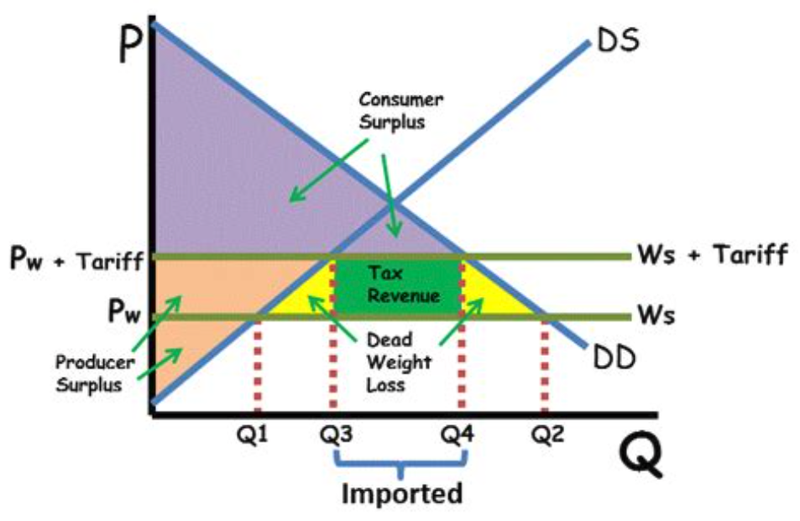
- Tariffs are used to reduce imports in a situation where the domestic price equilibrium is higher than the world price.
- It causes the world price to shift upwards, reducing the amount of imports as the world price approaches the domestic price.
Tariff Effectiveness
- Governments will also consider the elasticity and availability of goods that they put a tariff on.
Goods with Elastic Demand
- Any tariff on a good with elastic demand generates large change in quantity demanded and encourages consumers to switch to domestic producers they offer a readily available substitute.
- Tariffs are more effective with elastic goods.
Goods with Inelastic Demand
- Due to lack of available substitutes from domestic producers, tariffs on inelastic goods are not effective.
- When tariffs are applied, the winners are domestic producers and the government.
- The losers are consumers, foreign producers and society as a whole.
Quota
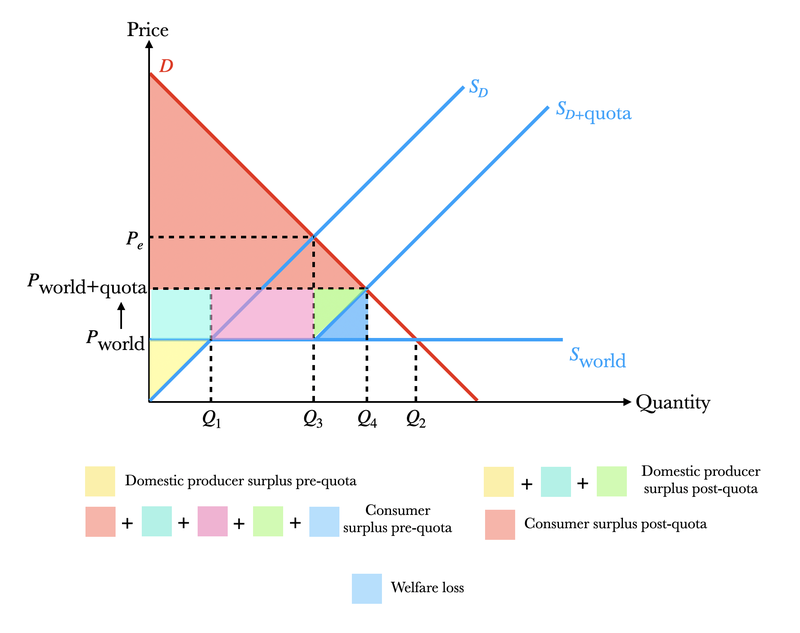
- A quota diagram creates a second domestic supply curve, leading to a reduction in imports.
- Consider a free trade diagram:
- Suppliers supply until they meet the world price.
- After that the gap is filled with import.
- The quota limits the amount of imports, so once foreign producers reach the quota, domestic suppliers take over once again.
- This is shown as a curve parallel to the domestic supply curve that starts from the world price and the quantity of the quota + domestic supply.
- There is a new price where the supply of domestic firms after the quota meets the demand curve.
Subsidy
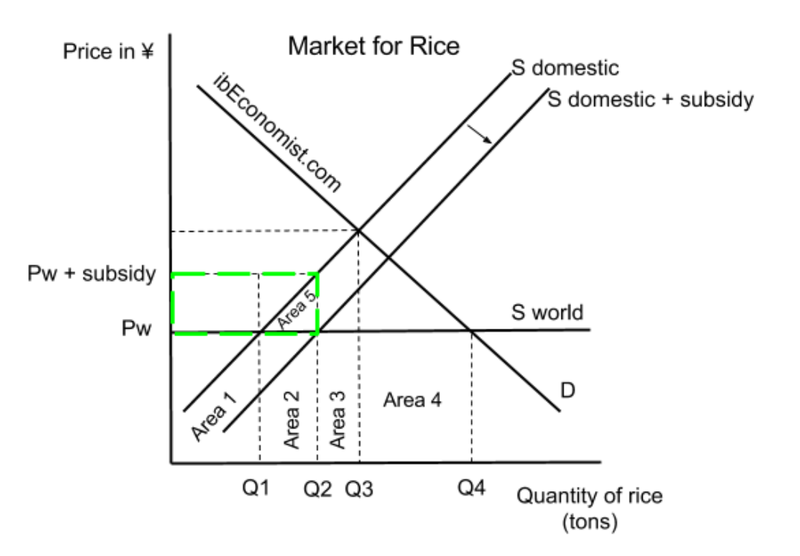
- Subsidies can be applied to markets to make lower their price and reduce the need for imports.
- The subsidy works like that of a microeconomics supply/demand graph, shifting domestic supply to the right.
- They come with the benefits and downsides of subsidies we're already used to, such as complacency.
Administrative Barriers
- Countries may choose to establish bureaucratic barriers preventing or disincentivizing foreign producers from importing goods or services.
- These barriers include:
- Product Standards
- Health and safety regulations
- Voluntary Export Restraint Agreement
- Agreement between two countries to limit the amount of exports/imports.
- "Buy National" Policies
- A marketing campaign to encourage domestic consumers to support local, domestic firms.
Evaluation of Protectionism
- All forms of protectionism result in some sort of reduction in total welfare, leading to a negative outcome for society as a whole.
- In fact it is due to this reason that protectionism isn't often used as a tool to improve a nation's economy.
- Instead it is more often used to control political relations, prevent malpractice and protect sectors in need.
Arguments for Trade Protectionism
- Protection of infant (sunrise) industries
- Especially developing economies might choose to protect certain industries so it can be built up for some time.
- Later on the protection is dropped so that the industry can compete normally.
- National security
- Protecting industries relating to national security, such as military.
- Having these industries be local means they are safe from sabotage and more secure, for example.
- Health and safety
- Protecting industries so that they meet health and safety standards which might not be met by imported goods.
- Environmental standards
- Protecting certain industries so that they meet required environmental standards.
- Anti-dumping
- Dumping is selling below cost price, which can be harmful for an economy.
- Protectionism can be used to prevent this by blocking imported goods.
- Unfair competition
- Protectionism such as tariffs can be used to create fair competition between local goods and imported goods which might have benefits such as lots of subsidies.
- Balance of payments correction
- Protectionism can be used to balance inflow and outflow so that an economy's currency is more stable.
- Government revenue
- Tariffs are a great way to collect government revenue, especially for lower-income economies.
- Protection of jobs
- Free trade can lead to unemployment in certain industries that get outcompeted.
- Economically least developed country (ELDC) diversification
- To diversify industries, lower developed countries might use protectionism to protect growing industries.
Arguments Against Trade Protectionism
- Misallocation of resources
- Consumers demand greater quantities of goods at lower prices.
- Foreign importers can typically offer those goods at lower prices compared to domestic producers but protectionist policies prevent the allocation of resources.
- Retaliation
- When one country imposes tariffs or quotas, the trading partner may retaliate causing a trade war.
- Trade wars often lead to higher prices for both parties, an increase in production costs and potentially unemployment.
- When one country imposes tariffs or quotas, the trading partner may retaliate causing a trade war.
- Increased costs
- When raw materials have a tariff or quota imposed on them, the cost of production increases.
- Higher prices
- Consumers must pay a higher price for a good than they should compared to free trade.
- This is due to increased costs of production.
- Consumers must pay a higher price for a good than they should compared to free trade.
- Less choice
- Protectionism limits imports and choices for domestic consumers.
- These policies limit the variety of goods available as there are less options brought on by trade.
- Less incentive for domestic producers to improve
- Protectionist policies limit competition from international competition and provides no incentive for domestic producers to improve efficiency, quality, or engage in research and development.
- Reduced export competitiveness
- As your country's producers pay more for imported materials, domestic producers must charge higher prices to cover increased costs.
- This increase in price leads to a less competitive market for exports.
Sources
http://ibeconomist.com/revision/3-1-international-trade-trade-protection-subsidy/