Marshall-Lerner Condition
- A condition stating that depreciation or devaluation of a currency will lead to an improvement in the current account balance if the sum of the price elasticity of demand for exports plus the price elasticity of demand for imports is greater than one.
- PED for exports + PED for imports > 1
- Essentially, if the demand for exports and imports are elastic, it's easy to decrease consumer demand for foreign goods and the current account deficit will correct itself and collect a surplus.
- The same is true for the opposite.
- If the demand for exports and imports is inelastic, a current account deficit may continue to worsen and further depreciate currency.
The J-Curve Effect
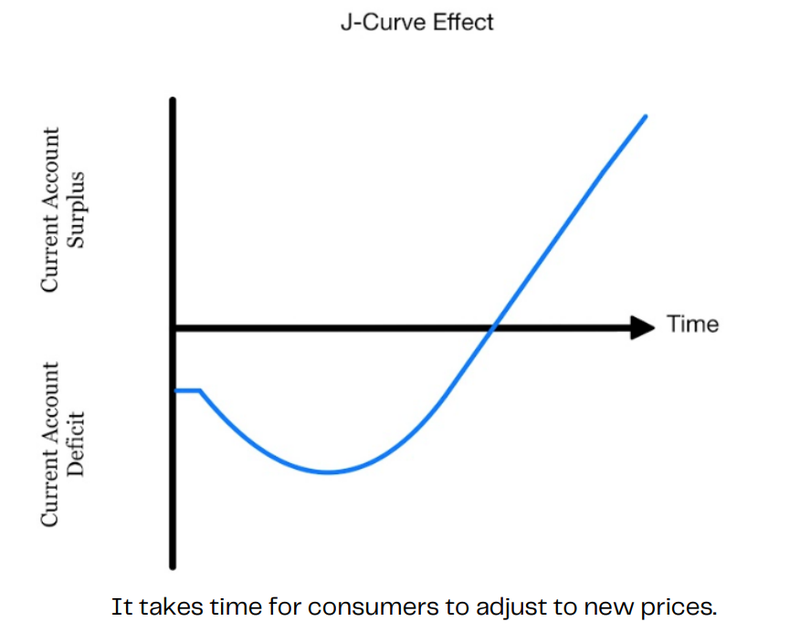
- Following devaluation or a sharp depreciation, a trade deficit will typically widen before it starts improving thus tracing the letter “J” if plotted against time, because the Marshall-Lerner condition is satisfied only after a period of several months following the decrease value of the currency.
- This is because in short time frames, all goods are quite price inelastic.
- In simple terms, the J-curve effect shows that it takes time for a current account adjustment to take place.
Sources
Banananomics