Economic Integration
- Economic integration between countries usually involves agreements between two or more countries to phase out or eliminate trade barriers between them.
- Organizations such as the World Trade Organization, encourage economic integration and help facilitate it.
- Preferential trade agreements allow for different levels of economic integration between countries.
World Trade Organization (WTO)
- An international body that sets the rules for global trading and resolves disputes between its member countries.
- It also hosts negotiations concerning the reduction of trade barriers between its member nations.
- The WTO also serves as an archive for trade agreements.
Preferential Trade Agreements (PTA)
- Where a country agrees to give preferential access for certain products to one or more trading partners.
- France reducing tariffs for cars imported from Germany would be an example of PTA.
- This is typically seen as the first stage of economic integration.
Types of PTA
Unilateral
- A country provides preferential tariff reductions for another without receiving the same treatment in return.
- "Unilateral" means one-sided.
Bilateral
- An agreement between two countries to phase out or eliminate trade-related barriers.
- "Bilateral" means two-sided.
- For example, Japan reducing tariffs on Chinese steel imports and China reduces tariffs on Japanese fish imports.
Multilateral
- An agreement between many countries to lower tariffs or other protectionist measures.
- Currently carried out within the framework of the WTO.
Regional Trade Agreements (RTA)
- Regional trade agreements are between a group of countries usually within a geographical region to lower or eliminate trading barriers.
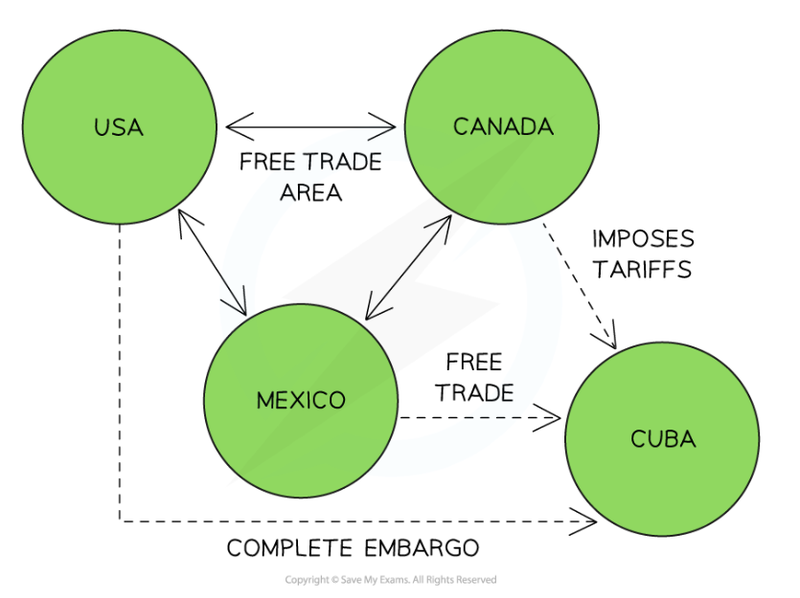
- For example, the US-Mexico-Canada agreement was a form of RTA.
Trading Blocs
- A trading bloc is a group of countries that have agreed to reduce protectionist measures like tariffs and quotas between them.
- Trading blocs are a higher level of economic integration than PTA.
Types of Trading Blocs
Free Trade Area (FTA)
- An agreement between two or more countries to phase-out or eliminate trade barriers between them.
- Members of the agreement are free to maintain their own trading policies towards non-members.
- This is considered the first level of trading blocs.
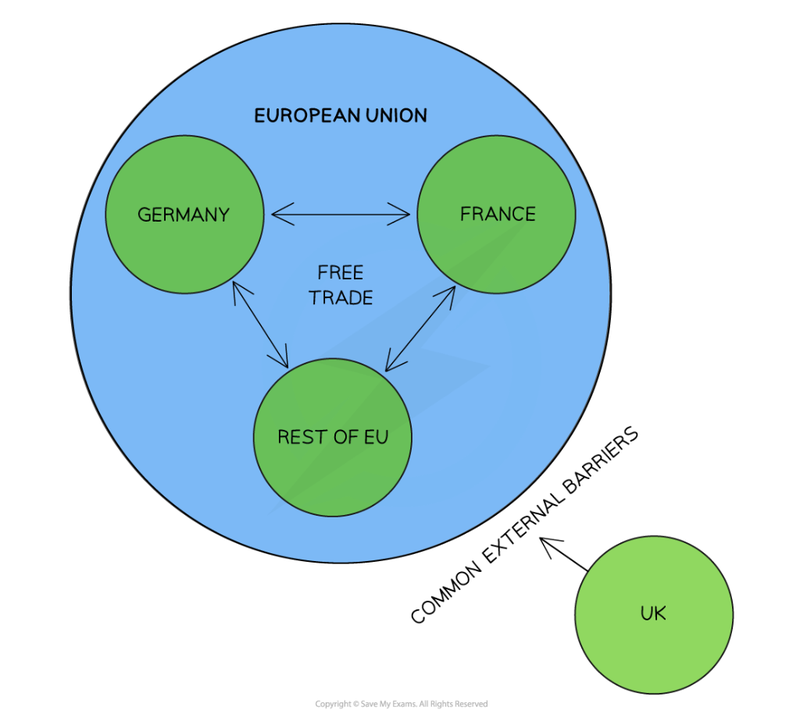
Customs Union
- An agreement between countries to phase out or eliminate tariffs and other trade barriers and establish a common external barriers towards non-members.
- Examples include:
- European Union Customs Union (EUCU)
- Southern African Customs Union (SACU)
- Eurasian Economic Union (EACU)
- Examples include:
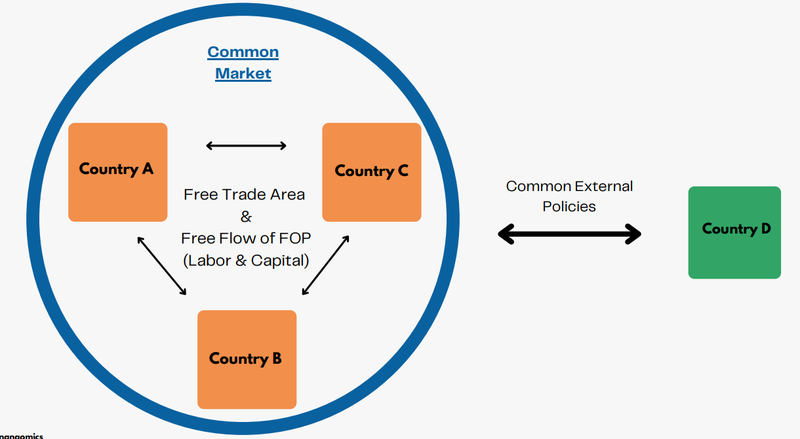
Common Markets
- When a group of countries agree not only to free trade of goods and services but also to the free movement of capital and labor.
- For example, the EU is a common market as you can freely move and work or transport goods between EU-member countries.
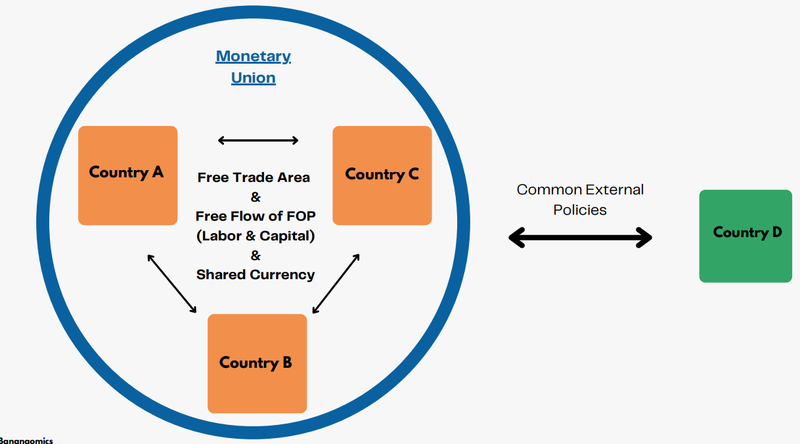
Monetary Union
- When two or more countries share the same currency and have a common central bank.
- This is the highest level of integration.
- For example, the Eurozone, which includes all countries using the Euro.
- They are all tied to the EU central bank, whereas countries such as Sweden (outside Eurozone) have their own central bank.
- Complete economic integration would be the only and final step above a monetary union.
- It would mean that members would have no control of economic policy, full monetary union, and complete harmonization of fiscal policy.
- The Eurozone is slowly moving towards this.
Advantages of Trading Blocs
- Trade Creation
- Greater access to markets offers potential for economies of scale.
- Free movement of labor.
- There are more opportunities for individuals in member countries.
- Membership in a trading bloc may allow for stronger bargaining power in multilateral negotiations.
- A world made up of large trading blocs has far easier negotiations.
- This is because many members have common interests so its easier to satisfy the majority.
- Greater political stability and cooperation would prevent disagreements and wars.
Disadvantages of Trading Blocs
- Trade diversion
- Loss of sovereignty
- Countries must cooperate or give up the idea of being fully independent and autonomous.
- For example, some countries in the EU are not in the Eurozone as they want to be able to control their money supply and most likely have some cultural connection to the currency.
- Challenge to multilateral trading negotiation.
- Countries may have social, political, historical and economic differences that make the development of trading blocs difficult.
Advantages and Disadvantages of Membership of Monetary Unions
- Monetary unions are the final stage of trade creation, and thus there is a lot at hand when a country enters a monetary union.
Advantages of Membership of a Monetary Union
- No more exchange-rate fluctuations between countries.
- As all countries in a monetary union use the same currency, there is no exchange-rate fluctuation.
- This leads to a reduction in uncertainty and an increase in cross-border investment and trade.
- Monetary union currencies are more stable against speculation.
- Monetary union currencies, such as the euro, have the enhanced credibility of being used in a large currency zone.
- Business confidence tends to improve.
- There is less of a perceived risk involving trading among member countries.
- Increased trade and reduced uncertainty leads to internal growth and trade growth.
- There is less of a perceived risk involving trading among member countries.
- Transaction costs are eliminated within the monetary union.
- There is no transaction fee as countries have the same currency.
- A common currency makes price difference more obvious between countries.
- Over time this should lead to prices equalizing over borders.
- There is a much smaller price difference in goods between EU members than between non-EU members.
Disadvantages of Membership of a Monetary Union
- Interest rates are no longer decided by individual countries.
- As all monetary union members share a common central bank, they no longer decide their own interest rate.
- Thus it can no longer be used as a monetary policy tool to influence inflation, unemployment rate and economic growth rate.
- This issue is most prominent if one member country is experiencing issues not experienced by other countries.
- Issues experienced by many members are addressed by the central bank.
- Without fiscal integration, a monetary union might be weak.
- Without a common treasury, harmonized tax rates and a common budget, fiscally irresponsible countries might threaten the stability of the union.
- Individual countries are not able to adjust exchange rates to affect international competitiveness.
- The initial costs of converting the individual currency to the common currency are very large.
- They include the costs of taking back old currencies, printing and distributing new currencies, converting databases and software, re-pricing goods and services and recalibrating machinery that uses coins and notes (such as ATMs).
Sources
Bananomics