Why Do Countries Trade?
- We've discussed how trading has numerous benefits.
- But why can't countries simply produce everything they need themselves?
- This comes down to comparative advantage.
Comparative Advantage
- Comparative advantage can be illustrated through a PPC diagram.
- While some countries might have absolute advantages in producing both of two goods, some countries might have a comparative advantage as they have to sacrifice less of one good to produce more of the other.
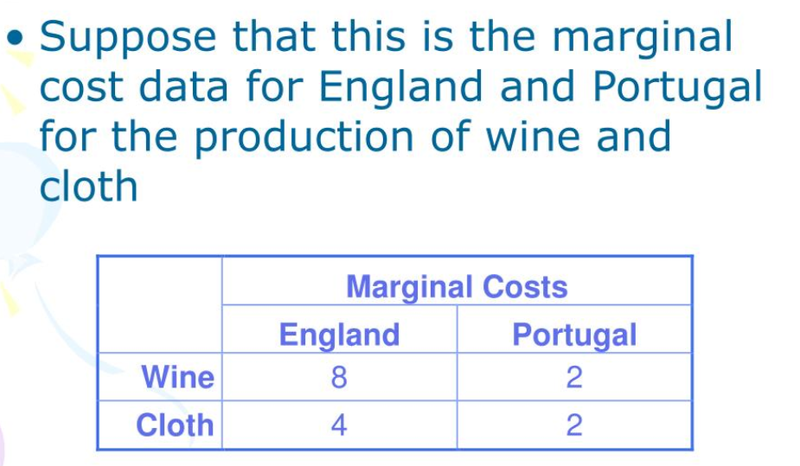
- Here we can see that England can produce either 8 units of wine or 4 units of cloth.
- England can produce more cloth or more wine than Portugal can, meaning it has absolute advantage.
- However, for every extra unit of wine England wants to produce, they sacrifice 4/8 units of cloth, or 1/2 units of cloth.
- This is their opportunity cost.
- For every extra unit of cloth England wants to produce, they sacrifice 8/4 units of wine, or 2 units of wine.
- Portugal on the other hand only has the opportunity cost of 2/2, or 1 for producing wine or cloth.
- As the opportunity cost of 1 unit of wine for Portugal is less than the opportunity cost of 2 units of wine for England, the most efficient would be if Portugal produced cloth and England produced wine.
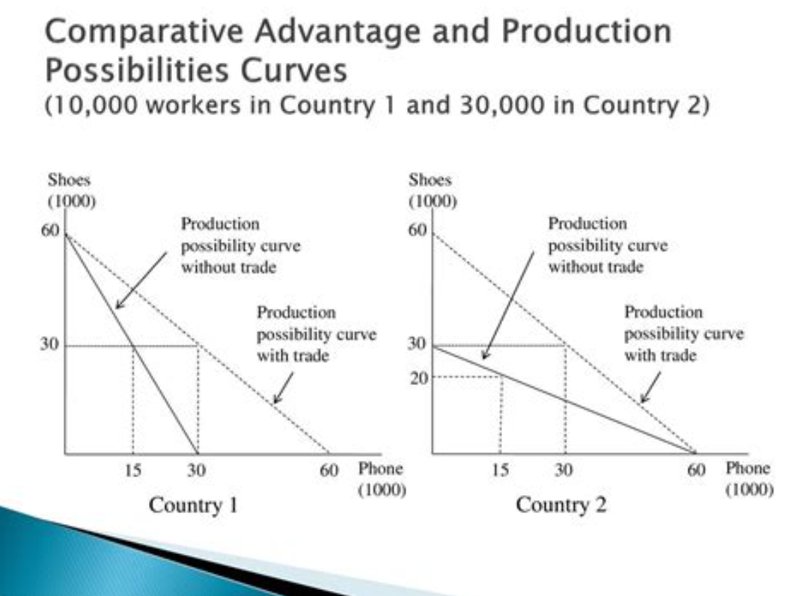
- Comparative advantage can also be shown using possible production curves.
- Here the curves are assumed to be straight as there is no additional efficiency loss from switching from producing one good to another.
Limitations of Comparative Advantage
- Only 2 goods and 2 countries producing
- Simplified and unrealistic
- Assumption of homogenous goods
- In reality there might be a difference in quality
- Assumption of free trade
- Assumption that factors of production stay in the country
- Assumption of full employment
- Assumption of perfect information
- Assumption that technology is fixed
- No calculation of the cost of transportation between countries
Sources
https://www.slideserve.com/uttara/theory-of-comparative-advantage