Automatic Adjustment of Balance of Payments
Current Account and Exchange Rate
- Current account deficits and surpluses are automatically adjusted under a floating exchange rate system.
- These adjustments will not be possible in fixed exchange rate regimes.
- For example, if a country exports airplanes, they receive a current account surplus.
- As the payment for these planes is eventually exchanged to USD, this results in increased demand of USD, leading to appreciation.
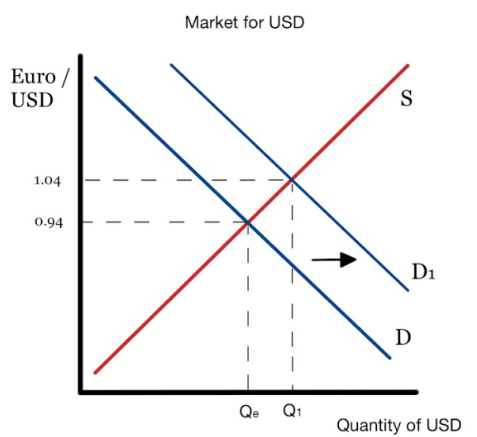
- This appreciation causes exports to appear more expensive and results in a decrease in the demand for exports as consumers will buy planes from other countries instead.
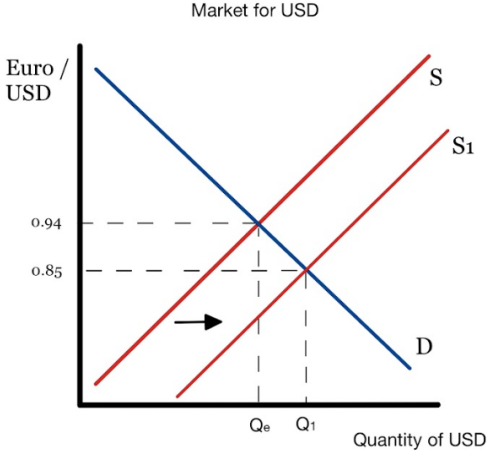
- A similar scenario occurs for a current account deficit.
- A current account deficit means money is leaving a country and the supply of its currency is increasing, causing depreciation.
- Exports now appear to be cheaper leading to an eventual increase in demand.
Financial Account and Exchange Rate
- Uncertainty and interest rates also have the ability to affect the exchange rate.
- For example, if US banks offer a higher interest rates than countries in Europe, USD appreciates due to the increase in demand.
- However, due to appreciation this results in a decrease in demand for exports and an increase in demand for imports, eventually causing the exchange rate to back down.
- The opposite scenario occurs if US banks were to lower their interest rates instead, leading to reduced demand for the USD.
Consequences of a Persistent Current Account Deficit
Implications
Exchange Rates
- CA deficit puts downward pressure on a currency's exchange rate.
- Typically this adjusts back but there are scenarios for countries that import a large number of raw materials where this damages their economy long-term.
Interest Rates
- CA deficits can cause increases in interest rates potentially causing a decrease in AD due to a lack of consumption and investment.
Foreign ownership of domestic assets
- Due to the decrease in the exchange rate, foreign investors may purchase larger quantities of domestic assets, meaning the money will continue to exit the economy.
Debt
If a country's imports are greater than exports persistently, this can lead to indebtedness.
Credit Ratings
- If a country is unable to service its financial account debt (capital payments on loans), it could receive a downgrade in its credit score.
Demand Management
- CA deficits must be taken into account by governments attempting to use demand-side policies as government spending can impact the BOP in a negative way.
Economic Growth
- If a country's citizens consistently buy foreign products and services, domestic producers receive no revenue and are forced to lay off workers and reduce output.
Methods to Correct a Persistent Current Account Deficit
Expenditure Switching
- The goal is to switch consumption from imports to domestic goods by the use of protectionist measures.
- This includes tariffs, quotas or subsidies to domestic firms.
- Attempting to slow down the economy, a government may use contractionary demand side policies to reduce aggregate demand.
Supply-Side Policies
- If domestic producers are simply uncompetitive or not innovative enough to compete in international markets, supply-side policies should be able to help with a focus on production, efficiency, and R&D.
Effectiveness of Correction Methods
Expenditure Switching
- As this method deals with protectionist measures, the primary factor in the effectiveness will be the elasticity of the good on which the tariff or quota is placed.
- In order for it to be effective, a country must be able to produce the good domestically.
- For example, if Cambodia were to place a tariff on electronic semiconductor chips it would not be effective as Cambodia is unable to produce them domestically due to lack of appropriate technology.
Expenditure Reduction
- Contractionary demand-side policies do have the ability to correct a CA deficit.
- However, too much contractionary policies can lead to a recession and drastic fall in real GDP.
Supply-Side Policies
- Both expenditure switching and reducing policies don't address the direct issue of why consumers prefer foreign imports over domestic goods.
- A government may chose to enact supply side policies designed to increase efficiency and competition to create better goods and increase export demand.
Consequences of a Persistent Current Account Surplus
- CA surplus occurs only when imports are decreasing and exports increasing
Implications
Domestic Consumption and Investment
- During a recession, consumers may import less or exports may be more attractive.
- It is difficult to maintain a persistent current account surplus as it generally balances out over time.
Exchange Rates
- CA surplus leads to appreciation.
- Eventually, this decreases exports as they appear more expensive and an increase in imports as the domestic currency is now stronger.
Inflation
- Due to an increase in exports, aggregate demand typically increases, potentially causing inflation.
Employment
- As increasing exports cause aggregate demand to increase, the quantity of employed typically increases.
- This leads to reduced unemployment.
Export Competitiveness
- CA surplus leads to appreciation and potentially inflation due to increased aggregate demand.
- Eventually, this decreases exports as they appear more expensive.
Sources
Bananomics