Poverty Traps and Cycles
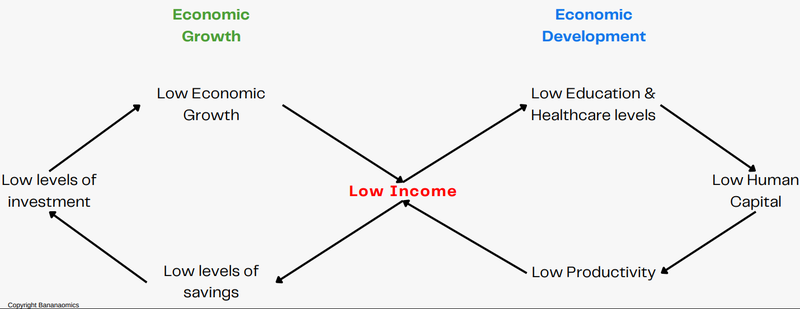
- Poverty traps, or poverty cycles, are a series of events that lead into each other, that make it increasingly difficult for people born into poverty to break out of poverty.
- Economists debate the existence and effects of poverty traps and cycles.
- This is because a large variety of different poverty traps are possible, and might include different factors not always considered in diagrams.
- Governments use these diagrams to formulate greater understanding to guide intervention and if it is possible to break out of the cycle.
- Poverty cycle diagrams can be applied to both discussions of economic growth and development.
Economic Barriers
Infrastructure
- Infrastructure is the physical capital in an economy that is often provided by governments.
- It includes roads, railroads, police, education services, airports, harbors, public transport and sometimes healthcare.
Importance of infrastructure in development and growth:
- Facilitates economic activity
- Ensures protection of citizens
- Poor infrastructure leads to poor supply chains, leading to increased costs of production.
- This is also often reflected in higher prices, and thus reduced international competition.
- Infrastructure includes components like gas, drinking water and communication systems.
- Poor management or availability of these components can lead to health issues or inefficient production of goods and services.
Appropriate Technology
- Technology that relies mostly on the relatively abundant factor an economy is endowed with.
- Typically small-scale, environmentally friendly, locally made, and affordable.
- Technologies developed in high-income countries are typically sophisticated and require more capital equipment (electricity, factories, etc.).
- While the technology developed in low-income countries typically use less capital, more labor, and are easily repaired, creating jobs locally.
- However appropriate technology in low-income countries might be less valuable and not worth exporting, making it more difficult to achieve economic growth.
- Appropriate technology is related to sustainable development as it must be environmentally friendly and produced locally.
Low Human Capital
- Human capital is the education, training, skills, experience and good health embodied in the labour force of a country.
- High human capital is vital for the productivity and output of an economy.
- However, many developing countries often face low levels of human capital.
- Low human capital is a result of:
- Poor education
- Poor healthcare
- Poor job training opportunities
Dependence on the Primary Sector
- The primary sector is anything derived from the factor of production land.
- Includes agricultural products, metals and minerals
- Typically, developing countries rely heavily on the primary sector while developed countries focus more on manufacturing or services.
- Issues with dependence on the primary sector.
- Reliance on imports of manufactured goods and services
- This can lead to reduced economic growth, especially if there are more imports than exports.
- Instability
- Unpredictable changes in prices and yields (crops/mine).
- Exchange Rate issues
- High demand for raw materials leads to an exchange rate increase lowering export competitiveness in other sectors.
- Political and Civil unrest
- Land and natural resources are so valuable here, there is frequently conflict to acquire more.
- Reliance on imports of manufactured goods and services
Lack of Access to International Markets
- Trade is very important for a country's economic growth and development.
- Access to global trade markets is uneven or restricted by protectionist policies for a significant portion of low-income countries.
- Typically, protectionist policies placed on developing countries are highly effective as similarly-priced substitutes of similar quality are available from other countries due to low technology and capital.
- It's important to note that some protectionist policies such as tariffs may be defensive and enacted by the lower-income country in order to protect infant industries to increase domestic competition.
- However, this often leads to increased domestic prices due to higher production costs, which might have negative affects on low-income consumers, who likely comprise a majority of the population.
Existence of an Informal Economy
Formal vs Informal Sector
- Formal economic activity is registered, taxed, and legally regulated while informal activity is hidden, unrecorded, and unregulated.
- Low-Income countries typically don't have the institutional framework to track trade as they lack established tax systems or record keeping.
- Thus they tend to have a far larger informal economy than developed countries.
- Oftentimes the informal economy can constitute nearly half of all economy activity in an developing country.
- Citizens in low-income countries also typically grow, consume, and sell food, clothing, and shelter for their families, friends, and members of their local community, which constitutes activity in the informal sector.
Disadvantages of the existence of an Informal Economy
- Lower incomes
- Lack of safety net for entrepreneurs as they are not registed.
- Thus they get no unemployment benefits.
- Lack of government revenue leading to less money for public goods such as education or healthcare.
- Potentially illegal economic activity resulting in human rights issues and worker exploitation.
Capital Flight
- Capital Flight is an outflow of money from an economy.
- Typically these are due to negative political, social, or economic changes.
- It should be noted that countries normally have some outflow of funds but capital flight refers to a high degree of outflow.
Disadvantages of Capital Flight
- Interest rates will rise in hopes of keeping money in the economy.
- However, this also discourages business and consumer loans, leading to reduced consumption and investment.
- The government may enact control over funds leaving the country.
- While this keeps funds in the country, it serves as a deterrent for foreign investors as they may not be able to remove funds.
- Demand-Side policies have less of an impact due to uncertainty and unwillingness to spend.
- Lower domestic investment.
- In the long-run, capital flight is typically associated with large foreign debt.
Indebtedness
- Countries take on debt to:
- To service debts already owed.
- Pay the principle on the loan
- Finance current expenditures
- Finance long-term goals such as infrastructure, healthcare and industrial projects.
- To service debts already owed.
- The first two reasons are considered to be inappropriate as they further the amount of indebtedness and are considered to be unsustainable.
- The third example can be appropriate if funds are allocated effectively.
- Debt from loans has increased dramatically in middle-low-income countries.
- While these loans can be beneficial for development and economic growth, they often come with strings attached as the developed lending countries promote their own agendas focused on international trade.
Geographic Barriers
Landlocked Countries
- Landlocked countries don't have direct access to the sea.
- This typically prevents easy economic integration as all imports and exports by sea must enter or exit through at least one other country.
Climate
- Each country lives in a different biome with varying climate conditions.
- One of the largest issues with climate is drought.
- Due to lower-income countries' reliance on the primary sector (agriculture and raw materials), stressed water supplies typically result in lower crop yields.
- Higher income countries focus less on the primary sector and therefore are less effected by drought.
Disease
- Each country has different endemic diseases native to its region.
- Diseases, especially widespread or dangerous ones, can impact economic development and growth.
- An unhealthy workforce leads to a lack of development/growth due to low human capital.
- Sick people cannot work and in countries with no safety nets, these people fall into a cycle of poverty.
- Sick people are unable to devote time to increasing human capital (education, training).
- Devastating impacts on overall well-being and relationships
Examples
- Real-world examples of endemic diseases currently affecting many low-income countries include:
- HIV/AIDS
- Malaria transmitted via mosquito - most cases in Africa.
Political Barriers
Governance
- Governance is the decision-making or processes within an organization or an institution.
- Governance is not simply the government.
- Governance from non-government and government bodies greatly impacts economic growth and development.
- The governance of large companies can be equally important, especially in low-income countries where these firms may create a majority of the economic output.
- A lack of effective governance results in power asymmetry (asymmetrical power), where specific stakeholders have greater power.
- Power asymmetry results in certain favored groups receiving preferential treatment and furthering the power disparity.
- This often leads to corruption.
Effective Governance Traits
- Transparent
- Accountable
- Consensus oriented
- Equitable and inclusive
- Follows rule of law
- Responsive
Political Systems
- Each country in the world has a unique political system (legal institutions that determine government structure and functions).
- While each political system should only be evaluated on a case-by-case basis, democratic political systems theoretically provide the greatest governance.
Corruption
- Abuse of power for private gain.
Types of Common Corruption
- Bribery
- Embezzlement
- Extortion
- Blackmail
Institutional Barriers
Legal Systems
- Rule of law is the ability of citizens to exercise power is restricted through well-defined and established laws.
- Laws should uphold core foundations of ideal legal systems such as accountability, just laws, accessible and affordable justice, and transparency.
- A poor legal framework, such as in the US, can lead to overcomplications and loopholes.
Property and Land Rights
- Systems need to exist to organize and structure the means of owning, selling and regulating property.
- Countries that have no formal system of property records typically experience greater levels of hostility and general unrest.
- This lack of documentation and rights leads to challenges for economic growth and development.
Taxation System and Structure
- Typically, higher-income countries receive greater tax revenues compared to lower-income countries.
- Tax revenues allow governments to boost economic growth and development through government spending.
- Additionally, because developed countries tend to have little/no informal economy, they receive most of their revenue from direct taxes while low-income countries with a large informal economy relies primarily on indirect taxes.
- Indirect taxes are regressive, which can lead to worsened inequality issues in developing countries.
Banking System
- Banking systems in low-income countries take on a significant amount of risk in these areas as individuals typically have no collateral for loans, low savings, and low financial literacy.
- When a bank does choose to work with citizens to provide loans, they are typically with high-interest rates to ensure a profit is made.
- This lack of access to finances hinders economic activity as entrepreneurs are unable to gain funds through bank loans.
- Additionally, citizens have a low degree of financial security as their money is not in a secure bank but most likely physically stowed away.
Social Barriers
Gender Inequality
- Limits to women's access to education, healthcare, job opportunities, or political opportunities impact economic growth and development negatively in the following ways:
- Lack of education leads to a lack in human capital
- Unequal income
- Low political representation in government
- Little/no political or educational role models
- Increased sexual and physical violence against women
Caste and Ethnic Discrimination
- Ethnic discrimination can be based on race, ethnicity, or social/cultural differences.
- Ethnic discrimination is typically targeted against a specific minority group in the population and has been solidified for a long period of time or targets new immigrants.
- Ethnic discrimination hinders economic development/growth resulting in:
- Higher rates of unemployment and income for minorities
- Lack of equal access to healthcare, education, and economic opportunities
- Restriction of freedoms
- Caste discrimination is primarily associated with South Asian countries such as India, especially after the system was furthered by the British Raj.
- Traditional caste systems divide the population hierarchically based on birth.
- Individuals in the lowest groups typically experience the most significant discrimination.
- This leads to individuals in lower groups being unable to access the same economic opportunities as those in higher classes, leading to overall reduced human capital.
Sources
Bananomics