Primary Characteristics of Robots
Work Envelope
- A fixed 3D space where work activities take place, considering clearance and reach.
- The range of movement and degree of axis is determined by the length and operation of a robotic arm respecitvely.
Load Capacity
- The weight a robot can manipulate.
- Robots on average are already much stronger than humans.
Single tasking vs Multitasking
Single Task Robots
- Can perform one task only.
- They are specialized to that task and need to be re-programmed or physically modified to do a different task.
Multi-Task Robots
- A type of robot that can perform more than one task in a manufacturing environment.
- Multi-tasking robots are often more generalized, such as a robot arm that can bend parts, insert screws and combine components.
Robot Generations
First Generation Robots
- A simple mechanical arm that has the ability to make precise motions at high speed.
- They need constant supervision by a human operator.
Second Generation Robots
- Robots that are equipped with sensors that can provide information about their surroundings.
- They can synchronize with each other and do not require constant supervision by a human.
- However, they are controlled by an external control unit.
Third Generation Robots
- Autonomous robots that can operate largely without supervision from a human.
- They have their own central control unit.
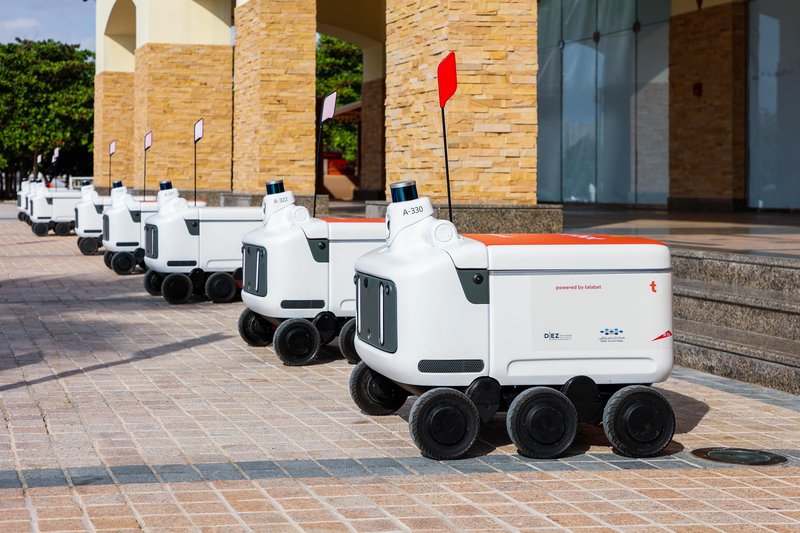
- Swarms of smaller autonomous robots also fit in this category.
- For example, small, wheeled delivery robots.
Teams of Robots
- Groups of robots working together on a task.
- To work as a team, robots use different communication methods.
Machine to Machine
- Wired and wireless communication between similar devices.
Examples of Machine to Machine (M2M)
- Manufacturing and assembly lines
- In a car factory, one robot arm welds a frame and automatically signals another robot arm to start painting once welding is complete.
- M2M is used to coordinate directly, without needing humans to tell the second robot when to start.
- This uses less labor, wastes less time, and has a smaller chance of errors.
- Warehouse and logistics
- At Amazon warehouses, robots moves shelves to human packers.
- When one drop drops off a package, it signals another robot to bring the next one.
- Robots "talk" to each other to avoid collisions and keep a smooth workflow.
- Smart agriculture
- A drone scans crops and detects weeds, then sends instructions to an autonomous weeding robot to spray only the affectd spots.
- M2M allows the drone and ground robot to share data and act without waiting for a farmer's command.
- Autonomous vehicles
- Self-driving cars on the road exchange information about speed, braking and traffic jams.
- M2M communication helps prevent accidents and reduces traffic congestion.
- Healthcare robotics
- A patient-monitoring robot detects irregular heart rate and immediately signals a robotic medicine dispenser to prepare medication.
- Fast M2M response in emergencies can be vital.
Advantages and Disadvantages of Robots in Automated Production
Advantages
- Improves health and safety of the workforce.
- High accuracy of work, reduced errors and waste.
- Quality of the final product is high.
- Can perform repetitive and dangerous tasks.
- Can work in confined spaces.
- Performs functions 24/7, leading to higher production.
- Re-programmability and flexibility.
- Small workforce needed.
- Only one technician can maintain and equip a large number of robots.
Disadvantages
- Expertise needed to operate robotic systems.
- Training of workers required in both operation and maintenance.
- High initial capital cost.
- Often making skilled workers redundant, which can lead to:
- Widening inequality with business owners reaping the benefits rather than the workforce.
- Lower spending power as the community will have less money to spend due to unemployment.
- Social unrest
- The community may object to job losses, causing strikes or political instability.
- Responsibility gaps
- Harder to assign accountability if a mistake is made.
Sources
https://mediaoffice.ae/en/news/2023/February/15-02/RTA-DIEZ-and-talabat