Form Versus Function
- Characteristics of a good user interface include:
- Simplicity
- Simple design allows for clarity on how the design can be used.
- Ease of use / learnability
- How easy it is to learn to use a product or how intuitive a product is to use.
- Intuitive logic and organization
- Novice users of a product should be able to learn all its basic functions within one or two hours.
- Low memory burden
- The user does not need to have to memorize many features, how to use it, etc.
- Affordance
- The perceptions, feelings and opinions about a product by a user.
- The extent to which the user understands what to do.
- Constraints
- Limitations on how the product can be used.
- Visibility
- Controls should be easily accessible to the human eye.
- Mapping
- The correspondence between the layout of the controls and their required action.
- Feedback
- The provision of information as a result of an action, this can be a audio, visual or aesthetic response.
- These characteristics allow for a good function and form.
Form
- Considered as the three-dimensional space that a product takes up, in the context of classic design, form relates to the shape of a product and the aesthetic qualities that the shape implies.
- Form increases pleasure of using an object.
- Pursuit of appearance over functionality might lead to guilt or second-thoughts.
Function
- Functionality focuses on the practical aspects of a product.
- Products can be considered classic designs based on how well they fulfil the task that they have been designed for.
- Help alleviate stress by meeting functional needs
- Giving up on functionality evokes feelings of guilt.
- For a design to become a classic design, the form can transcend the function.
- The images of classic designs are iconic and consumers and firms are often unwilling to change them, preferring to sacrifice function for form.
ATC Model
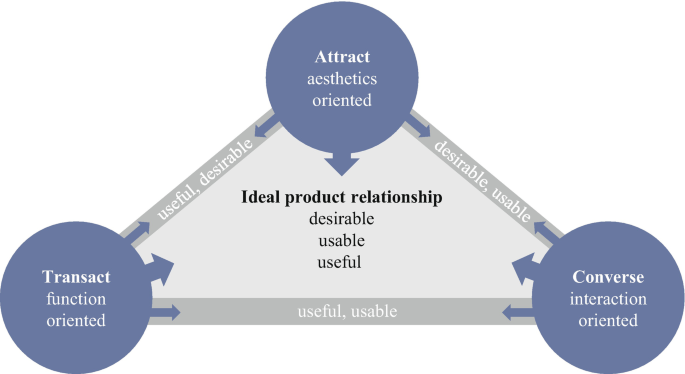
- The ATC-model is a framework for creating designs that improve the relations of users with a product and intentionally trigger emotional responses.
- The attract part of the model is aesthetics oriented.
- The converse part of the model is interaction oriented.
- The transact part of the model is function oriented.
- When all three elements are addressed, products can become desirable, usable and useful.
Practical Function
- Mostly concerned with criteria related to the performance of the product, such as dimensions, weight and ease of use.
Psychological Function
- Mostly concerned with the different emotional reactions or attachments people have with products such as their favorite clothing item.
Don Norman's 3 Levels of Emotional Appeal

- Dan Norman's framework aims to include 3 aspects that can be combined to make a great design.
Visceral Design
- Design that speaks to people's nature in terms of how they expect products and systems to function and how they expect to interact with them based on appearance.
- Considers psychological function.
Behavioral Design
- Focused on use and understanding, this considers how people will use a product, focusing on functionality.
- Considers practical function.
Reflective Design
- Design that evokes personal memory focusing on the message, culture and the meaning of a product or its use.
- Considers psychological function.
Manufacturing Considerations
- Forms can be dictated by other functions such as design for manufacture techniques.
Design for Manufacture
- Design for manufacture is when designers design specifically for optimum use of existing manufacturing capability.
- Some materials or forms might be preferrable for manufacturing, even if they aren't aesthetically appealing.
Design for Disassembly
- Designing a product so that when it becomes obsolete it can easily and economically be taken apart, the components reused or repaired, and the materials recycled.
- Sometimes aesthetic properties of components or materials might be sacrificed for easier disassembly.
- However, this comes with the benefit of consumers feeling more responsible for the environment when they purchase the product.
Recycling/Reuse
- Examples of designing for recycling or reuse include dematerialization, cradle-to-cradle or design for disassembly.
- Considering these aspects might lead to some restrictions in material and manufacturing choice, but could also create products with a unique aesthetic appeal.
Retro-Styling
- A design that uses the form and decoration from a particular period of time and/or style.
- Retro product design is an approach that's significantly influenced many industries, particularly fashion and technology.
- Why brands use it:
- It sets them apart
- Appealing to customers' nostalgic sensibilities.
- It creates a more emotional connection
- It brings together two things that consumers can appreciate, familiarity and innovation.
- It's consistently popular
- Nostalgic product design is a remarkably consistent design trend.
- When retro-styling a new product the designer needs to respect and understand the original form and underlying structure before making changes.
- There is a tension between form and function when developing new products based on a classic design.
Form Follows Function
- Some products are so well designed with function as their primary goal, that their use is intuitive.
- Classic design holds “form follows function” as a fundamental principle, but this is not always evident in practice.
- As designers develop new technologies the lines between the form and function of a product continue to blur.
- The balance between function and form is often an area of difficulty for the designer.
- If a product is purely functional, it may be lacking in appeal to consumers, no matter how good it may be at completing its job.
- Often we are drawn to products that have been developed with form as a primary consideration.
- The human psyche appreciates beauty.