Why Design for Emotion?
- To ensure people love a product, it needs to be usable (making it a pleasure to use), but also desirable through emotional means.
- Designing for emotion allows people to become "attached" to the product and engages the user in the product.
- This develops brand loyalty, as if a user is satisfied with a product, they will likely come back to the same brand for replacements or new products.
- Emotional appeal can also increase and maintain sales for a company.
Aesthetic Appeal and Pleasure
- A designer’s ability to provide satisfaction through aesthetic appeal and pleasure can greatly influence the success of a product, service or system.
- Understanding attitudes, expectations and motivations of consumers plays a significant role in predicting product interaction.
- Designers need to be sympathetic and empathetic to user emotion, which acts as a critical component to determine how he or she interprets and interacts with a product, service or system.
- This allows for the product to be designed to better suit the user's emotions.
Sympathetic
- The decisions required for the product to be the most helpful for the user given certain conditions.
- More of an outsider's perspective on the user's emotions and problems. They can be identified, but cannot be as in-depth as the empathetic understanding.
Empathetic
- When the designer takes the place of the user to see who potentially could use the product and the object could be better suited for the consumer.
- By being in the user's shoes, the designer can get a comprehensive understanding of feelings and needs.
The Four-Pleasure Framework
- A framework devised by Professor Lionel Tiger that encourages design for pleasure and emotion.
- It comprises of four areas, those being socio, physio, psycho and ideo-pleasure.
- A very good design can appeal to all 4 aspects.
Socio-Pleasure
- Appeal to social wants and needs, such as social status and identity.
- Pleasure comes from the purpose of the product in social life, as it is derived from social interaction.
- Generally the pleasure that comes from a feeling of belonging to a social group.
- Products might facilitate social interaction, such as products that enable communication or conversation-starters.
- Products can also communicate one's social belonging and status, giving the sense of belonging to a group.
Physio-Pleasure
- Appeal to physical wants of the user, such as touch, sound, smell, sight and (in some cases) taste.
- Pleasure obtained from sensorial stimulations of using the product, such as the feel of the product during use, or for foods the taste or smell (smell of materials could be a factor in other products too, such as leather).
- Physio-pleasure can be intentionally designed, or can sometimes occur accidentally as people grow accustomed to and enjoy the features of familiar products.
Psycho-Pleasure
- Appeal to cognitive needs and emotional appraisal.
- Types of pleasure that comes from cognition, discovery, knowledge and other things that satisfy the intellect.
- The cognitive load and stimulation of a product, and the emotional reactions incited through the use of it.
- Products can benefit from a lot of and little cognitive loads, depending on the product. For example you would want a car to have little mental load, to make it relaxing to drive, but you would want a puzzle to have a heavy cognitive load, to give a sense of overcoming challenge.
Ideo-Pleasure
- Pleasures linked to our ideals, aesthetically, culturally and otherwise.
- Ideo-pleasure can be derived from products that are aesthetically pleasing by appealing to the consumer’s values.
- Values could be philosophical or religious or may relate to some particular issue such as the environment or a political movement.
- These values can be embodied in products, and the user will gain satisfaction from using products that reflect their ideals.
Design for Emotion
- Designing for emotion is a design strategy that focuses on increasing user engagement, loyalty and satisfaction with a product by incorporating emotion and personality into product design.
3-Levels of Design Appeal
- The 3 levels of design appeal is a theory about emotional appeal of designs created by infamous designer Dan Norman, and it can help guide designing strategies.
- It is an alternative model to the four-pleasure framework.

- While most designs only include 1 or 2 of the aspects, Norman says that a great design should incorporate all three aspects.
- Visceral design appeals to the instinctual or subconscious reaction based on the physical properties (mainly visual appearance)of the product.
- A viscerally-appealing design speaks to people's nature in terms of how they expect products and systems to function and how they expect to interact with them.
- Behavioral design appeals to the reaction that stems from the difficulty or ease of use.
- Considers how people will use a product and focuses on functionality.
- Reflective design appeals to the reaction that derives from self-image, experience and memories.
- Focuses on evoking memory, message, culture and meaning through the product or use of the product.
- The product reflects the user's self-image and aspirations to others and themselves.
Attract-Converse-Transact Model
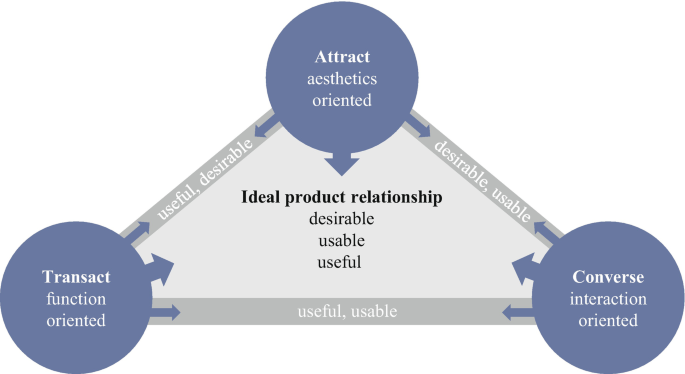
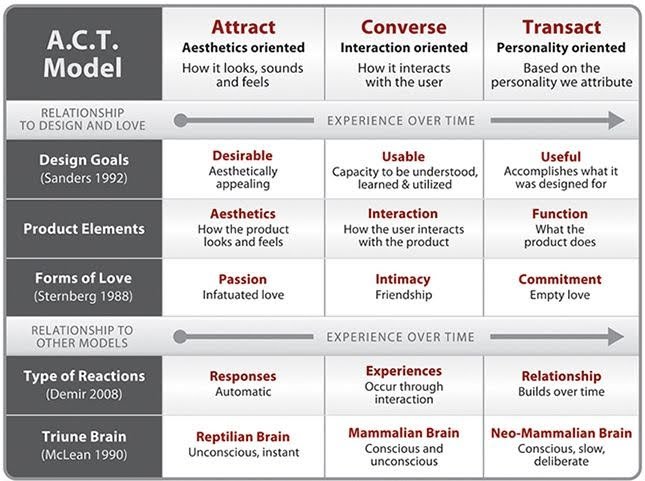
- The ACT-model is a framework for creating designs that improve the relations of users with a product and intentionally trigger emotional responses.
- The model was constructed by the designer Trevor van Gorp and it consists of three parts, the aesthetically-oriented attract part, the interaction-oriented converse part and the function-oriented transact part.
- The model represents similar ideas to the 3-level and the four-pleasure frameworks.
- The product becomes desirable when all three elements are addressed.
Sources
https://www.aela.io/en/blog/all/emotional-design-adding-value-products
https://link.springer.com/chapter/10.1007/978-3-030-78368-6_5